No products added!

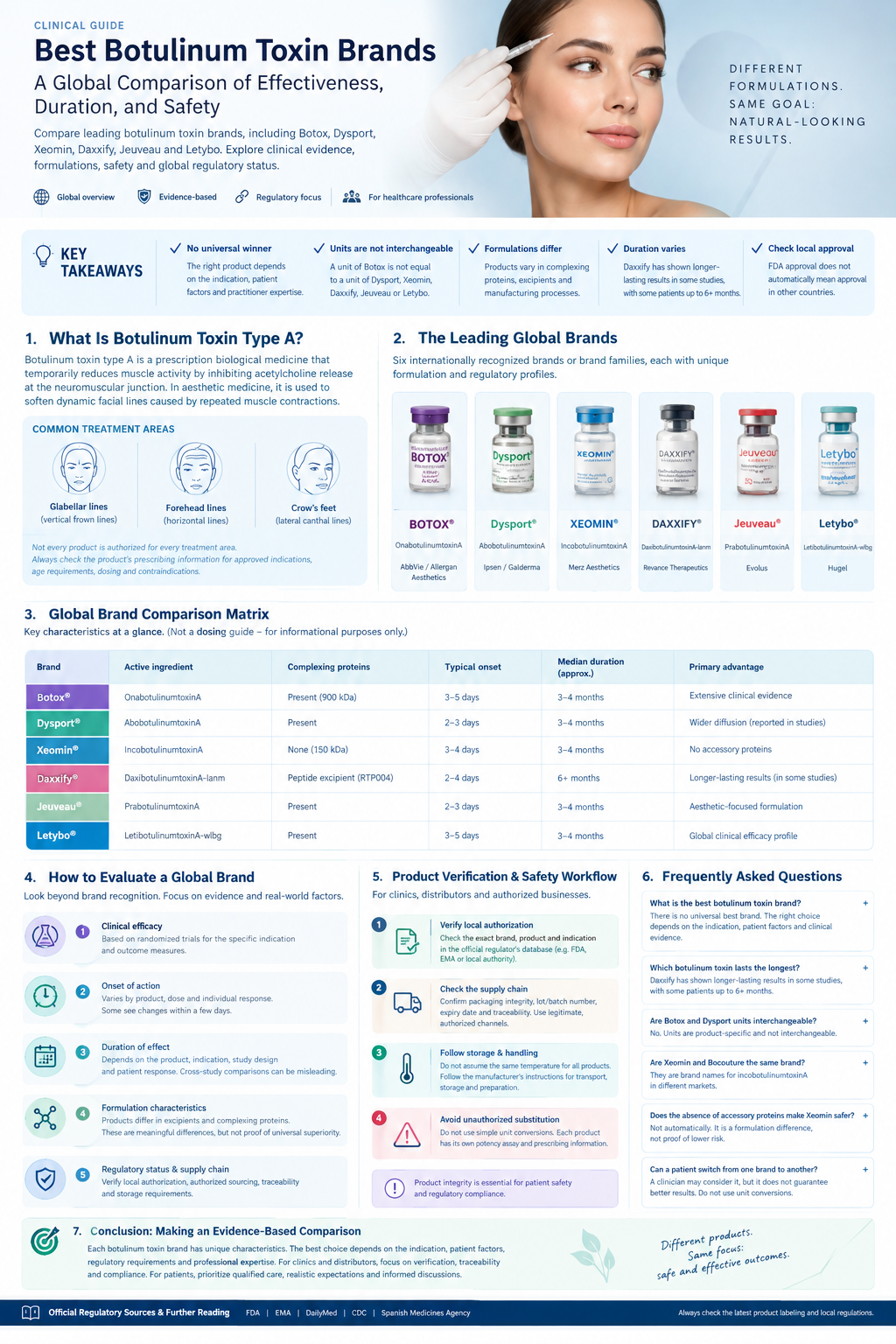
Botulinum toxin type A is widely used in aesthetic medicine to temporarily reduce the appearance of dynamic wrinkles, as well as in several therapeutic applications. However, not all botulinum toxin products are identical.
Different brands have distinct formulations, manufacturing processes, approved indications, dosing instructions, storage requirements, and clinical evidence. Their effects and duration can also vary significantly depending on the treatment area, dose, patient characteristics, and the specific outcome measured.
For healthcare professionals, clinics, and qualified distributors, understanding these differences is essential when evaluating products and verifying supply chains.
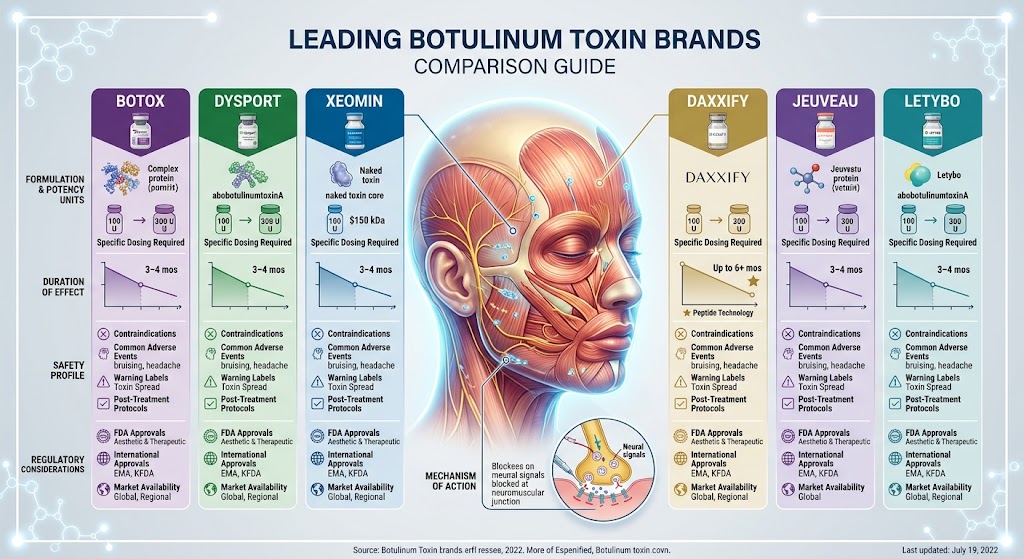
This guide compares six widely discussed botulinum toxin type A brands: Botox, Dysport, Xeomin, Daxxify, Jeuveau, and Letybo. It focuses on formulation, clinical evidence, duration, safety, and regulatory considerations, rather than declaring a universal “winner.”
⚠️ IMPORTANT MEDICAL DISCLAIMER
Botulinum toxin products are prescription medicines. They should be handled, prescribed, and administered only by appropriately qualified healthcare professionals, in strict accordance with local regulations and the product’s official prescribing information.
📑 Table of Contents
- Quick Comparison
- What is Botulinum Toxin Type A?
- How to Compare Botulinum Toxin Brands
- Leading Brands: Individual Profiles
- Effectiveness and Duration: What the Evidence Shows
- Safety Considerations
- Regulatory Status and Product Verification
- How to Evaluate a Supplier
- Frequently Asked Questions (FAQ)
- Conclusion
1. Quick Comparison
The following table provides a high-level overview. Regulatory authorizations and brand names can differ by country, so always confirm the specific product and indication in the relevant market.
| Brand | Active Ingredient | Key Formulation Characteristic | Important Consideration |
|---|---|---|---|
| Botox Cosmetic | OnabotulinumtoxinA | Established formulation with human serum albumin and sodium chloride. | Verify the exact product, indication, and local authorization. |
| Dysport | AbobotulinumtoxinA | Distinct formulation and product-specific potency units. | Units are NOT interchangeable with those of other brands. |
| Xeomin | IncobotulinumtoxinA | Manufactured WITHOUT accessory complexing proteins. | This formulation difference does not establish universal clinical superiority. |
| Daxxify | DaxibotulinumtoxinA-lanm | Uses a proprietary peptide excipient. | Certain aesthetic studies have reported longer-lasting effects for the studied indication. |
| Jeuveau | PrabotulinumtoxinA-xvfs | Developed specifically for aesthetic use in markets where authorized. | Availability and approved uses vary significantly by country. |
| Letybo | LetibotulinumtoxinA-wlbg | Distinct botulinum toxin type A product with its own prescribing information. | Confirm local authorization, labeling, and supply-chain provenance. |
↔ Scroll horizontally to view the full table
💡 How to read this table: formulation differences can be clinically relevant, but they do not automatically prove that one brand is safer, more effective, or more suitable for every patient.
2. What is Botulinum Toxin Type A?
Botulinum toxin type A is a purified neurotoxin that temporarily reduces the release of acetylcholine at the neuromuscular junction. In aesthetic medicine, this reduces the activity of selected muscles, softening dynamic wrinkles caused by repeated facial movements.
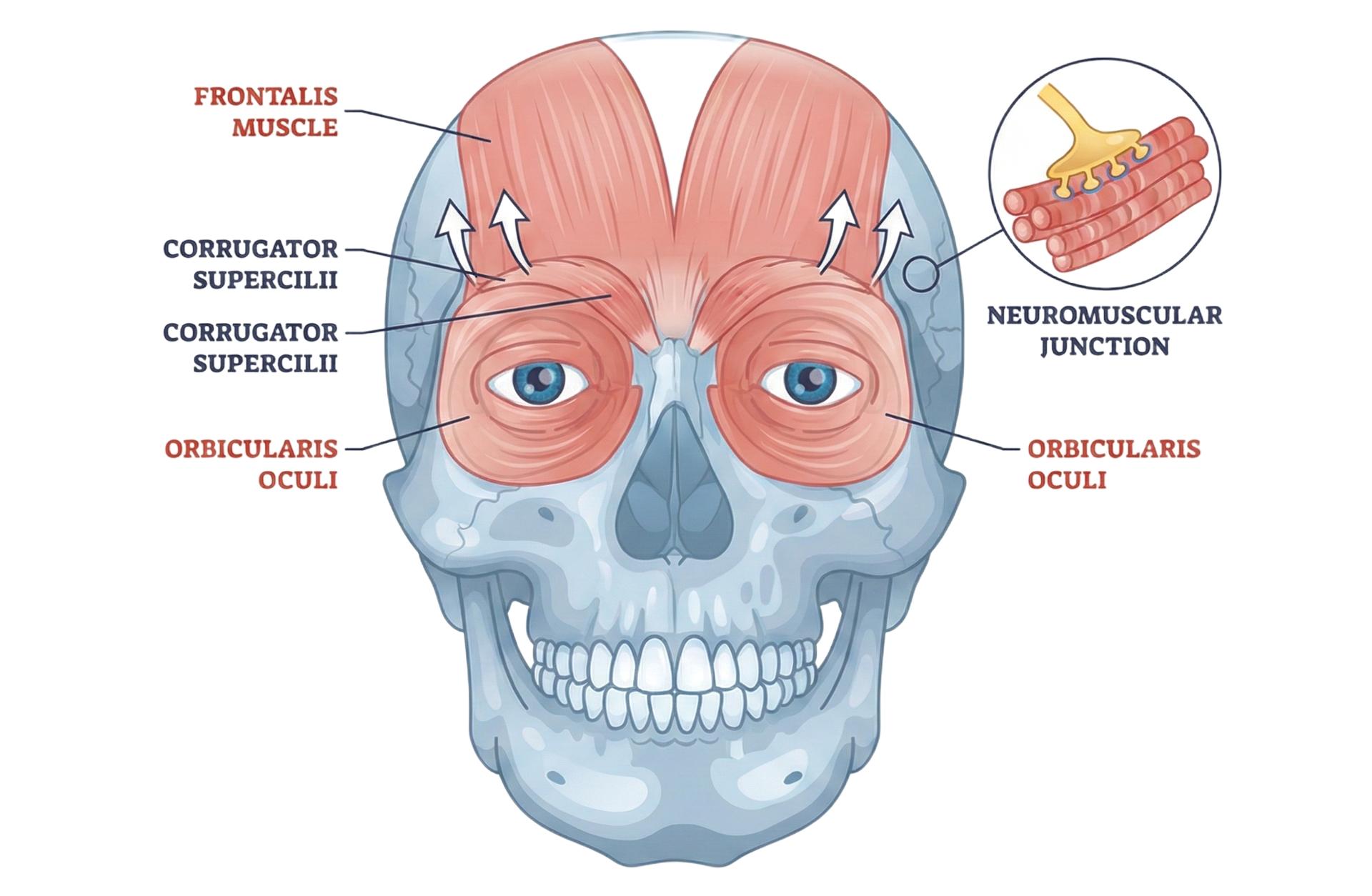
Common aesthetic treatment areas include:
- Glabellar lines: Vertical frown lines between the eyebrows.
- Forehead lines: Horizontal lines across the forehead.
- Lateral canthal lines: Commonly known as “crow’s feet” around the eyes.
Note: Approved indications vary by product and jurisdiction. A product authorized for one facial area or therapeutic condition should not automatically be assumed to be authorized for another.
3. How to Compare Botulinum Toxin Brands
A meaningful comparison must look beyond brand recognition or marketing claims. The following five criteria help distinguish relevant clinical information from promotional language:
- 🔬 Formulation: Active ingredient, excipients, manufacturing process, and product-specific characteristics.
- 📊 Clinical Effectiveness: Outcomes measured in controlled trials, including the percentage of patients achieving predefined improvement and the assessment timeline.
- ⏱️ Duration: How long a clinically meaningful effect persists, based on the specific indication and endpoint studied.
- 🛡️ Safety and Tolerability: Contraindications, warnings, adverse reactions, and evidence from clinical trials and post-market monitoring.
- 🌍 Regulatory Status: Approval for the exact product, indication, and market where it will be supplied and used.
4. Leading Brands: Individual Profiles
Editorial note: The following sections summarize product characteristics, clinical consensus, and market feedback. They do not constitute a ranking of clinical superiority.
1. Botox Cosmetic (OnabotulinumtoxinA)
Clinical Consensus Metrics:
📜 Track Record & Data: ⭐⭐⭐⭐⭐
💡 Innovation: ⭐⭐⭐
💰 Cost-Efficiency: ⭐⭐⭐
✅ Key Advantages (Pros)
- Unmatched global clinical data and predictability.
- Highly precise, targeted diffusion (ideal for crow’s feet).
- Widest range of approved therapeutic and aesthetic indications.
⚠️ Important Considerations (Cons)
- Premium pricing compared to newer market entrants.
- Strict cold-chain storage requirements.
- Contains human serum albumin (a consideration for a very small subset of patients).
💬 Community & Practitioner Feedback Trends: On platforms like RealSelf and professional forums, Botox is consistently praised as the “gold standard” for reliability. However, a recurring patient discussion point is the perception that it may “wear off faster” after many years of continuous use, prompting some to switch to protein-free alternatives.
2. Dysport (AbobotulinumtoxinA)
Clinical Consensus Metrics:
📜 Track Record & Data: ⭐⭐⭐⭐
💡 Innovation: ⭐⭐⭐⭐
💰 Cost-Efficiency: ⭐⭐⭐⭐
✅ Key Advantages (Pros)
- Broader diffusion profile, excellent for larger areas like the forehead.
- Often reported to have a slightly faster onset of action (2-3 days).
- Generally more cost-effective per treatment area due to unit pricing.
⚠️ Important Considerations (Cons)
- Units are NOT interchangeable with Botox (requires specific practitioner training).
- Wider diffusion can be a disadvantage if not injected precisely around the eyes.
💬 Community & Practitioner Feedback Trends: Highly favored by practitioners for treating the masseter muscle (jaw slimming) and broad forehead lines. Patient feedback often highlights a “softer, more natural” look, though some note that the effects can feel slightly less “targeted” than Botox in delicate areas.
3. Xeomin (IncobotulinumtoxinA)
Clinical Consensus Metrics:
📜 Track Record & Data: ⭐⭐⭐⭐
💡 Innovation: ⭐⭐⭐⭐⭐
💰 Cost-Efficiency: ⭐⭐⭐⭐
✅ Key Advantages (Pros)
- “Naked” toxin: No accessory complexing proteins, reducing theoretical immunogenicity risk.
- Can be stored at room temperature before reconstitution (simplifies logistics).
- Ideal for long-term patients who may have developed resistance to other brands.
⚠️ Important Considerations (Cons)
- Some anecdotal reports suggest a slightly slower onset compared to Dysport.
- Less brand recognition among laypatients compared to Botox.
💬 Community & Practitioner Feedback Trends: Frequently discussed in aesthetic medicine forums as the “rescue” product for patients experiencing “Botox resistance.” Patients appreciate its purity, and practitioners value the simplified storage requirements prior to mixing.
4. Daxxify (DaxibotulinumtoxinA-lanm)
Clinical Consensus Metrics:
📜 Track Record & Data: ⭐⭐⭐
💡 Innovation: ⭐⭐⭐⭐⭐
💰 Cost-Efficiency: ⭐⭐
✅ Key Advantages (Pros)
- Longest documented duration (median of 6 months in clinical trials).
- Uses proprietary peptide technology (RTP004), no human or animal-derived ingredients.
- Reduces the frequency of clinic visits for patients.
⚠️ Important Considerations (Cons)
- Significantly higher cost per treatment compared to traditional toxins.
- Newer to the market; long-term (10+ years) real-world data is still accumulating.
- Regulatory approval is currently limited to specific markets (e.g., US FDA).
💬 Community & Practitioner Feedback Trends: Patient reviews on aesthetic forums are highly positive regarding the 6-month longevity, calling it a “game-changer.” However, practitioners note that the premium price point makes it a harder sell for first-time patients or those on a budget.
5. Jeuveau (PrabotulinumtoxinA-xvfs)
Clinical Consensus Metrics:
📜 Track Record & Data: ⭐⭐⭐
💡 Innovation: ⭐⭐⭐⭐
💰 Cost-Efficiency: ⭐⭐⭐⭐⭐
✅ Key Advantages (Pros)
- Specifically developed and approved for aesthetic use (Hi-Pure™ process).
- Highly competitive pricing, making it accessible for younger demographics (“prejuvenation”).
- Fast onset of action reported in clinical settings.
⚠️ Important Considerations (Cons)
- Lacks the extensive therapeutic indications of older brands.
- Shorter overall market history compared to legacy brands.
💬 Community & Practitioner Feedback Trends: Dubbed “Newtox” in social media communities, it is highly popular among millennials and first-time users due to its affordability. Clinical feedback suggests its efficacy and duration are virtually indistinguishable from Botox for standard glabellar treatments.
6. Letybo (LetibotulinumtoxinA-wlbg)
Clinical Consensus Metrics:
📜 Track Record & Data: ⭐⭐⭐
💡 Innovation: ⭐⭐⭐⭐
💰 Cost-Efficiency: ⭐⭐⭐⭐
✅ Key Advantages (Pros)
- Backed by South Korea’s advanced biopharmaceutical manufacturing standards.
- Recent FDA approval (2024) validates its safety and efficacy profile globally.
- Offers a strong value proposition for clinics seeking reliable alternatives.
⚠️ Important Considerations (Cons)
- Supply chain verification is absolutely critical to avoid unauthorized imports.
- Fewer independent, long-term Western clinical studies compared to legacy brands.
💬 Community & Practitioner Feedback Trends: Gaining rapid traction in international aesthetic forums for its cost-to-quality ratio. Practitioners emphasize that it performs comparably to established brands, but strongly warn buyers to verify the distributor’s authorization to ensure product authenticity.
5. Effectiveness and Duration: What the Evidence Shows
One of the most common questions is: “Which botulinum toxin lasts the longest?” The answer depends entirely on how duration is defined and which treatment is being evaluated.
How to Interpret Duration Claims
- Product Label (Primary Reference): Always use the approved prescribing information for the exact product and indication.
- Controlled Clinical Trials (Study-Specific): Check the population, dose, endpoint, assessment time, and percentage of patients maintaining a response.
- Marketing Statements (Verify): Claims such as “longer lasting” must be checked against the underlying evidence and the exact comparison being made.
Why a Simple Duration Ranking is Misleading
| Factor | Why it Matters |
|---|---|
| Treatment Area | Different facial muscles and indications have different response patterns. |
| Dose and Technique | The administered dose and injection protocol directly affect outcomes. |
| Definition of Response | A “one-grade improvement” is not the same as a return to baseline. |
| Patient Characteristics | Muscle activity, metabolism, and individual immune responses vary. |
| Study Design | Different trial endpoints and follow-up schedules limit direct, head-to-head comparisons. |
↔ Scroll horizontally to view the full table
Practical Conclusion: A single “best to worst” ranking based on months of duration oversimplifies the evidence. Compare results only when the indication, endpoint, and study conditions are sufficiently similar.
6. Safety Considerations
Botulinum toxin products can cause adverse effects, even when used for aesthetic purposes. Safety depends on appropriate patient selection, product authenticity, correct handling, and administration by a qualified healthcare professional.
Commonly reported adverse reactions vary by product and indication. They may include injection-site reactions, headache, bruising, eyelid drooping (ptosis), or unwanted weakness of nearby muscles.
⚠️ CRITICAL SAFETY WARNING
Product labeling warns that toxin effects can sometimes spread beyond the injection site. Symptoms such as difficulty swallowing, speaking, or breathing require urgent medical attention. Consult the official prescribing information for complete warnings and contraindications.
Important Safety Checks
- Confirm the exact product and its authorized indication.
- Review contraindications, warnings, and the patient’s relevant medical history.
- Follow product-specific storage, preparation, and administration instructions.
- Never assume that units or reconstitution instructions are interchangeable between brands.
- Never use products from unverified or unauthorized sources.
7. Regulatory Status and Product Verification
A brand’s availability in one country does not prove that the same product is authorized in another. Names, presentations, indications, and marketing authorizations can vary drastically across jurisdictions.
Before purchasing, distributing, or using a product, verify the following:
- Product Identity: Exact brand name, active ingredient, strength, and presentation.
- Marketing Authorization: The relevant national regulator’s record for the product and intended indication.
- Authorized Supply Chain: Manufacturer or marketing authorization holder, and authorized distributor.
- Packaging and Traceability: Lot or batch number, expiry date, tamper evidence, and product-specific documentation.
- Storage and Transport: The exact labeled requirements, including any applicable cold-chain conditions.
- Documentation: Current official prescribing information and any required import/distribution documentation.
For the United States: Check the FDA’s official product information.
For European markets: Verify the relevant national authorization (e.g., AIFA in Italy, EMA records).
A product’s presence on a website or marketplace is not evidence of regulatory approval.
8. How to Evaluate a Botulinum Toxin Supplier
For clinics and qualified buyers, the product itself is only part of the evaluation. Supplier reliability, documentation, traceability, and compliance are equally important.
| Evaluation Area | What to Check |
|---|---|
| Business Legitimacy | Verifiable company identity, physical address, and relevant business authorizations. |
| Product Provenance | Documented source and a fully traceable supply chain back to the manufacturer. |
| Regulatory Compliance | Explicit permission to supply the product in the destination market. |
| Storage and Logistics | Documented handling and transport conditions (e.g., cold-chain logs). |
| Product Documentation | Batch details, expiry information, and official product information/leaflets. |
| Commercial Terms | Clear invoices, delivery terms, return policies, and procedures for handling suspected quality issues. |
↔ Scroll horizontally to view the full table
Avoid relying solely on low prices, brand popularity, online reviews, or product photographs. These do not establish authenticity or regulatory compliance.
9. Frequently Asked Questions (FAQ)
❓ Which botulinum toxin brand is the best?
There is no universally “best” brand for every patient or indication. The appropriate choice depends on clinical evidence, the intended treatment, patient characteristics, approved labeling, and the judgment of a qualified healthcare professional.
❓ Which botulinum toxin lasts the longest?
Daxxify has clinical evidence supporting a longer-lasting effect for its approved glabellar-line indication (up to 6 months or more in some patients). However, duration varies by patient and measurement method. Cross-brand comparisons should use comparable study endpoints, not promotional claims.
❓ Are Botox, Dysport, Xeomin, Daxxify, Jeuveau, and Letybo interchangeable?
No. They are distinct products with product-specific potency units, formulations, dosing instructions, and prescribing information. Their units should not be converted or substituted on a unit-for-unit basis.
❓ Is Xeomin safer because it does not contain accessory complexing proteins?
Not necessarily. The absence of accessory complexing proteins is a formulation characteristic, not proof of universal safety superiority. Safety and immunogenicity must be evaluated using appropriate clinical and post-marketing evidence.
❓ Is Letybo FDA-approved?
Yes. The FDA approved Letybo on February 29, 2024, for the temporary improvement of moderate to severe glabellar lines in adults. That authorization should not be interpreted as approval for every indication or every country.
❓ Can products approved in one country be sold in another?
Not automatically. Importation, distribution, and clinical use are subject to the destination country’s laws and applicable marketing authorizations. Always verify the exact product and its regulatory status before proceeding.
❓ Should duration alone determine which product is selected?
No. Duration is one factor among several. Safety, approved indications, clinical evidence, patient suitability, product availability, and the clinician’s assessment are equally critical.
10. Conclusion: Choosing a Product Based on Evidence
Botox, Dysport, Xeomin, Daxxify, Jeuveau, and Letybo each have distinct product characteristics and clinical evidence. Differences in formulation, duration claims, and regulatory status are useful data points when evaluating them, but no single brand should be considered the best choice in every situation.
A reliable comparison should prioritize:
- Evidence from studies relevant to the intended indication.
- Product-specific safety information and prescribing instructions.
- Appropriate, nuanced interpretation of duration claims.
- Verification of regulatory authorization in the destination market.
- Authenticity, traceability, and a fully compliant supply chain.
For healthcare professionals and qualified buyers, the strongest purchasing decision is one supported by verifiable clinical evidence, official product documentation, and a legitimate supply chain—not by brand recognition or marketing claims alone.
📚 Official Sources and Further Reading
Use these primary sources when reviewing product information or updating this article:
- FDA Drugs@FDA Database – Official U.S. drug approval records.
- DailyMed (NLM) – Current drug labeling and prescribing information.
- FDA Drug Trials Snapshot: Letybo – Overview of the trials supporting its original U.S. approval.
- European Medicines Agency (EMA) – European regulatory information and public assessment reports.
Editorial note: Regulatory status and product labeling can change. Review the latest official documentation before publication and recheck the claims whenever the article is updated.