No products added!
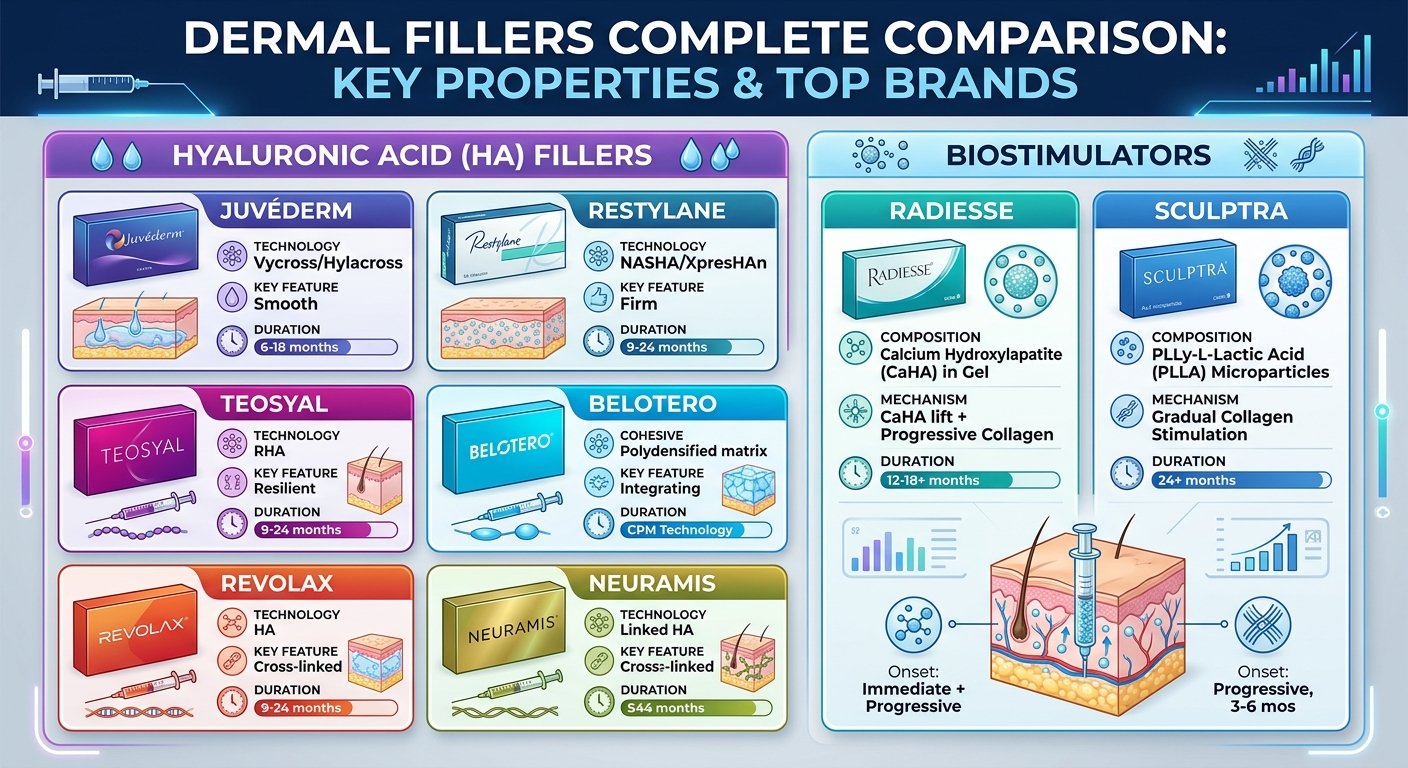

Dermal fillers are among the most sought-after minimally invasive aesthetic treatments globally, used to restore volume, contour facial features, and smooth static wrinkles. However, the term “dermal filler” encompasses a diverse range of products with vastly different chemical compositions, rheological properties, and clinical indications.
For healthcare professionals, clinics, and qualified distributors, understanding the distinctions between Hyaluronic Acid (HA) fillers and biostimulatory agents is essential for ensuring patient safety, achieving optimal aesthetic outcomes, and maintaining a compliant, traceable supply chain.
This guide compares eight of the most widely discussed and clinically validated dermal filler brands: Juvéderm, Restylane, Teosyal, Belotero, Radiesse, Sculptra, Revolax, and Neuramis. It focuses on technology, clinical evidence, longevity, safety profiles, regulatory considerations, and real-world feedback from both practitioners and patients.
⚠️ IMPORTANT MEDICAL DISCLAIMER
Dermal fillers are medical devices (or prescription medicines, depending on the jurisdiction) that must be handled, prescribed, and administered only by appropriately qualified healthcare professionals. This article is for educational purposes and does not replace official product labeling or clinical training.
📑 Table of Contents
- Quick Comparison
- What Are Dermal Fillers? (HA vs. Biostimulators)
- How to Compare Dermal Filler Brands
- Leading Brands: Individual Profiles
- Longevity and Efficacy: What the Evidence Shows
- Safety Considerations and Risk Management
- Regulatory Status and Supply Chain Verification
- Frequently Asked Questions (FAQ)
- Conclusion
1. Quick Comparison
The following table provides a high-level overview. Always confirm the specific product variant and its local regulatory authorization for the intended indication.
| Brand Family | Active Ingredient | Key Technology | Primary Clinical Use | Origin |
|---|---|---|---|---|
| Juvéderm | Hyaluronic Acid | Vycross® | Cheeks, lips, jawline, folds | 🇺🇸 USA / 🇫🇷 France |
| Restylane | Hyaluronic Acid | NASHA™ & OBT™ | Versatile: deep volume to fine lines | 🇸🇪 Sweden / 🇨🇭 Switzerland |
| Teosyal RHA | Hyaluronic Acid | Resilient HA | Dynamic areas (lips, smile lines) | 🇨🇭 Switzerland |
| Belotero | Hyaluronic Acid | CPM® | Superficial lines, tear troughs | 🇩🇪 Germany |
| Radiesse | Calcium Hydroxylapatite | CaHA microspheres | Deep volume, jawline, biostimulation | 🇩🇪 Germany / 🇺🇸 USA |
| Sculptra | Poly-L-Lactic Acid | PLLA microparticles | Global volume loss, collagen building | 🇫🇷 France / 🇨🇭 Switzerland |
| Revolax | Hyaluronic Acid | High cross-linking, monophasic | Deep volume, contouring, lips | 🇰🇷 South Korea |
| Neuramis | Hyaluronic Acid | SHAPE™ Technology | Versatile: volume, lips, fine lines | 🇰🇷 South Korea |
↔ Scroll horizontally to view the full table
2. What Are Dermal Fillers? (HA vs. Biostimulators)
Dermal fillers are injectable substances used to add volume, contour, and smooth the skin. They are broadly categorized into two distinct classes:
- Hyaluronic Acid (HA) Fillers: Made from a sugar molecule naturally found in the skin. They provide immediate volume and hydration. Crucially, they are reversible using the enzyme hyaluronidase in case of complications or patient dissatisfaction.
- Biostimulatory Fillers: Made from substances like Calcium Hydroxylapatite (CaHA) or Poly-L-Lactic Acid (PLLA). They provide some immediate volume via the carrier gel but primarily work by stimulating the body’s own collagen production over months. They are not reversible with hyaluronidase.
3. How to Compare Dermal Filler Brands
- 🔬 Rheology (G-Prime): The gel’s stiffness and lifting capacity.
- 🔗 Cross-Linking Technology: The chemical process that binds HA molecules, directly impacting longevity and swelling.
- ⏱️ Longevity: Duration of clinically visible improvement.
- 🛡️ Safety & Reversibility: Risk of nodules, vascular complications, and availability of an antidote.
- 🌍 Regulatory Status: CE Mark (Europe), FDA clearance (USA), or local health authority approval.
4. Leading Brands: Individual Profiles
Editorial note: The following sections summarize product characteristics, clinical consensus, expert opinions, and real-world market feedback. They do not constitute a ranking of clinical superiority.
1. Juvéderm (Allergan Aesthetics / AbbVie)
Clinical Consensus Metrics:
📜 Track Record & Data: ⭐⭐⭐⭐⭐
💡 Innovation: ⭐⭐⭐⭐
💰 Cost-Efficiency: ⭐⭐⭐
✅ Key Advantages (Pros)
- Vycross® technology offers smooth, highly cohesive gels with reduced water absorption (less swelling).
- Comprehensive portfolio: Voluma (cheeks), Volbella (lips), Volux (jawline), Volite (skin quality).
- Contains lidocaine for enhanced patient comfort.
- Fully reversible with hyaluronidase.
⚠️ Important Considerations (Cons)
- Premium pricing tier — among the most expensive HA fillers globally.
- Highly cohesive gels require precise, deep placement to avoid visibility or palpability.
- Counterfeit Juvéderm is one of the most common fake fillers on the black market.
👨⚕️ Expert Practitioner Opinions
Dr. Mauricio de Maio — 🇧🇷 Brazil | Plastic Surgeon | Creator of the MD Codes™ technique
Widely recognized as one of the most influential aesthetic physicians globally, Dr. de Maio developed the MD Codes™ injection methodology in partnership with Allergan. In his published lectures and official training materials, he advocates for Juvéderm Voluma and Volux for structural facial recontouring, emphasizing that the Vycross® technology’s high cohesivity allows for precise, predictable lifting at the supraperiosteal level. He has stated that “understanding the rheology of your filler is as important as understanding the anatomy of your patient.”
Dr. Arthur Swift — 🇨🇦 Canada | Plastic Surgeon | McGill University
Co-developer of the MD Codes™ and a leading voice in facial beautification, Dr. Swift has published extensively on the use of Juvéderm Volbella for perioral rejuvenation and lip augmentation. In his clinical presentations, he highlights the product’s low swelling profile as a key advantage for patients seeking subtle, natural-looking lip enhancement with minimal downtime.
💬 Community & Patient Feedback Trends
RealSelf (USA): Juvéderm consistently maintains a “Worth It” rating above 90% across its product line. Patients most frequently praise Juvéderm Voluma for cheek augmentation, with many reporting results that “look natural and not overdone.” A recurring theme in negative reviews is dissatisfaction with lip results when Volbella is used — some patients describe the initial feel as “too firm” or “lumpy” during the first two weeks, though most acknowledge this resolves as the product integrates.
Reddit (r/Fillers, r/PlasticSurgery): Juvéderm is the most frequently mentioned filler brand. Users often compare it directly to Restylane, with a common consensus being that Juvéderm tends to produce a “smoother, more hydrated” look, while Restylane offers more “structural definition.” Several long-term users report that after 5+ years of regular Juvéderm treatments, they notice the product lasting longer between sessions, likely due to cumulative collagen stimulation.
Practitioner Forums (Aesthetic Medicine Community): Injectors frequently cite Juvéderm as their “go-to” for first-time filler patients due to its predictability and reversibility. However, many experienced injectors note that they have gradually shifted to Teosyal RHA or Restylane for lip treatments, citing a softer tissue integration.
2. Restylane (Galderma)
Clinical Consensus Metrics:
📜 Track Record & Data: ⭐⭐⭐⭐⭐
💡 Innovation: ⭐⭐⭐⭐⭐
💰 Cost-Efficiency: ⭐⭐⭐⭐
✅ Key Advantages (Pros)
- Dual technology: NASHA™ (firm, structural) and OBT™ (flexible, dynamic).
- Excellent versatility across all facial zones.
- Strong long-term safety data spanning over 25 years of clinical use.
- Fully reversible with hyaluronidase.
⚠️ Important Considerations (Cons)
- NASHA-based products can have a slightly higher initial swelling profile.
- The extensive portfolio (Lyft, Kysse, Defyne, Refyne, etc.) requires thorough product knowledge.
👨⚕️ Expert Practitioner Opinions
Dr. Uliana Gout — 🇬🇧 United Kingdom | Aesthetic Physician | Member of the British College of Aesthetic Medicine
Dr. Gout is a prominent UK-based aesthetic physician known for her conservative, anatomy-driven approach. In her published clinical commentary and training sessions, she frequently recommends Restylane Refyne and Defyne (OBT™ technology) for dynamic perioral and nasolabial areas, noting that the gel’s flexibility allows it to move naturally with facial expressions without creating visible ridges. She has emphasized that “the ability of a filler to stretch and recoil is what separates a natural result from a static, mask-like appearance.”
Dr. Tim Pearce — 🇬🇧 United Kingdom | Aesthetic Doctor | eLearning Educator
One of the most followed aesthetic educators in the English-speaking world, Dr. Pearce regularly discusses Restylane in his online training content. He has publicly stated that Restylane Lyft remains his preferred product for midface volumizing due to its high G-prime and reliable lifting capacity, while he reserves Restylane Kysse for lip treatments because of its balance between structure and softness.
💬 Community & Patient Feedback Trends
RealSelf (USA): Restylane holds a “Worth It” rating comparable to Juvéderm (88-92% depending on the variant). Restylane Kysse is particularly well-reviewed for lip augmentation, with patients frequently describing the result as “pillowy” and “kissable” — a term that appears in dozens of reviews. Restylane Lyft receives high marks for cheek augmentation, though some patients note slightly more bruising compared to Juvéderm Voluma.
Reddit (r/Fillers): Users who have tried both Juvéderm and Restylane often report a subjective preference for Restylane in the lips and nasolabial folds, citing a “softer, more natural movement.” A frequently discussed topic is the “Restylane glow” — patients report that the NASHA-based products seem to improve overall skin hydration and texture in the treated area beyond just volumizing.
Practitioner Forums: Many injectors appreciate the clear differentiation between NASHA and OBT products within the Restylane line, which allows them to “mix and match” within the same brand family. A common sentiment is that Restylane offers more granular control for advanced injectors, while Juvéderm is more forgiving for those still building experience.
3. Teosyal RHA (Teoxane)
Clinical Consensus Metrics:
📜 Track Record & Data: ⭐⭐⭐⭐
💡 Innovation: ⭐⭐⭐⭐⭐
💰 Cost-Efficiency: ⭐⭐⭐⭐
✅ Key Advantages (Pros)
- Resilient Hyaluronic Acid (RHA) withstands repetitive facial movements without breaking down.
- Preserves more of the natural HA structure, resulting in significantly less post-treatment swelling.
- Ideal for highly dynamic zones (perioral lines, forehead, lips).
- Fully reversible with hyaluronidase.
⚠️ Important Considerations (Cons)
- Not the first choice for deep, bone-level structural volumizing.
- Slightly less brand recognition in conservative markets compared to Allergan or Galderma.
👨⚕️ Expert Practitioner Opinions
Dr. Tapan Patel — 🇬🇧 United Kingdom | Aesthetic Doctor | PHI Clinic, London
Dr. Patel is one of the UK’s most prominent aesthetic physicians and a regular speaker at international conferences. He has publicly discussed his preference for Teosyal RHA for lip augmentation and perioral rejuvenation, noting in clinical presentations that the RHA technology’s ability to stretch up to 4 times its original length without breaking makes it uniquely suited for the lips, which undergo constant movement. He has described it as “the closest thing we have to a filler that truly behaves like native tissue.”
Dr. Souphiyeh Samizadeh — 🇬🇧 United Kingdom | Aesthetic Dentist & Facial Aesthetics Specialist
Dr. Samizadeh, a published researcher in facial aesthetics, has incorporated Teosyal RHA into her practice for dynamic wrinkle treatment. In her clinical commentary, she highlights the product’s low swelling profile as a significant advantage for patients who cannot afford social downtime, particularly professionals in public-facing roles.
💬 Community & Patient Feedback Trends
RealSelf (USA/Europe): Teosyal has a growing but smaller review base compared to Juvéderm and Restylane, reflecting its more recent global expansion. However, the reviews it does receive are overwhelmingly positive, with a “Worth It” rating consistently above 93%. Patients specifically seeking “undetectable” lip filler frequently mention Teosyal RHA 2 and RHA 3 by name.
Reddit (r/Fillers, r/AestheticMedicine): Teosyal is increasingly discussed as the “injector’s secret weapon.” Users who have switched from Juvéderm to Teosyal for lip treatments frequently report less swelling, less bruising, and a more natural feel during kissing and eating. A common thread title is “Finally found a lip filler that doesn’t look like filler.” The main complaint is availability — not all clinics carry Teosyal, particularly in smaller US markets.
Practitioner Forums: Advanced injectors increasingly favor Teosyal RHA for the “upper face” (forehead lines, glabella) — areas traditionally treated only with botulinum toxin. The ability to use a resilient HA filler in these highly mobile zones without creating visible ridges is considered a significant clinical advancement.
4. Belotero (Merz Aesthetics)
Clinical Consensus Metrics:
📜 Track Record & Data: ⭐⭐⭐⭐
💡 Innovation: ⭐⭐⭐⭐
💰 Cost-Efficiency: ⭐⭐⭐⭐
✅ Key Advantages (Pros)
- CPM® technology allows seamless integration into superficial skin layers.
- Extremely low risk of the Tyndall effect (bluish discoloration) under the eyes.
- Excellent for fine lines, tear troughs, and delicate areas.
⚠️ Important Considerations (Cons)
- Lower G-prime means it lacks lifting capacity for deep volume restoration.
- May require more frequent touch-ups in highly mobile areas.
👨⚕️ Expert Practitioner Opinions
Dr. Steven Dayan — 🇺🇸 USA | Facial Plastic Surgeon | Chicago, Illinois
Dr. Dayan, a board-certified facial plastic surgeon and clinical researcher, has published studies on the use of Belotero Balance for superficial perioral lines and tear trough correction. In his clinical presentations, he emphasizes that Belotero’s unique polydensified matrix allows it to be placed in the superficial dermis — a depth where most other HA fillers would create visible lumps or the Tyndall effect. He has described it as “the only filler I trust for the most delicate areas of the face.”
💬 Community & Patient Feedback Trends
RealSelf (USA): Belotero is the most reviewed filler specifically for tear trough (under-eye) treatments, with a “Worth It” rating of approximately 89%. Patients consistently praise the subtlety of the results — the most common positive comment is “I look rested, not done.” Negative reviews typically relate to longevity, with some patients reporting that the under-eye results fade within 4-6 months, faster than expected.
Reddit (r/Fillers): Belotero is frequently recommended by experienced users to newcomers specifically for under-eye correction. A recurring piece of advice is “If your injector suggests Juvéderm for tear troughs, get a second opinion — Belotero is the safer choice.” Users also appreciate its use for “barcode lines” (vertical lip lines), where thicker fillers would look unnatural.
5. Radiesse (Merz Aesthetics)
Clinical Consensus Metrics:
📜 Track Record & Data: ⭐⭐⭐⭐
💡 Innovation: ⭐⭐⭐⭐
💰 Cost-Efficiency: ⭐⭐⭐⭐
✅ Key Advantages (Pros)
- CaHA provides immediate volume plus long-term collagen and elastin neogenesis.
- Excellent for deep structural support (jawline, chin) and hand rejuvenation.
- Hyper-diluted Radiesse can be used for skin tightening on the neck and body.
⚠️ Important Considerations (Cons)
- NOT reversible with hyaluronidase.
- Should never be injected superficially or into the lips (high nodule risk).
- Requires advanced anatomical knowledge.
👨⚕️ Expert Practitioner Opinions
Dr. Sabrina Fabi — 🇺🇸 USA | Board-Certified Dermatologist | San Diego, California
Dr. Fabi is one of the world’s leading experts on biostimulatory fillers and has published extensively on Radiesse and Sculptra. In her clinical lectures and peer-reviewed publications, she advocates for hyper-diluted Radiesse as a “collagen bank” treatment for the neck, décolletage, and hands. She has stated that “Radiesse is not just a filler — it is a regenerative medicine tool that reprograms the skin’s extracellular matrix.” She emphasizes that proper dilution ratios and injection depth are critical to avoiding complications.
💬 Community & Patient Feedback Trends
RealSelf (USA): Radiesse maintains a “Worth It” rating of approximately 87%. Patients who received it for jawline contouring and hand rejuvenation report the highest satisfaction. The most common praise is the “dual benefit” — immediate volume followed by continued improvement over 3-6 months as collagen builds. Negative reviews almost exclusively relate to nodules or lumps, typically in cases where the product was injected too superficially by an inexperienced provider.
Reddit (r/Fillers): Radiesse generates significant discussion due to its non-reversibility. Users frequently warn newcomers: “Make sure you trust your injector 100% before getting Radiesse — there is no undo button.” Patients who received hyper-diluted Radiesse for skin tightening on the neck report “subtle but noticeable” improvements in skin texture and crepiness, though many note it requires 2-3 sessions for optimal results.
6. Sculptra (Galderma)
Clinical Consensus Metrics:
📜 Track Record & Data: ⭐⭐⭐⭐⭐
💡 Innovation: ⭐⭐⭐⭐
💰 Cost-Efficiency: ⭐⭐⭐⭐⭐ (long-term)
✅ Key Advantages (Pros)
- PLLA stimulates robust, natural collagen production over 3–6 months.
- Results can last up to 2 years or more, offering excellent long-term value.
- Ideal for global facial volume loss, temples, and body contouring.
⚠️ Important Considerations (Cons)
- NOT reversible and provides no immediate volumizing effect.
- Requires meticulous reconstitution (24+ hours) and strict post-treatment massage (“5-5-5 rule”).
- Contraindicated in lips and periorbital areas.
👨⚕️ Expert Practitioner Opinions
Dr. Rebecca Fitzgerald — 🇺🇸 USA | Board-Certified Dermatologist | Los Angeles, California
Dr. Fitzgerald is a leading authority on facial rejuvenation and has spoken extensively about Sculptra at AAD (American Academy of Dermatology) meetings. She advocates for Sculptra as a “foundation treatment” for patients over 40 experiencing global volume loss, often combining it with HA fillers for immediate correction. In her clinical commentary, she emphasizes that “Sculptra is not a quick fix — it is an investment in your skin’s structural future. Patients who understand the timeline are almost universally thrilled with the results.”
💬 Community & Patient Feedback Trends
RealSelf (USA): Sculptra holds a “Worth It” rating of approximately 85%, slightly lower than HA fillers primarily due to the delayed gratification factor. Patients who complete the full 3-session series report extremely high satisfaction, with comments like “I look 5 years younger and nobody can tell I’ve had anything done.” The most common negative reviews come from patients who expected immediate results and were disappointed after the first session.
Reddit (r/Fillers, r/PlasticSurgery): Sculptra is frequently described as a “marathon, not a sprint.” Long-term users (2+ years) are among the most vocal advocates, with many stating they will “never go back to just HA fillers.” The most discussed concern is nodule formation — experienced users strongly advise choosing an injector who follows the latest dilution protocols (higher dilution ratios than the original manufacturer guidelines) and who emphasizes the importance of the post-treatment massage regimen.
7. Revolax (Across Co., Ltd.)
Clinical Consensus Metrics:
📜 Track Record & Data: ⭐⭐⭐
💡 Innovation: ⭐⭐⭐⭐
💰 Cost-Efficiency: ⭐⭐⭐⭐⭐
✅ Key Advantages (Pros)
- Highly cross-linked, monophasic HA gel providing strong lifting capacity and structural support.
- Exceptional cost-to-performance ratio — significantly more affordable than European/US premium brands.
- Versatile portfolio: Revolax Fine (superficial), Deep (mid-dermis), Sub-Q (deep volume).
- Contains lidocaine (0.3%) for patient comfort.
- Fully reversible with hyaluronidase.
⚠️ Important Considerations (Cons)
- Not FDA-approved in the United States; primarily CE-marked for European and Asian markets.
- Higher viscosity can make injection more technique-sensitive, especially for less experienced practitioners.
- Supply chain verification is critical — counterfeit Revolax is prevalent in unauthorized online channels.
- Fewer independent, peer-reviewed Western clinical studies compared to legacy brands.
👨⚕️ Expert Practitioner Opinions
Dr. Kyoung-Tae Suk — 🇰🇷 South Korea | Dermatologist | Seoul
Dr. Suk is a prominent South Korean dermatologist specializing in injectable treatments and has contributed to clinical evaluations of Korean-manufactured HA fillers. In his published commentary on the Korean aesthetic market, he notes that products like Revolax have achieved widespread adoption in South Korea due to their consistent manufacturing quality and competitive pricing. He emphasizes that “Korean HA fillers have closed the quality gap with Western brands significantly over the past decade, and their rheological profiles are now comparable to many established European products.”
Dr. Tijion Esho — 🇬🇧 United Kingdom | Cosmetic Doctor | The ESHO Clinic, London & Newcastle
Known as “The Lip Doctor” and one of the UK’s most high-profile aesthetic practitioners, Dr. Esho has publicly discussed the growing presence of Korean fillers in the European market. While he primarily uses premium European brands in his own practice, he has acknowledged in industry interviews that “the quality of Korean-manufactured HA fillers has improved dramatically, and for clinics operating in price-sensitive markets, they represent a legitimate and safe option — provided they are sourced through authorized channels and carry proper CE certification.”
💬 Community & Patient Feedback Trends
RealSelf (Europe/Middle East): Revolax has a growing review base, particularly from patients in the UK, Turkey, and the Middle East. The “Worth It” rating hovers around 82-86%, with the most common praise being the “incredible value for money.” Patients who received Revolax Sub-Q for jawline and chin contouring report results comparable to Juvéderm Volux at a fraction of the cost. Negative reviews frequently mention slightly more swelling in the first 48-72 hours compared to premium brands.
Reddit (r/Fillers, r/AestheticMedicine): Revolax is one of the most discussed “budget-friendly” fillers on Reddit. Users in the UK and Europe frequently share before-and-after photos with positive outcomes, particularly for lip augmentation (Revolax Deep) and cheek volumizing (Revolax Sub-Q). A recurring discussion point is the importance of verifying the product’s CE mark and batch number — several users have warned about counterfeit Revolax being sold on social media platforms at suspiciously low prices. The community consensus is: “Great product if authentic, but do your due diligence on the supplier.”
Practitioner Forums (International Aesthetic Groups): Clinics in price-sensitive markets (Eastern Europe, Middle East, Southeast Asia) report high patient satisfaction with Revolax. Practitioners note that the Sub-Q variant provides excellent lifting capacity for deep structural work, though some caution that the gel’s higher viscosity requires slower injection speeds and careful cannula technique to minimize tissue trauma.
8. Neuramis (Medytox Inc.)
Clinical Consensus Metrics:
📜 Track Record & Data: ⭐⭐⭐
💡 Innovation: ⭐⭐⭐⭐
💰 Cost-Efficiency: ⭐⭐⭐⭐⭐
✅ Key Advantages (Pros)
- SHAPE™ (Stabilized Hyaluronic Acid and Purification Enhancement) technology ensures high purity and consistent cross-linking.
- Extensive portfolio: Neuramis Deep, Volume, Light, and Lidocaine variants.
- Excellent tissue integration with minimal swelling and a natural feel.
- Highly competitive pricing with strong manufacturing quality control (GMP-certified facilities).
- Fully reversible with hyaluronidase.
⚠️ Important Considerations (Cons)
- Not FDA-approved in the United States; primarily available in Asian, European, and Middle Eastern markets.
- Limited long-term (10+ year) clinical data in Western populations compared to Juvéderm or Restylane.
- Brand recognition among patients in Western markets is still developing.
- As with all Korean fillers, supply chain authenticity must be rigorously verified.
👨⚕️ Expert Practitioner Opinions
Dr. Jong-Ho Lee — 🇰🇷 South Korea | Plastic Surgeon | Seoul National University
Dr. Lee is a respected academic plastic surgeon who has contributed to clinical research on HA filler safety and efficacy in the Korean market. In his published work, he has noted that Neuramis demonstrates favorable rheological properties for Asian facial anatomy, particularly in the midface and nasolabial fold regions. He has highlighted that the SHAPE™ purification process results in a gel with low residual BDDE (cross-linking agent) levels, which is an important safety consideration for long-term tissue biocompatibility.
Dr. Wassim Taktouk — 🇬🇧 United Kingdom | Aesthetic Doctor | London
Dr. Taktouk, a well-known London-based aesthetic physician, has discussed the growing role of Korean fillers in the UK market in industry publications. He has noted that products like Neuramis offer “a compelling combination of quality and affordability” for clinics serving diverse patient demographics. He emphasizes that the key to safe use is ensuring the product is sourced from the manufacturer’s authorized UK distributor and carries a valid CE mark.
💬 Community & Patient Feedback Trends
RealSelf (Asia/Europe): Neuramis has a strong review presence in South Korea, Japan, and increasingly in the UK and Turkey. The “Worth It” rating averages around 84-88%. Patients particularly praise Neuramis Deep for lip augmentation, with many describing the result as “soft, natural, and not over-projected.” Neuramis Volume receives positive feedback for cheek and chin contouring. The most common criticism is slightly shorter longevity compared to premium Western brands — some patients report noticeable fading at the 6-8 month mark, compared to 9-12 months for Juvéderm or Restylane.
Reddit (r/Fillers, r/KoreanBeauty): Neuramis is frequently discussed in the context of “K-beauty aesthetics” and is popular among users who travel to South Korea for treatments. Many report that Korean clinics use Neuramis as their standard filler, and the results are “indistinguishable from what I got with Juvéderm back home, but at half the price.” A recurring concern on Reddit is the prevalence of counterfeit Neuramis on unauthorized websites — experienced users strongly advise purchasing only from verified medical professionals and checking the holographic authentication sticker on the box.
Practitioner Forums: Clinics in the Middle East and Southeast Asia report that Neuramis has become their “volume workhorse” due to its excellent cost-to-performance ratio. Practitioners note that the gel integrates smoothly into tissue with minimal post-injection swelling, making it well-suited for patients who desire natural-looking results with short recovery times. Some European injectors who have trialed Neuramis alongside Restylane report that the clinical outcomes are comparable for most indications, though they still prefer legacy brands for high-risk areas like the tear trough.
5. Longevity and Efficacy: What the Evidence Shows
Duration is highly variable and depends on the product’s rheology, the injection site, and the patient’s individual metabolism.
| Filler Category | Average Longevity | Reversible? |
|---|---|---|
| Soft HA (Belotero, Neuramis Light) | 6 – 9 months | Yes |
| Medium HA (Teosyal RHA, Neuramis Deep) | 8 – 12 months | Yes |
| Firm HA (Juvéderm, Restylane, Revolax Sub-Q) | 12 – 18 months | Yes |
| Radiesse (CaHA) | 12 – 18 months (+ collagen) | No |
| Sculptra (PLLA) | Up to 24+ months | No |
↔ Scroll horizontally to view the full table
6. Safety Considerations and Risk Management
⚠️ CRITICAL SAFETY WARNING: VASCULAR OCCLUSION
Accidental injection into a blood vessel can cause tissue necrosis or blindness. Practitioners must have extensive knowledge of facial anatomy and an emergency protocol in place, including immediate access to hyaluronidase (for HA fillers).
- HA Fillers (all brands): Risk of Tyndall effect, swelling, bruising. Advantage: Fully reversible with hyaluronidase.
- Biostimulators (Radiesse, Sculptra): Risk of granulomas or nodules. Crucial: Not reversible; requires advanced techniques.
- Korean HA Fillers (Revolax, Neuramis): Same safety profile as European/US HA fillers when authentic and properly administered. Critical: Verify authenticity and CE/FDA status before use.
7. Regulatory Status and Supply Chain Verification
- Regulatory Approval: CE Mark (Europe), FDA clearance (USA), MFDS (South Korea), or local equivalent.
- Authorized Distributors: Purchase only from the manufacturer or their authorized national distributors.
- Authentication: Check holographic seals, QR codes, and scratch-off verification labels.
- Counterfeit Alert: Revolax, Neuramis, Juvéderm, and Restylane are among the most counterfeited fillers globally. Never purchase from social media sellers or unverified wholesalers.
8. Frequently Asked Questions (FAQ)
❓ Which dermal filler is the safest?
HA fillers are generally considered the safest starting point because they are fully reversible with hyaluronidase. Safety depends more on the injector’s anatomical knowledge and technique than on the brand itself.
❓ Are Korean fillers (Revolax, Neuramis) as good as Juvéderm or Restylane?
Clinical data and practitioner feedback suggest that authentic, CE-marked Korean HA fillers like Revolax and Neuramis offer comparable safety and efficacy to premium Western brands for most indications. The key differences are longevity (Korean fillers may last slightly shorter in some patients) and the critical importance of verifying supply chain authenticity.
❓ What is the best filler for lips?
Soft to medium G-prime HA fillers are typically preferred. Popular choices include Juvéderm Volbella, Restylane Kysse, Teosyal RHA 2, and Neuramis Deep. The best choice depends on the patient’s anatomy and desired outcome.
❓ Can dermal fillers be dissolved?
Only HA fillers can be dissolved using hyaluronidase. Biostimulatory fillers (Radiesse, Sculptra) cannot be dissolved and must naturally metabolize over time.
❓ How long do dermal fillers last?
Soft HA fillers: 6–9 months. Firm HA fillers: 12–18 months. Radiesse: 12–18 months. Sculptra: up to 24+ months. Individual results vary significantly.
9. Conclusion: Choosing a Filler Based on Evidence
Juvéderm, Restylane, Teosyal, Belotero, Radiesse, Sculptra, Revolax, and Neuramis each offer distinct technological advantages. The choice should be driven by clinical indication, patient anatomy, budget, and the injector’s expertise — not by marketing trends or brand prestige alone.
A reliable approach prioritizes:
- Matching the filler’s rheology to the anatomical depth and tissue requirement.
- Understanding the reversibility profile (HA vs. Biostimulatory).
- Sourcing exclusively from authorized, traceable supply chains — especially for Korean-manufactured products.
- Ensuring the procedure is performed by a qualified, anatomically trained medical professional.
📚 Official Sources and Further Reading
- FDA 510(k) Database – U.S. medical device clearance records.
- EUDAMED – European medical device regulatory verification.
- MFDS (South Korea) – Korean Ministry of Food and Drug Safety.
- PubMed Central – Peer-reviewed clinical studies on filler safety and efficacy.
Editorial note: Medical device regulations, product formulations, and clinical guidelines can change. Review the latest official documentation before publication or clinical application.