
No products added!

In aesthetic medicine, hyaluronidase is not just a tool; it is the ultimate safety net. As the only enzyme capable of rapidly depolymerizing hyaluronic acid (HA), it is the mandatory “antidote” for correcting overcorrection, asymmetry, Tyndall effect, and, most critically, vascular occlusion (VO).
However, not all hyaluronidase products are created equal. They vary significantly in their source (recombinant human, bovine, or ovine), purity, unit concentration, storage requirements, and allergenic potential. For healthcare professionals, selecting the right hyaluronidase brand is a critical decision that directly impacts patient safety, treatment efficacy, and emergency response capabilities.
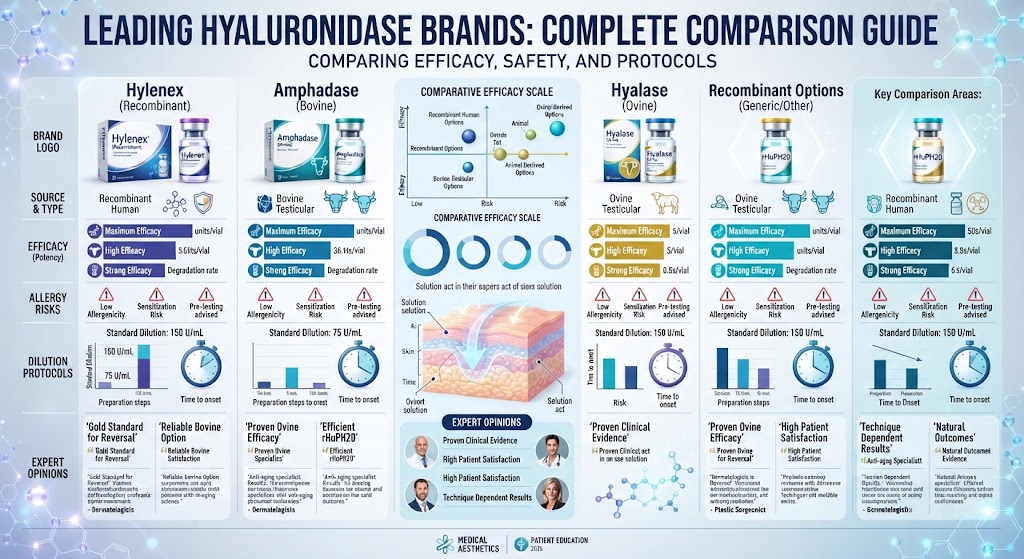
This guide compares five of the most widely used and clinically validated hyaluronidase brands: Hylenex, Amphadase, Hyalase, Vitrase, and Generic Recombinant Human Hyaluronidase (rHuPH20). It focuses on formulation, clinical efficacy, allergy risk, regulatory considerations, and real-world feedback from both practitioners and patients.
⚠️ CRITICAL MEDICAL DISCLAIMER
Hyaluronidase is a prescription medication that must be handled, prescribed, and administered only by appropriately qualified healthcare professionals. It carries a risk of severe anaphylaxis. Practitioners must have an emergency anaphylaxis protocol in place, including immediate access to epinephrine, before using this product. This article is for educational purposes and does not replace official product labeling or clinical training.
📑 Table of Contents
- Quick Comparison
- What is Hyaluronidase and Why Does the Source Matter?
- How to Compare Hyaluronidase Brands
- Leading Brands: Individual Profiles
- Clinical Protocols and Dilution Best Practices
- Safety Considerations and Anaphylaxis Risk Management
- Regulatory Status and Supply Chain Verification
- Frequently Asked Questions (FAQ)
- Conclusion
1. Quick Comparison
The following table provides a high-level overview of the leading hyaluronidase brands. Always confirm the specific product variant and its local regulatory authorization.
| Brand | Active Ingredient / Source | Typical Concentration | Key Advantage | Origin |
|---|---|---|---|---|
| Hylenex | Recombinant Human (rHuPH20) | 150 Units/mL | Lowest allergy risk, gold standard | 🇺🇸 USA |
| Amphadase | Bovine Testicular Extract | 150 Units/mL | Widely available, cost-effective | 🇺🇸 USA |
| Hyalase | Ovine (Sheep) Extract | 1500 Units/vial | Standard of care in the UK/Europe | 🇬🇧 UK |
| Vitrase | Ovine (Sheep) Extract | 200 Units/mL | Historical use, highly purified | 🇺🇸 USA |
| Generic rHuPH20 | Recombinant Human | Varies (e.g., 150-300 Units/mL) | Cost-effective, low allergy risk | 🌍 Global |
↔ Scroll horizontally to view the full table
2. What is Hyaluronidase and Why Does the Source Matter?
Hyaluronidase is an enzyme that catalyzes the hydrolysis (breakdown) of hyaluronic acid, a major component of the extracellular matrix. In aesthetics, it is used to dissolve HA dermal fillers.
The source of the enzyme is the most critical differentiator between brands, as it directly impacts the risk of allergic reaction:
- Recombinant Human Hyaluronidase (rHuPH20): Genetically engineered to be identical to human hyaluronidase. It contains no animal proteins, resulting in the lowest possible risk of allergic reaction or anaphylaxis. It is considered the modern gold standard.
- Bovine (Cow) or Ovine (Sheep) Extracts: Derived from animal tissues. While highly purified, they contain trace animal proteins that can trigger IgE-mediated allergic reactions in sensitized individuals. Skin testing is historically recommended (though debated) for these variants.
3. How to Compare Hyaluronidase Brands
Clinicians evaluate hyaluronidase based on strict safety and efficacy criteria:
- 🧬 Source and Purity: Recombinant human is preferred over animal-derived due to superior safety profiles.
- ⚗️ Unit Standardization: Consistency in unit potency is critical for accurate dosing, especially in emergency vascular occlusion protocols.
- 🌡️ Storage and Stability: Some products require strict refrigeration, while others are stable at room temperature, impacting clinic logistics and emergency readiness.
- 💧 Solubility: How easily the lyophilized (freeze-dried) powder reconstitutes with sterile saline or bacteriostatic water without clumping.
- 🌍 Regulatory Status: FDA approval (USA), MHRA/CE Mark (Europe/UK), or local health authority clearance.
4. Leading Brands: Individual Profiles
Editorial note: The following sections summarize product characteristics, clinical consensus, expert opinions, and real-world market feedback. They do not constitute a ranking of clinical superiority.
1. Hylenex (Baxter / Halozyme)
Clinical Consensus Metrics:
📜 Track Record & Data: ⭐⭐⭐⭐⭐
💡 Innovation: ⭐⭐⭐⭐⭐
🛡️ Safety Profile: ⭐⭐⭐⭐⭐
✅ Key Advantages (Pros)
- Recombinant human origin (rHuPH20): Virtually eliminates the risk of allergic reaction or anaphylaxis.
- FDA-approved specifically for enhancing the dispersion and absorption of other injected drugs (including HA fillers).
- Highly consistent unit potency (150 Units/mL).
- Does not require skin testing prior to administration.
- Lyophilized powder is stable and reconstitutes easily.
⚠️ Important Considerations (Cons)
- Premium pricing — significantly more expensive than animal-derived alternatives.
- Supply chain shortages have occurred historically, requiring clinics to have backup plans.
- Requires refrigeration for long-term storage (though stable at room temperature for short periods).
👨⚕️ Expert Practitioner Opinions
Dr. William Finkle — 🇺🇸 USA | Dermatologist & Vascular Occlusion Expert
Dr. Finkle, a leading authority on managing filler complications, strongly advocates for recombinant human hyaluronidase. He states, “In a vascular occlusion emergency, every second counts. Hylenex provides the most predictable, rapid, and safe dissolution of HA filler without the confounding variable of potential allergic reactions. It is the undisputed gold standard for emergency protocols.”
💬 Community & Practitioner Feedback Trends
Practitioner Forums: Hylenex is overwhelmingly the preferred choice among US-based injectors and complication management experts. The primary complaint is cost and occasional supply shortages, but practitioners universally agree that the safety profile justifies the premium.
2. Amphadase (Amphastar Pharmaceuticals)
Clinical Consensus Metrics:
📜 Track Record & Data: ⭐⭐⭐⭐
💡 Innovation: ⭐⭐⭐
🛡️ Safety Profile: ⭐⭐⭐⭐
✅ Key Advantages (Pros)
- FDA-approved and widely available in the US and select international markets.
- More cost-effective than recombinant human options.
- Comes in a convenient, ready-to-use liquid formulation (150 Units/mL) or lyophilized powder, reducing preparation time in emergencies.
- Extensive historical clinical data supporting its efficacy.
⚠️ Important Considerations (Cons)
- Bovine origin: Carries a higher, albeit still low, risk of allergic reaction compared to recombinant human versions.
- Some guidelines still recommend a test dose or careful patient history screening for beef/bovine allergies.
- May cause slightly more localized swelling or erythema post-injection compared to rHuPH20.
💬 Community & Practitioner Feedback Trends
Practitioner Forums: Amphadase is highly regarded for its convenience, particularly the liquid formulation, which is ideal for emergency crash kits. Many practitioners use it as a reliable, cost-effective workhorse, provided they thoroughly screen patients for bovine allergies.
3. Hyalase (Focus Pharmaceuticals / Wockhardt)
Clinical Consensus Metrics:
📜 Track Record & Data: ⭐⭐⭐⭐⭐
💡 Innovation: ⭐⭐⭐
🛡️ Safety Profile: ⭐⭐⭐⭐
✅ Key Advantages (Pros)
- The most widely used and recognized hyaluronidase brand in the UK and Europe.
- High potency (1500 Units per vial), allowing for flexible dilution protocols.
- Extensive real-world data and inclusion in major UK complication guidelines (e.g., ACE Group World).
- Cost-effective and readily available through UK medical suppliers.
⚠️ Important Considerations (Cons)
- Ovine (sheep) origin: Carries a risk of allergic reaction. A skin prick test is traditionally recommended by UK guidelines prior to full treatment, though recent debates question its predictive value.
- Lyophilized powder requires reconstitution, which takes a few minutes in an emergency.
- Not FDA-approved in the United States.
Dr. Tim Pearce — 🇬🇧 United Kingdom | Aesthetic Doctor & Complication Expert
Dr. Pearce, a leading voice in UK aesthetic safety, frequently discusses Hyalase in his training. He notes, “Hyalase is the backbone of UK complication management. While it is ovine-derived, its efficacy is undeniable. Practitioners must respect the allergy risk, take a thorough patient history, and follow ACE Group guidelines for skin testing and emergency dosing.”
4. Vitrase (ISTA Pharmaceuticals)
Clinical Consensus Metrics:
📜 Track Record & Data: ⭐⭐⭐⭐
💡 Innovation: ⭐⭐⭐
🛡️ Safety Profile: ⭐⭐⭐⭐
✅ Key Advantages (Pros)
- Highly purified ovine testicular hyaluronidase.
- FDA-approved for ophthalmic use, but widely used off-label in aesthetics with a strong safety track record.
- Available in a convenient liquid formulation (200 Units/mL).
⚠️ Important Considerations (Cons)
- Ovine origin carries inherent allergy risks.
- Less commonly marketed specifically for aesthetic use compared to Hylenex or Amphadase in the US.
- Availability can be inconsistent in some regions.
5. Generic Recombinant Human Hyaluronidase (rHuPH20)
Clinical Consensus Metrics:
📜 Track Record & Data: ⭐⭐⭐⭐
💡 Innovation: ⭐⭐⭐⭐
🛡️ Safety Profile: ⭐⭐⭐⭐⭐
✅ Key Advantages (Pros)
- Matches the safety profile of brand-name Hylenex (recombinant human, no animal proteins).
- Significantly more cost-effective, making it accessible for smaller clinics or high-volume practices.
- Increasingly available from reputable, regulated compounding pharmacies and medical suppliers globally.
⚠️ Important Considerations (Cons)
- Quality and purity can vary significantly between manufacturers. Rigorous supplier vetting is mandatory.
- May lack the extensive, brand-specific clinical trial data of Hylenex.
- Regulatory status varies; some are sold as research chemicals or unapproved compounds in certain jurisdictions.
💬 Community & Practitioner Feedback Trends
Practitioner Forums: Generic rHuPH20 is gaining rapid traction as clinics seek to balance safety and cost. The consensus is clear: “If you can verify the supplier’s regulatory compliance and purity testing, generic rHuPH20 is an excellent, safe alternative to brand-name Hylenex.” However, practitioners strongly warn against buying unverified “cheap” versions from non-medical platforms.
5. Clinical Protocols and Dilution Best Practices
Proper dilution and administration are critical for both elective filler correction and emergency vascular occlusion (VO) management.
| Indication | Recommended Dose (Units) | Diluent | Technique |
|---|---|---|---|
| Elective Correction (Overcorrection, asymmetry) |
10 – 50 Units per area | 0.9% Normal Saline or Bacteriostatic Water | Superficial intradermal or subcutaneous injection directly into the filler deposit. |
| Tyndall Effect | 5 – 15 Units per area | 0.9% Normal Saline (highly diluted) | Very superficial micro-droplets to avoid skin depression. |
| Vascular Occlusion (Emergency) | 200 – 1000+ Units (flood the area) | 0.9% Normal Saline | Multiple high-volume injections into and around the affected area. Repeat every 60-90 mins until perfusion returns. |
↔ Scroll horizontally to view the full table
Note: Dosing protocols vary by guideline (e.g., ACE Group World, HARM Group). Always follow your local, evidence-based complication management protocols.
6. Safety Considerations and Anaphylaxis Risk Management
⚠️ CRITICAL SAFETY WARNING: ANAPHYLAXIS RISK
Hyaluronidase, particularly animal-derived forms, can cause severe, life-threatening anaphylaxis. Every clinic using hyaluronidase MUST have a fully stocked anaphylaxis emergency kit (including intramuscular epinephrine/adrenaline, antihistamines, corticosteroids, and oxygen) and staff trained in its immediate use.
Key Safety Protocols:
- Allergy Screening: Take a thorough medical history. Ask specifically about allergies to bee/wasp stings (which contain natural hyaluronidase), beef/bovine products, or sheep/ovine products.
- Skin Testing: While debated, many European guidelines (e.g., for Hyalase) still recommend a skin prick test (injecting 0.02mL of 15 Units/mL solution) and waiting 15-20 minutes before full administration.
- Endogenous HA Breakdown: Hyaluronidase temporarily breaks down the body’s natural hyaluronic acid. This is transient and replenishes within 24-48 hours, but patients should be informed they may experience temporary dryness or mild swelling.
- Over-dissolution: Using excessive units in elective correction can dissolve native tissue HA, leading to temporary skin laxity or depression. Start low and titrate up.
7. Regulatory Status and Supply Chain Verification
Because hyaluronidase is a critical emergency medication, product authenticity is a matter of life and death. Counterfeit or improperly stored hyaluronidase may have zero enzymatic activity, leading to catastrophic failure during a vascular occlusion event.
For clinics and qualified distributors, verifying the supply chain is non-negotiable:
- Regulatory Approval: Ensure the product has valid regulatory authorization (FDA, MHRA, CE Mark, or local equivalent) as a prescription medication or medical device.
- Authorized Medical Suppliers: Purchase only directly from the manufacturer or licensed, authorized medical distributors. For verified professional-grade filler dissolvers and emergency complication kits, practitioners can explore reputable options at Aesthetic Supply Store’s Filler Dissolvers Category.
- Cold Chain Integrity: Verify that the supplier maintains proper refrigeration during transit, as heat degradation can render the enzyme inactive.
- Batch Verification: Always check the batch number, expiry date, and intactness of the vial seal upon receipt.
8. Frequently Asked Questions (FAQ)
❓ Which hyaluronidase brand is the safest?
Recombinant human hyaluronidase (rHuPH20), such as Hylenex or verified generic equivalents, is considered the safest due to its lack of animal proteins, which virtually eliminates the risk of allergic reaction or anaphylaxis.
❓ Do I need to do a skin test before using hyaluronidase?
For recombinant human hyaluronidase, skin testing is generally not required. For animal-derived products (like Hyalase or Amphadase), many national guidelines (e.g., in the UK) still recommend a skin prick test, though its predictive value for severe anaphylaxis is debated. A thorough allergy history is mandatory regardless.
❓ How long does it take for hyaluronidase to dissolve filler?
The enzymatic action begins immediately. Visible softening of the filler can be seen within 15–30 minutes, with maximal effect occurring within 24–48 hours. In vascular occlusion emergencies, high doses are repeated every 60–90 minutes until capillary refill returns.
❓ Can hyaluronidase dissolve non-HA fillers (e.g., Radiesse, Sculptra, Silicone)?
No. Hyaluronidase only breaks down hyaluronic acid. It is completely ineffective against calcium hydroxylapatite (Radiesse), poly-L-lactic acid (Sculptra), PMMA (Bellafill), or silicone. Attempting to dissolve these with hyaluronidase will waste critical time in an emergency.
❓ Does hyaluronidase permanently damage the skin?
No. While it temporarily breaks down the skin’s native hyaluronic acid, the body naturally replenishes its HA stores within 24 to 48 hours. Any mild swelling or dryness is transient.
9. Conclusion: Choosing Hyaluronidase Based on Safety and Efficacy
Hylenex, Amphadase, Hyalase, Vitrase, and generic rHuPH20 each have distinct roles in aesthetic practice. The choice depends on regional availability, budget, and the practitioner’s risk tolerance regarding allergic potential.
A reliable, evidence-based approach prioritizes:
- Safety First: Opting for recombinant human hyaluronidase (rHuPH20) whenever possible to minimize anaphylaxis risk.
- Emergency Readiness: Maintaining an adequately stocked, unexpired supply of high-potency hyaluronidase and a full anaphylaxis kit at all times.
- Verified Sourcing: Purchasing exclusively from authorized, regulated medical suppliers to guarantee enzymatic activity and purity.
- Continuous Training: Regularly reviewing vascular occlusion protocols and practicing emergency dilution and administration techniques.
For healthcare professionals, the strongest decisions are supported by verifiable clinical data, rigorous safety protocols, and legitimate, traceable supply chains.
📚 Official Sources and Further Reading
- FDA Drugs@FDA Database – Official U.S. prescribing information for Hylenex and Amphadase.
- ACE Group World Guidelines – Comprehensive, evidence-based guidelines for the management of complications in aesthetic practice, including hyaluronidase dosing.
- PubMed Central – Peer-reviewed clinical studies on hyaluronidase efficacy, allergy rates, and vascular occlusion management.
- EUDAMED – European medical device and pharmaceutical regulatory verification.
Editorial note: Medical regulations, product formulations, and clinical guidelines can change. Review the latest official documentation and local regulatory updates before clinical application.