No products added!

The aesthetic medicine landscape has shifted from merely “filling” wrinkles to actively regenerating the skin. Collagen stimulator fillers, also known as biostimulators, represent the pinnacle of this regenerative approach. Unlike traditional hyaluronic acid (HA) fillers that simply occupy space, biostimulators work by triggering the body’s own fibroblasts to produce new collagen, elastin, and extracellular matrix components.
The result is a gradual, natural-looking improvement in skin density, elasticity, and structural support that continues to develop for months after treatment and lasts significantly longer than conventional fillers. The market features several distinct classes of biostimulators, including Poly-L-Lactic Acid (PLLA), Calcium Hydroxylapatite (CaHA), Polycaprolactone (PCL), Poly-D,L-Lactic Acid (PDLLA), and advanced hybrid formulations.
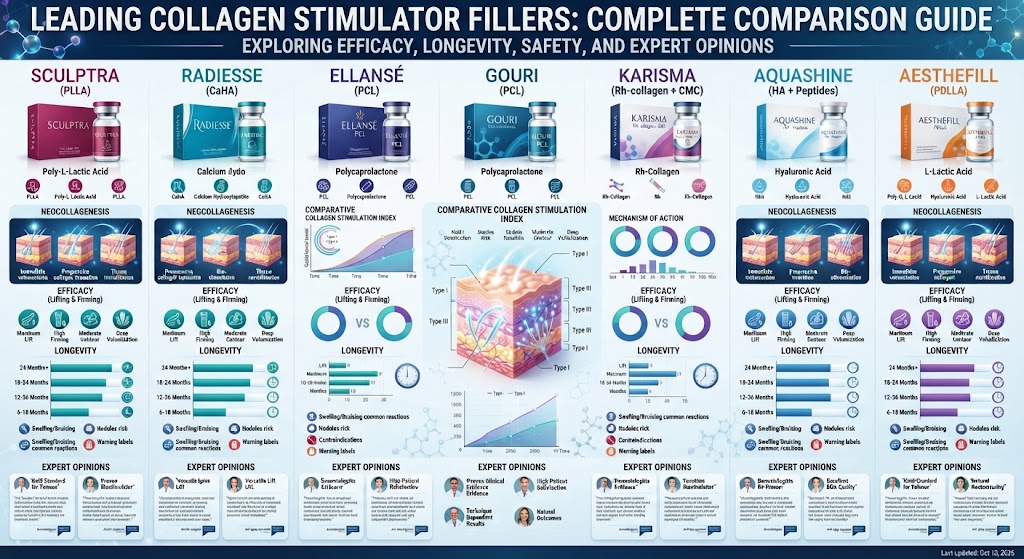
This guide compares seven of the most widely used and clinically validated collagen stimulator brands: Sculptra, Radiesse, Ellansé, Gouri, AestheFill, Karisma, and Aquashine. It focuses on formulation, mechanism of action, longevity, safety profiles, regulatory considerations, and real-world feedback from both practitioners and patients.
⚠️ IMPORTANT MEDICAL DISCLAIMER
Collagen stimulator fillers are medical devices (or prescription medicines, depending on the jurisdiction) that must be handled, prescribed, and administered only by appropriately qualified healthcare professionals. These treatments require advanced anatomical knowledge and specific injection techniques. This article is for educational purposes and does not replace official product labeling or clinical training.
📑 Table of Contents
- Quick Comparison
- What Are Collagen Stimulators? (vs. Traditional Fillers)
- How to Compare Collagen Stimulator Brands
- Leading Brands: Individual Profiles
- Longevity and Treatment Protocols
- Safety Considerations and Risk Management
- Regulatory Status and Supply Chain Verification
- Frequently Asked Questions (FAQ)
- Conclusion
1. Quick Comparison
The following table provides a high-level overview of the leading collagen stimulator brands. Always confirm the specific product variant and its local regulatory authorization for the intended indication.
| Brand | Active Ingredient | Key Technology | Primary Benefit | Origin |
|---|---|---|---|---|
| Sculptra | Poly-L-Lactic Acid (PLLA) | Microparticle collagen stimulator | Gold standard for global volume & neocollagenesis | 🇫🇷 France / 🇨🇭 Switzerland |
| Radiesse | Calcium Hydroxylapatite (CaHA) | Microspheres in aqueous gel | Immediate volume + long-term collagen | 🇩🇪 Germany / 🇺🇸 USA |
| Ellansé | Polycaprolactone (PCL) | PCL microspheres in CMC gel | Customizable longevity (1–4 years) | 🇳🇱 Netherlands |
| Gouri | 100% Soluble PCL | Fully soluble liquid PCL | Collagen stimulation with zero nodule risk | 🇰🇷 South Korea |
| AestheFill | Poly-D,L-Lactic Acid (PDLLA) | Nanoparticle porous sponge technology | Immediate mixing, no pre-dilution wait | 🇰🇷 South Korea |
| Karisma | HA + Collagen-Stimulating Peptides | Hybrid biostimulatory complex | Hydration + targeted fibroblast activation | 🇰🇷 South Korea |
| Aquashine (BR/BTX) | HA + 56 Active Ingredients | Peptide-driven bio-revitalization | Skin quality, elasticity, and collagen synthesis | 🇰🇷 South Korea |
↔ Scroll horizontally to view the full table
2. What Are Collagen Stimulators? (vs. Traditional Fillers)
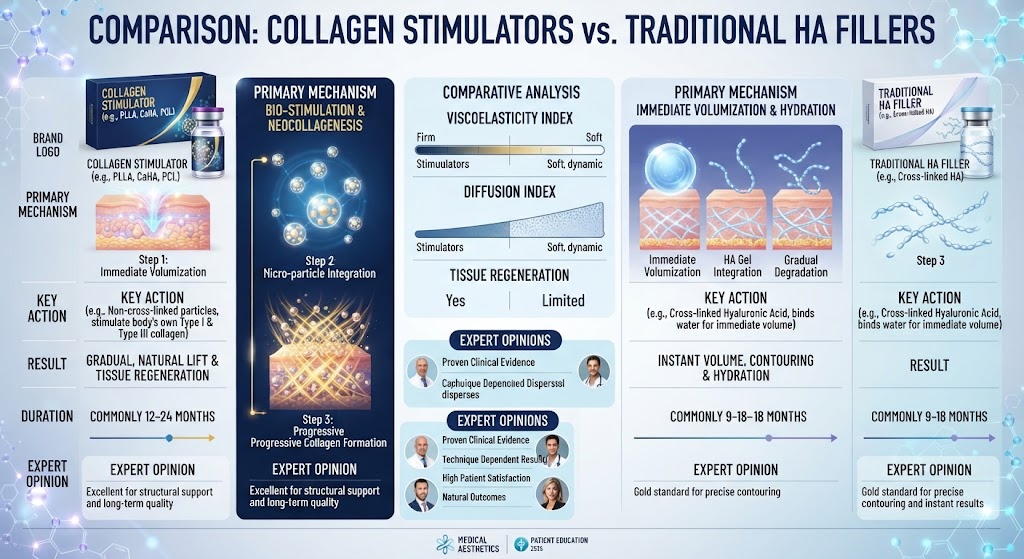
Collagen stimulators occupy a unique category in aesthetic medicine, fundamentally differing from traditional dermal fillers in both mechanism of action and clinical outcomes.
Key Differences:
- Traditional HA Fillers: Provide immediate volume through physical space-occupation. Results are visible immediately but gradually metabolized over 6–18 months. Fully reversible with hyaluronidase.
- Collagen Stimulators: Work by activating the body’s own regenerative processes (neocollagenesis). Results develop gradually over weeks to months as new collagen is produced. Effects can last 1–4 years depending on the product. Not reversible with hyaluronidase.
The Main Classes of Collagen Stimulators:
- PLLA / PDLLA (Poly-Lactic Acids): The original collagen stimulators. Microparticles trigger a controlled inflammatory response that leads to robust Type I and III collagen production. Results develop over 2–3 months and can last up to 2+ years.
- CaHA (Calcium Hydroxylapatite): Provides immediate volume via a gel carrier, then stimulates collagen as the CaHA microspheres are gradually metabolized into calcium and phosphate ions.
- PCL (Polycaprolactone): A newer generation biostimulator. Can be formulated as microspheres (Ellansé) for extended longevity or as a 100% soluble liquid (Gouri) for safer, more flexible collagen stimulation.
- Hybrid/Peptide Stimulators: Advanced formulations (like Karisma or Aquashine) combining HA with specific biomimetic peptides or growth factors to gently stimulate fibroblasts while providing immediate hydration.
3. How to Compare Collagen Stimulator Brands
A meaningful comparison requires understanding the science behind each formulation. Clinicians evaluate collagen stimulators based on:
- 🧬 Active Ingredient & Particle Size: Determines the intensity of collagen stimulation and the risk of nodules or granulomas.
- ⚗️ Immediate vs. Delayed Effect: Whether the product offers immediate volume (CaHA, PCL) or requires patience for gradual results (PLLA).
- ⏱️ Longevity: Duration of collagen stimulation and clinical results (ranging from 6 months to 4+ years).
- 🛡️ Safety Profile: Risk of nodules, granulomas, vascular complications, and the critical fact that they are not reversible with hyaluronidase.
- 🌍 Regulatory Status: FDA approval (USA), CE Mark (Europe), MFDS (South Korea), or local health authority approval.
4. Leading Brands: Individual Profiles
Editorial note: The following sections summarize product characteristics, clinical consensus, expert opinions, and real-world market feedback. They do not constitute a ranking of clinical superiority.
1. Sculptra (Galderma)
Clinical Consensus Metrics:
📜 Track Record & Data: ⭐⭐⭐⭐⭐
💡 Innovation: ⭐⭐⭐⭐
💰 Cost-Efficiency: ⭐⭐⭐⭐⭐ (long-term)
✅ Key Advantages (Pros)
- The original and most extensively studied PLLA biostimulator with over 20 years of clinical use.
- Stimulates robust Type I and III collagen production over 3–6 months.
- Results can last up to 2 years or more, offering exceptional long-term value.
- Ideal for global facial volume loss, temple hollowing, and deep structural restoration.
- FDA-approved for facial lipoatrophy and aesthetic indications.
⚠️ Important Considerations (Cons)
- NOT reversible and provides no immediate volumizing effect (requires patience).
- Requires meticulous reconstitution (often 24+ hours in advance) and strict post-treatment massage (“5-5-5 rule”).
- Contraindicated in lips and periorbital areas (high risk of visible nodules).
- Risk of delayed-onset nodules if reconstitution or injection technique is suboptimal.
👨⚕️ Expert Practitioner Opinions
Dr. Rebecca Fitzgerald — 🇺🇸 USA | Board-Certified Dermatologist
Dr. Fitzgerald is a leading authority on facial rejuvenation. She advocates for Sculptra as a “foundation treatment” for patients experiencing global volume loss. She emphasizes that “Sculptra is not a quick fix — it is an investment in your skin’s structural future. Patients who understand the timeline are almost universally thrilled with the natural, progressive results.” She notes that proper, hyper-diluted reconstitution protocols are critical to minimizing nodule risk.
💬 Community & Patient Feedback Trends
RealSelf / Reddit: Sculptra is frequently described as a “marathon, not a sprint.” Long-term users are among the most vocal advocates, stating they “look naturally younger without looking done.” The most discussed concern is nodule formation, with experienced users strongly advising patients to choose an injector who follows modern, hyper-diluted protocols and emphasizes the post-treatment massage regimen.
2. Radiesse (Merz Aesthetics)
Clinical Consensus Metrics:
📜 Track Record & Data: ⭐⭐⭐⭐⭐
💡 Innovation: ⭐⭐⭐⭐
💰 Cost-Efficiency: ⭐⭐⭐⭐
✅ Key Advantages (Pros)
- CaHA provides immediate volume via the gel carrier, plus long-term collagen and elastin neogenesis.
- Excellent for deep structural support (jawline, chin, cheeks) and hand rejuvenation.
- Hyper-diluted Radiesse can be used for skin tightening and texture improvement on the neck and body.
- FDA-approved for facial lipoatrophy and hand volume restoration.
- Dual-action: immediate structural correction + ongoing collagen stimulation.
⚠️ Important Considerations (Cons)
- NOT reversible with hyaluronidase.
- Should never be injected into the superficial dermis or lips (high risk of visible nodules).
- Requires advanced anatomical knowledge due to higher viscosity and non-reversibility.
- Must be injected deep (supraperiosteal or submuscular) for safety and efficacy.
Dr. Sabrina Fabi — 🇺🇸 USA | Board-Certified Dermatologist
Dr. Fabi is a world-leading expert on biostimulatory fillers. She advocates for hyper-diluted Radiesse as a “collagen bank” treatment. She states, “Radiesse is not just a filler — it is a regenerative medicine tool that reprograms the skin’s extracellular matrix. Proper dilution ratios and deep injection depth are critical to avoiding complications and maximizing collagen production.”
Community Feedback: Patients praise the “dual benefit” of immediate volume followed by continued improvement. However, forums frequently warn newcomers: “Make sure you trust your injector 100% before getting Radiesse — there is no undo button.”
3. Ellansé (Sinclair Pharma)
Clinical Consensus Metrics:
📜 Track Record & Data: ⭐⭐⭐⭐
💡 Innovation: ⭐⭐⭐⭐⭐
💰 Cost-Efficiency: ⭐⭐⭐⭐⭐ (long-term)
✅ Key Advantages (Pros)
- PCL microspheres provide the longest-lasting biostimulation available (1–4 years depending on variant).
- Four variants: Ellansé-S (1 year), -M (2 years), -L (3 years), -E (4 years) — allowing customized longevity.
- CMC gel carrier provides immediate volume while PCL stimulates long-term collagen production.
- Excellent for deep structural volumizing (cheeks, jawline, chin).
- PCL is biocompatible and fully metabolized over time — no permanent residue.
⚠️ Important Considerations (Cons)
- NOT reversible with hyaluronidase.
- Not FDA-approved in the United States (available in Europe, Asia, Middle East).
- Requires advanced injection technique — must be placed deep to avoid nodules.
- Long-term presence means complications (if they occur) are more challenging to manage.
Community Feedback: Ellansé is frequently discussed as the “long-term solution” for patients tired of frequent maintenance. Users report that results “just keep getting better” over the first 3-6 months as collagen production increases. The non-reversibility is the most cited caveat.
4. Gouri (Caregen)
Clinical Consensus Metrics:
📜 Track Record & Data: ⭐⭐⭐⭐
💡 Innovation: ⭐⭐⭐⭐⭐
💰 Cost-Efficiency: ⭐⭐⭐⭐
✅ Key Advantages (Pros)
- The world’s first 100% soluble PCL. Unlike Ellansé, it contains no microspheres, eliminating the risk of long-term nodules or granulomas.
- Fully liquid formulation allows for smooth, even distribution and flexible injection techniques (including cannula).
- Stimulates robust collagen and elastin production with a much higher safety margin in delicate areas.
- Minimal downtime and very low risk of post-injection lumps.
- MFDS (Korea) and CE-approved, rapidly gaining global traction.
⚠️ Important Considerations (Cons)
- Does not provide the same immediate “filling” volume as microsphere-based PCL or CaHA.
- Shorter longevity compared to Ellansé (typically 6–12 months, requiring more frequent maintenance).
- Can cause transient, mild swelling or small, temporary bumps that resolve within a few days.
- Not FDA-approved in the United States.
Dr. Lee (Seoul National University) — 🇰🇷 South Korea | Plastic Surgeon
“Gouri represents a paradigm shift in PCL technology. By making the PCL 100% soluble, we retain the powerful collagen-stimulating benefits while virtually eliminating the nodule risk associated with traditional microspheres. It is a game-changer for full-face collagen remodeling.”
Community Feedback: Highly praised in Asian and European aesthetic communities for its safety profile. Patients appreciate the “natural, progressive glow” without the fear of long-term lumps. It is frequently recommended for patients who want biostimulation but are anxious about traditional semi-permanent fillers.
5. AestheFill (Medytox)
Clinical Consensus Metrics:
📜 Track Record & Data: ⭐⭐⭐⭐
💡 Innovation: ⭐⭐⭐⭐⭐
💰 Cost-Efficiency: ⭐⭐⭐⭐⭐
✅ Key Advantages (Pros)
- Uses PDLLA (Poly-D,L-Lactic Acid) with unique “sponge-like” nanoparticle technology.
- No pre-dilution wait time: Can be reconstituted immediately before the procedure, unlike Sculptra.
- Highly cost-effective compared to Western biostimulators.
- Provides a balance of immediate volume (from the carrier) and long-term collagen stimulation.
- Lower risk of nodules compared to traditional PLLA due to smaller, more uniform particle size.
⚠️ Important Considerations (Cons)
- Not FDA-approved in the United States.
- Less long-term (10+ year) clinical data in Western populations compared to Sculptra.
- Supply chain verification is critical, as counterfeit PDLLA products exist in unauthorized channels.
Community Feedback: AestheFill is frequently discussed as the “convenient, budget-friendly alternative to Sculptra.” Practitioners love the immediate reconstitution, and patients report excellent, natural-looking volume restoration with a lower incidence of post-treatment bumps.
6. Karisma (Caregen)
Clinical Consensus Metrics:
📜 Track Record & Data: ⭐⭐⭐⭐
💡 Innovation: ⭐⭐⭐⭐
💰 Cost-Efficiency: ⭐⭐⭐⭐
✅ Key Advantages (Pros)
- A hybrid biostimulatory filler combining highly cross-linked HA with collagen-stimulating peptides.
- Provides the immediate, predictable volume of HA alongside the long-term regenerative benefits of peptides.
- Fully reversible with hyaluronidase (due to the HA component), offering a safety net that pure biostimulators lack.
- Excellent for patients who want subtle volume correction with improved skin quality over time.
⚠️ Important Considerations (Cons)
- The collagen-stimulating effect is more gradual and subtle compared to pure PLLA or PCL products.
- Longevity is tied to the HA component (typically 9–12 months), shorter than pure biostimulators.
- Not FDA-approved in the United States.
Community Feedback: Karisma is praised as a “bridge” product. Patients who are hesitant about non-reversible biostimulators appreciate the safety of HA, while still gaining the added skin-quality benefits of the peptide complex. It is highly regarded for mid-face and jawline refinement.
7. Aquashine (Caregen)
Clinical Consensus Metrics:
📜 Track Record & Data: ⭐⭐⭐⭐
💡 Innovation: ⭐⭐⭐⭐⭐
💰 Cost-Efficiency: ⭐⭐⭐⭐
✅ Key Advantages (Pros)
- While technically a premium skin booster, variants like Aquashine BR (Bio Revitalizing) and Aquashine BTX are packed with 56+ active ingredients, including biomimetic peptides that actively stimulate collagen and elastin synthesis.
- Aquashine BTX contains hexapeptides that mimic botulinum toxin effects, relaxing dynamic lines while stimulating repair.
- Excellent for overall skin quality, elasticity, and brightening, especially when combined with microneedling or mesotherapy.
- Minimal downtime and highly versatile for face, neck, and décolletage.
⚠️ Important Considerations (Cons)
- Does not provide structural volume or lifting like Sculptra, Radiesse, or Ellansé.
- Requires a series of treatments (typically 3-4 sessions) for cumulative collagen-building effects.
- Results are focused on skin quality and texture, not deep fold correction.
Community Feedback: Aquashine is a cult favorite in K-beauty and European clinics. Patients report a dramatic “glass skin” glow, improved pore size, and enhanced elasticity. It is frequently used as a complementary treatment alongside traditional fillers to optimize the overlying skin quality.
5. Longevity and Treatment Protocols
Duration varies significantly between collagen stimulator brands and depends on the product’s rheology, injection depth, and the patient’s individual metabolic rate and age.
| Brand | Initial Protocol | Time to See Results | Duration of Results | Reversible? |
|---|---|---|---|---|
| Sculptra | 3 sessions (4-6 weeks apart) | 6–12 weeks | Up to 24+ months | No |
| Radiesse | 1-2 sessions | Immediate + 3 months | 12–18 months | No |
| Ellansé | 1 session (variant dependent) | Immediate + 3 months | 1–4 years | No |
| Gouri | 1-2 sessions | 4–8 weeks | 6–12 months | No |
| AestheFill | 2-3 sessions | 4–8 weeks | 18–24 months | No |
| Karisma | 1-2 sessions | Immediate + gradual | 9–12 months | Yes (HA component) |
| Aquashine | 3-4 sessions | 2–4 weeks | 6–9 months | Yes |
↔ Scroll horizontally to view the full table
6. Safety Considerations and Risk Management
⚠️ CRITICAL SAFETY WARNING
Unlike HA fillers, true collagen stimulators (PLLA, CaHA, PCL, PDLLA) cannot be dissolved with hyaluronidase. Improper placement can lead to long-term complications such as nodules, granulomas, or vascular occlusion. Practitioners must have extensive anatomical knowledge and use appropriate injection techniques (e.g., deep supraperiosteal placement, aspiration, or cannula use).
Key Safety Considerations by Category:
- Nodules & Granulomas: Highest risk with improperly diluted PLLA (Sculptra) or superficially injected CaHA/PCL. Strict adherence to reconstitution and injection depth protocols is mandatory.
- Vascular Occlusion: A rare but severe risk with all injectables. Deep injection planes and slow, low-pressure injection techniques minimize this risk.
- Hybrid Safety (Karisma, Aquashine): Because these contain HA, they carry a lower risk profile and can be partially or fully reversed if necessary, making them excellent entry points for biostimulation.
Contraindications:
- Active infection or inflammatory skin disease in the treatment area.
- History of hypertrophic scarring or keloid formation.
- Autoimmune disorders or immunosuppression.
- Pregnancy and breastfeeding.
- Known hypersensitivity to any component of the product (e.g., lidocaine, carboxymethylcellulose).
7. Regulatory Status and Supply Chain Verification
The biostimulator market is highly lucrative and, consequently, plagued by counterfeit products. For clinics and distributors, verifying the supply chain is a matter of patient safety and legal compliance.
- Regulatory Approval: Ensure the product has valid regulatory authorization (FDA, CE Mark, MFDS, or local equivalent) for the specific indication.
- Authorized Distributors: Purchase only directly from the manufacturer or their explicitly authorized national distributors.
- Authentication Features: Check for holographic seals, unique QR codes, or scratch-off verification labels on the packaging.
- Temperature Control: Some biostimulators (like Sculptra) have specific storage requirements. Verify that the supplier maintains proper logistics.
Never purchase collagen stimulators from unauthorized online marketplaces, social media sellers, or unverified third-party wholesalers. Counterfeit Sculptra, Ellansé, and Korean biostimulators are among the most common fake products on the black market.
8. Frequently Asked Questions (FAQ)
❓ Which collagen stimulator is the best?
There is no universally “best” product. Sculptra is the gold standard for global, gradual volume restoration. Radiesse is ideal for immediate structural lifting plus collagen. Ellansé offers customizable, long-lasting results. Gouri provides a safer, fully soluble PCL alternative. Karisma and Aquashine are excellent for patients wanting a gentler, reversible hybrid approach with skin quality benefits. The choice depends on patient anatomy, goals, and the practitioner’s expertise.
❓ Can collagen stimulators be dissolved?
No. Pure biostimulators (Sculptra, Radiesse, Ellansé, Gouri, AestheFill) cannot be dissolved with hyaluronidase. Only hybrid products containing HA (like Karisma or Aquashine) can be partially or fully reversed. This makes choosing an experienced, highly skilled injector absolutely critical.
❓ How long does it take to see results?
Products with a gel carrier (Radiesse, Ellansé, Karisma) provide immediate volume, with collagen benefits appearing over 1–3 months. Pure stimulators (Sculptra, Gouri, AestheFill) require patience, with visible results typically emerging at 6–12 weeks and peaking at 3–6 months.
❓ Are Korean biostimulators (Gouri, AestheFill) as safe as Western brands?
Yes, when sourced legitimately. Products like Gouri have introduced innovative, fully soluble PCL technology that actually reduces nodule risk compared to older microsphere formulations. The key is ensuring product authenticity through authorized, regulated supply chains.
❓ Can I get collagen stimulators if I have a history of cold sores?
Yes, but you should inform your practitioner. They may prescribe prophylactic antiviral medication prior to treatment to prevent a herpes simplex outbreak triggered by the needle trauma.
9. Conclusion: Choosing a Collagen Stimulator Based on Evidence
Sculptra, Radiesse, Ellansé, Gouri, AestheFill, Karisma, and Aquashine each offer distinct technological advantages. The choice should be driven by the patient’s specific concerns (global volume loss vs. localized lifting vs. skin quality), desired longevity, budget, and the practitioner’s expertise — not by marketing trends alone.
A reliable approach prioritizes:
- Matching the stimulator’s mechanism (immediate vs. delayed, reversible vs. non-reversible) to the patient’s goals.
- Understanding the treatment protocol and the necessity of patience for neocollagenesis.
- Sourcing exclusively from authorized, traceable supply chains.
- Ensuring the procedure is performed by a qualified, anatomically trained medical professional with specific expertise in biostimulators.
For healthcare professionals and qualified buyers, the strongest decisions are supported by verifiable clinical data, rigorous safety protocols, and legitimate supply chains.
📚 Official Sources and Further Reading
- PubMed – Collagen Stimulator Clinical Trials – Peer-reviewed studies on PLLA, CaHA, and PCL efficacy and safety.
- FDA Drugs@FDA Database – Official U.S. approval records for Sculptra and Radiesse.
- EUDAMED – European medical device regulatory verification for Ellansé, Gouri, and others.
- MFDS (South Korea) – Korean Ministry of Food and Drug Safety for Gouri, AestheFill, and Karisma verification.
Editorial note: Medical device regulations, product formulations, and clinical guidelines can change. Review the latest official documentation and local regulatory updates before publication or clinical application.