
No products added!
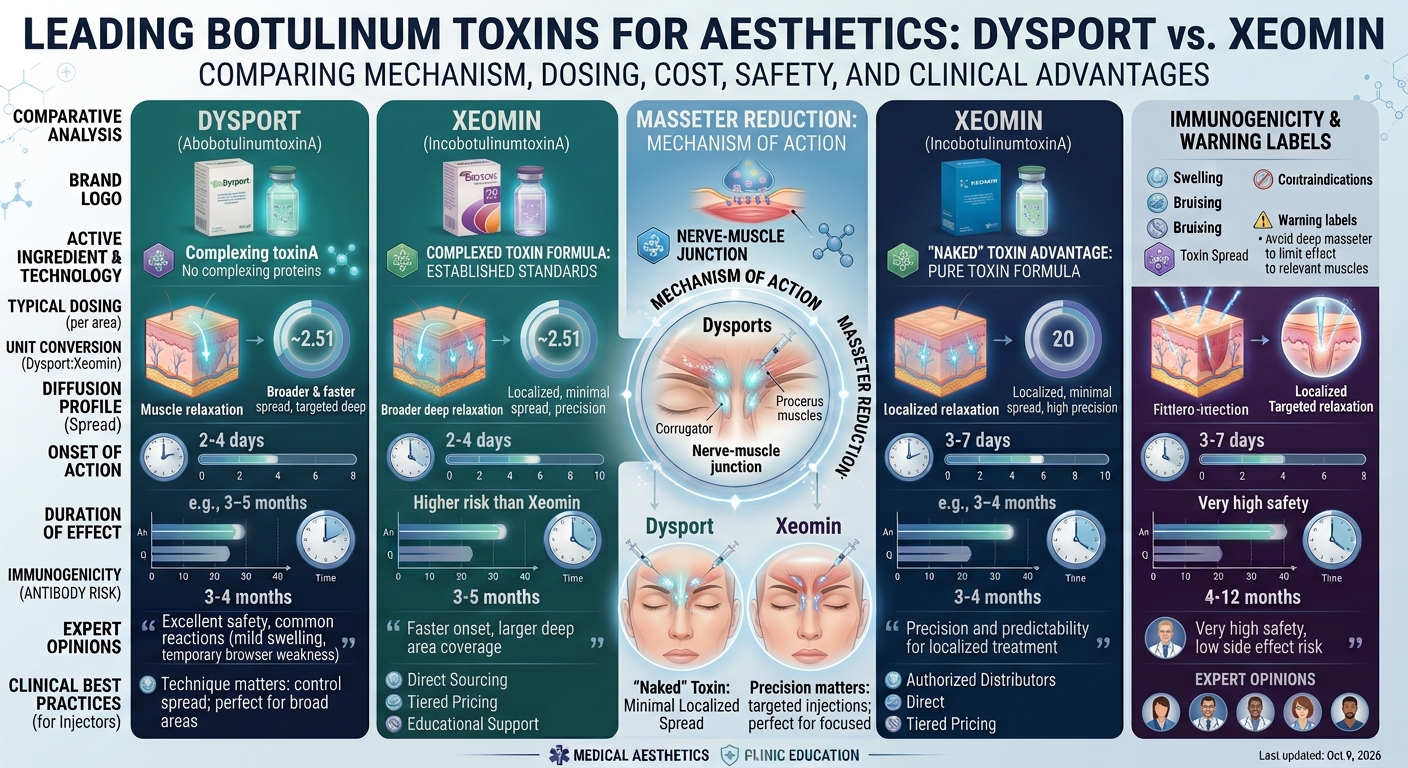

In the realm of aesthetic medicine, botulinum toxin type A remains the cornerstone of dynamic wrinkle reduction. While Botox (onabotulinumtoxinA) often dominates the conversation, experienced practitioners frequently debate the merits of two other highly effective, yet distinctly different, neurotoxins: Dysport (abobotulinumtoxinA) and Xeomin (incobotulinumtoxinA).
Although all three contain the same 150 kDa core neurotoxin, their manufacturing processes, molecular complex sizes, and formulation excipients create unique clinical behaviors. Choosing between Dysport and Xeomin is not a matter of which is universally “better,” but rather which is better suited for a specific patient’s anatomy, treatment goals, and treatment history.
This guide provides a comprehensive, evidence-based clinical comparison of Dysport and Xeomin, focusing on diffusion profiles, onset of action, dosing conversions, immunogenicity, and real-world application strategies.
⚠️ IMPORTANT MEDICAL DISCLAIMER
Botulinum toxin products are prescription medicines that must be handled, prescribed, and administered only by appropriately qualified healthcare professionals. The units of measurement between different botulinum toxin products are not interchangeable. This article is for educational purposes and does not replace official product labeling, clinical training, or professional medical judgment.
📑 Table of Contents
- Quick Comparison
- The Core Difference: Molecular Formulation
- Dysport: Clinical Profile & Ideal Use Cases
- Xeomin: Clinical Profile & Ideal Use Cases
- Dosing and Unit Conversion: A Critical Warning
- The Immunogenicity Debate
- Safety Considerations and Risk Management
- Wholesale Sourcing and Supply Chain Verification
- Frequently Asked Questions (FAQ)
- Conclusion
1. Quick Comparison
The following table highlights the key clinical and pharmacological differences between Dysport and Xeomin.
| Feature | Dysport (AbobotulinumtoxinA) | Xeomin (IncobotulinumtoxinA) |
|---|---|---|
| Molecular Complex | ~500–900 kDa (with complexing proteins) | 150 kDa (“Naked” core neurotoxin only) |
| Diffusion Profile | Wider, broader spread | Highly targeted, localized |
| Onset of Action | Fast (24–48 hours) | Standard (3–5 days) |
| Unit Equivalence | Not 1:1 with Xeomin/Botox (Typically 2.5:1 or 3:1) | Generally considered 1:1 with Botox |
| Immunogenicity Risk | Low (but contains complexing proteins) | Theoretically lowest (no complexing proteins) |
| Unreconstituted Storage | Refrigerated (2–8°C) | Room temperature (up to 25°C) |
↔ Scroll horizontally to view the full table
2. The Core Difference: Molecular Formulation
To understand how Dysport and Xeomin behave differently in tissue, one must look at their manufacturing. In nature, botulinum toxin exists as a large 900 kDa complex, consisting of the active 150 kDa core neurotoxin bound to accessory (complexing) proteins.
- Dysport retains some of these complexing proteins. While the exact size of the active complex in vivo is debated, its formulation is clinically observed to have a lower molecular weight footprint and higher spreadability in tissue compared to Botox.
- Xeomin undergoes an extensive purification process that strips away all accessory complexing proteins, leaving only the pure 150 kDa core neurotoxin. This is why it is famously marketed as the “naked” neurotoxin.
These structural differences directly dictate their diffusion patterns, onset times, and theoretical immunogenic profiles.
3. Dysport: Clinical Profile & Ideal Use Cases
Clinical Consensus Metrics:
📜 Track Record & Data: ⭐⭐⭐⭐⭐
🌊 Diffusion: ⭐⭐⭐⭐⭐
⚡ Onset Speed: ⭐⭐⭐⭐⭐
✅ Key Advantages
- Superior Diffusion: Spreads more readily through tissue, making it highly efficient for treating broad, expansive muscle areas (e.g., the frontalis, masseter, or calf muscles) with fewer injection points.
- Rapid Onset: Patients frequently report visible softening within 24–48 hours, which is highly appealing for patients with upcoming events.
- Cost-Effectiveness for Large Areas: Due to its spread and pricing structure, it often provides better value for treating large muscle groups.
⚠️ Important Considerations
- Migration Risk: The wider diffusion requires meticulous injection placement. Injecting too close to the orbital rim or smile muscles increases the risk of brow or eyelid ptosis and smile asymmetry.
- Unit Confusion: Dysport units are uniquely calibrated. Practitioners transitioning from other brands must undergo specific training to avoid severe under- or over-dosing.
👨⚕️ Expert Practitioner Opinion
“For patients with strong, broad frontalis muscles or severe masseter hypertrophy, Dysport is my first choice. Its ability to diffuse evenly prevents the ‘lumpy’ or uneven relaxation that can sometimes occur when trying to cover a large area with a more localized toxin.” — Dr. Tim Pearce, Aesthetic Medicine Educator.
4. Xeomin: Clinical Profile & Ideal Use Cases
Clinical Consensus Metrics:
📜 Track Record & Data: ⭐⭐⭐⭐⭐
🎯 Precision: ⭐⭐⭐⭐⭐
🛡️ Purity (Low Immunogenicity): ⭐⭐⭐⭐⭐
✅ Key Advantages
- The “Naked” Toxin: The absence of complexing proteins makes it the ideal choice for long-term, high-frequency patients who may have developed neutralizing antibodies (resistance) to other brands.
- Precise, Localized Control: Its diffusion profile is highly predictable and localized, making it exceptionally safe for delicate areas where precision is paramount (e.g., glabella, crow’s feet, perioral lines).
- Logistical Flexibility: Unreconstituted Xeomin can be stored at room temperature (up to 25°C), simplifying clinic inventory and reducing the risk of potency loss during shipping.
⚠️ Important Considerations
- Slower Onset: While peak effect is reached at the same time as other toxins (10-14 days), the initial visible onset may take 3–5 days, slightly longer than Dysport.
- Large Area Coverage: Treating very broad muscles (like the masseter) may require more injection points compared to Dysport to ensure even coverage.
👨⚕️ Expert Practitioner Opinion
“Xeomin is my go-to ‘rescue’ product for patients who have been getting treatments for a decade and complain that their results are fading faster. The lack of complexing proteins minimizes immunogenic risk, and its precise diffusion gives me total confidence in the glabellar complex.” — Dr. Sabrina Fabi, Board-Certified Dermatologist.
5. Dosing and Unit Conversion: A Critical Warning
⚠️ CRITICAL CLINICAL WARNING
Botulinum toxin units are NOT interchangeable. One unit of Dysport does not equal one unit of Xeomin. Dosing must be calculated based on the specific product’s proprietary bioassay.
While Xeomin and Botox are generally considered to have a 1:1 unit equivalence in clinical practice, Dysport requires a conversion ratio.
| Treatment Area | Typical Xeomin Dose | Typical Dysport Dose | Approx. Conversion Ratio |
|---|---|---|---|
| Glabellar Lines | 20 Units | 50 Units | 1 : 2.5 |
| Frontalis (Forehead) | 10–20 Units | 30–50 Units | 1 : 2.5 to 1 : 3 |
| Lateral Canthal Lines | 12–24 Units (total) | 30–60 Units (total) | 1 : 2.5 to 1 : 3 |
| Masseter (Per Side) | 25–30+ Units | 60–100+ Units | 1 : 3 to 1 : 4 (clinical judgment) |
↔ Scroll horizontally to view the full table
Note: Conversion ratios are not absolute science. They vary based on the treatment area, muscle mass, and the injector’s technique. Practitioners should always start conservatively and titrate based on individual patient response.
6. The Immunogenicity Debate
Immunogenicity refers to the body’s ability to recognize the botulinum toxin as a foreign invader and produce neutralizing antibodies (NAbs). If NAbs form, they bind to the toxin and render it ineffective, leading to “secondary non-response” (the treatment stops working).
- The Reality: In modern cosmetic dosing, the rate of NAb formation is extremely low (estimated at <1%) for all major brands, because the total protein dose injected is minuscule.
- The Xeomin Advantage: Because Xeomin lacks the accessory complexing proteins found in Dysport (and Botox), it theoretically presents fewer antigenic targets to the immune system. For patients who have received high doses frequently over many years and suspect diminishing efficacy, switching to Xeomin is a widely accepted and clinically sound strategy to “reset” the tissue response.
7. Safety Considerations and Risk Management
Both products are exceptionally safe when administered by trained professionals. However, their differing diffusion profiles demand tailored injection strategies.
Key Risks to Mitigate:
- Brow/Eyelid Ptosis: Higher risk with Dysport if injected too close to the orbital rim or if the dose is too high, due to its wider spread. Mitigation: Maintain a safe distance (≥1 cm) from the orbital rim and use precise, deep intramuscular placement.
- Smile Asymmetry: The risorius and zygomaticus muscles are vulnerable to anterior diffusion from the masseter or lower cheek. Mitigation: Xeomin’s localized diffusion makes it slightly more forgiving in borderline areas, but careful anatomical mapping is required for both.
- Over-treatment: Because Dysport requires higher unit numbers, a practitioner accustomed to Botox/Xeomin units might accidentally under-dose Dysport (leading to no result) or, conversely, a practitioner new to Dysport might miscalculate and over-dose. Mitigation: Strict adherence to brand-specific dosing protocols.
8. Wholesale Sourcing and Supply Chain Verification
The aesthetic botulinum toxin market is heavily targeted by counterfeiters. Diverted, fake, or improperly stored products can lead to treatment failure, severe adverse reactions, and legal liability.
For medical spas, dermatology clinics, and authorized distributors, verifying the supply chain is non-negotiable:
- Regulatory Approval: Ensure the product has valid regulatory authorization (FDA, EMA, MHRA, or local equivalent) for the intended indications.
- Authorized Distributors: Purchase only directly from the manufacturer (Galderma for Dysport, Merz for Xeomin) or their explicitly authorized national wholesale distributors.
- Authentication: Verify holographic seals, unique batch numbers, and scratch-off verification labels on all packaging.
- Cold Chain Integrity: While Xeomin offers room-temperature storage for unreconstituted vials, Dysport requires strict refrigeration (2–8°C). Verify that the wholesale supplier maintains proper cold-chain logistics during transit.
Never purchase botulinum toxins from unauthorized online marketplaces, social media sellers, or unverified third-party wholesalers.
9. Frequently Asked Questions (FAQ)
❓ Can I switch a patient from Dysport to Xeomin?
Yes. In fact, this is a common clinical strategy for patients who feel their Dysport treatments are “wearing off too quickly” after years of use, as Xeomin’s lack of complexing proteins may help bypass mild immunogenic resistance.
❓ Is Dysport more painful than Xeomin?
No. The discomfort is related to the needle prick and injection volume, not the brand. Both are reconstituted with similar volumes of preservative-free or preserved saline. Neither contains lidocaine.
❓ Which one is better for the masseter muscle?
Both are highly effective. Dysport is often favored by some injectors for the masseter because its wider diffusion can cover the broad muscle belly with fewer injection points. However, Xeomin is equally effective when proper injection mapping and adequate unit dosing are applied.
❓ Do Dysport and Xeomin last the same amount of time?
Clinical studies show their duration is highly comparable, typically lasting 3–4 months in the upper face. Individual variation depends on metabolism, muscle strength, injection technique, and the dose administered.
❓ Is it safe to buy Dysport or Xeomin wholesale online?
Only if purchased from a verified, authorized wholesale distributor that requires proof of medical licensure. Reputable suppliers ensure cold-chain integrity, authentic packaging, and regulatory compliance. Always verify the supplier’s credentials before purchasing.
10. Conclusion: Choosing the Right Tool for the Job
The debate between Dysport and Xeomin is not about which product is superior, but rather which product is the right tool for a specific clinical scenario.
- Choose Dysport when treating broad, expansive muscle areas (frontalis, masseter), when a rapid onset of action is a priority for the patient, or when seeking a highly cost-effective solution for large treatment zones.
- Choose Xeomin when precise, localized control is paramount (glabella, crow’s feet), when treating long-term patients who may have developed mild resistance to other brands, or when clinic logistics benefit from room-temperature storage of unreconstituted vials.
Ultimately, the success of any botulinum toxin treatment relies far more on the injector’s anatomical expertise, precise dosing, and tailored treatment planning than on the brand name. For healthcare professionals, sourcing authentic products from verified, regulated wholesale channels is the foundational step in ensuring patient safety and optimal clinical outcomes.
📚 Official Sources and Further Reading
- FDA Drugs@FDA Database – Official U.S. prescribing information for Dysport and Xeomin.
- PubMed – Dysport vs. Xeomin Clinical Trials – Peer-reviewed studies comparing efficacy, diffusion, and immunogenicity.
- PubMed – Immunogenicity in Aesthetic Botulinum Toxin – Clinical research on the role of complexing proteins in antibody formation.
- EUDAMED – European medical device and pharmaceutical regulatory verification.
Editorial note: Medical regulations, product formulations, and clinical guidelines can change. Review the latest official documentation and local regulatory updates before publication or clinical application.