No products added!
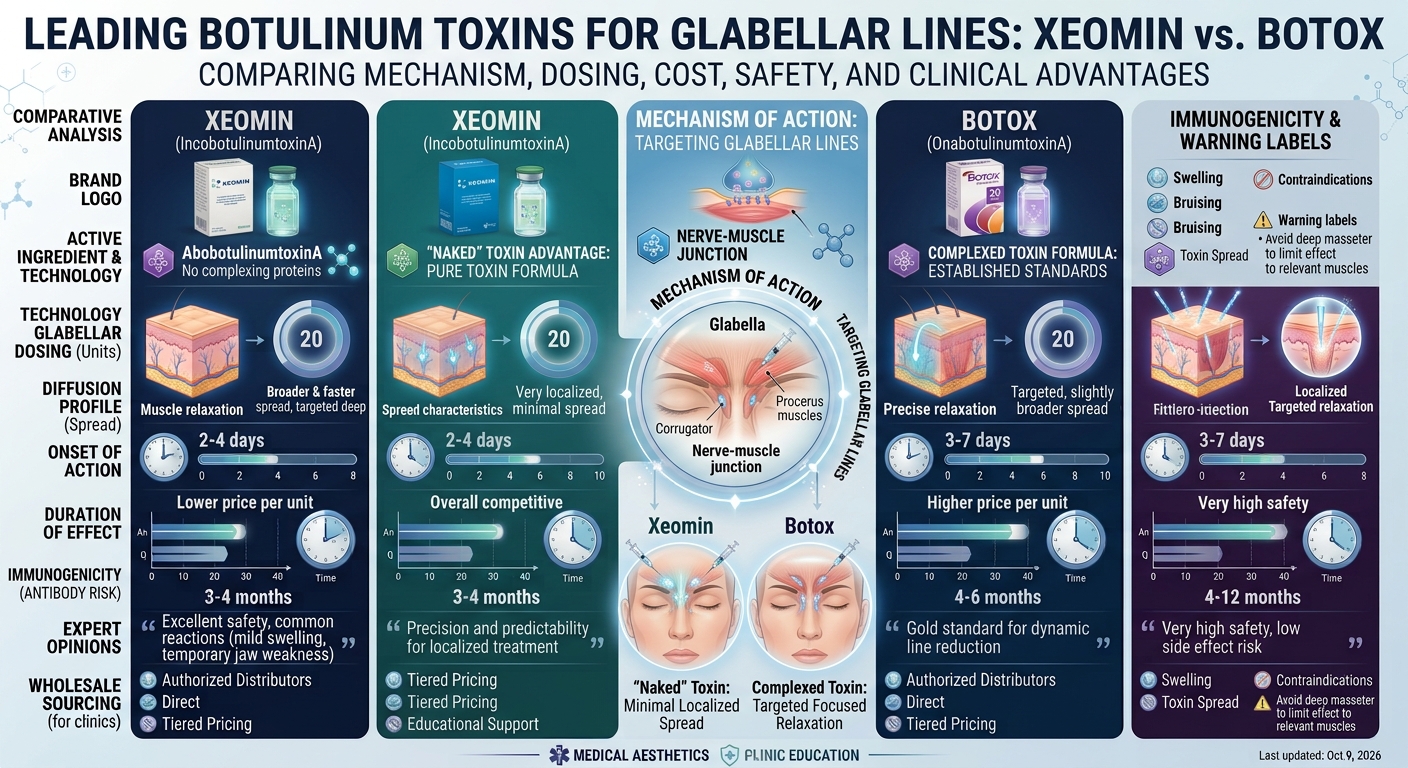

Glabellar lines, commonly known as “frown lines” or “elevens,” are the vertical creases that form between the eyebrows. Caused by the repetitive, forceful contraction of the corrugator supercilii and procerus muscles, these dynamic wrinkles can make a patient appear perpetually angry, stressed, or fatigued.
Botulinum toxin type A is the gold-standard treatment for glabellar lines. However, when selecting a product, practitioners and patients often face a common question: Is Botox (onabotulinumtoxinA) or Xeomin (incobotulinumtoxinA) the better choice for frown lines?
While both are highly effective, FDA-approved neurotoxins with similar clinical outcomes, they differ fundamentally in their formulation—specifically, the presence or absence of accessory complexing proteins. This guide provides a comprehensive, evidence-based comparison of Botox and Xeomin specifically for glabellar line treatment, covering efficacy, immunogenicity, dosing, and real-world clinical feedback.
⚠️ IMPORTANT MEDICAL DISCLAIMER
Botulinum toxin injections are prescription medicines that must be handled, prescribed, and administered only by appropriately qualified healthcare professionals. Treatment of the glabellar complex carries risks, including brow ptosis and vascular complications. This article is for educational purposes and does not replace official product labeling or clinical training.
📑 Table of Contents
- Quick Comparison
- The Clinical Challenge: The Glabellar Complex
- Botox for Frown Lines: Profile & Efficacy
- Xeomin for Frown Lines: Profile & Efficacy
- Dosing, Conversion, and Treatment Protocols
- The Immunogenicity Debate: Complexing Proteins
- Safety Considerations and Risk Management
- Wholesale Sourcing and Supply Chain Verification
- Frequently Asked Questions (FAQ)
- Conclusion
1. Quick Comparison
The following table highlights the key clinical differences between Botox and Xeomin when used for glabellar line reduction.
| Feature | Botox (OnabotulinumtoxinA) | Xeomin (IncobotulinumtoxinA) |
|---|---|---|
| Active Neurotoxin | 900 kDa core protein | 900 kDa core protein |
| Complexing Proteins | Yes (Accessory proteins present) | No (“Naked” neurotoxin) |
| Diffusion Profile | Precise, targeted, predictable | Precise, targeted, predictable |
| FDA-Approved Glabellar Dose | 20 Units (5 injection points) | 20 Units (5 injection points) |
| Onset of Action | 3–5 days (peak at 10-14 days) | 3–5 days (peak at 10-14 days) |
| Duration of Effect | 3–4 months | 3–4 months |
| Storage (Unreconstituted) | Refrigerated (2–8°C) | Room temperature (up to 25°C) |
↔ Scroll horizontally to view the full table
2. The Clinical Challenge: The Glabellar Complex
The glabellar region is anatomically complex, consisting of the corrugator supercilii (which pulls the eyebrows medially and downward) and the procerus (which pulls the medial eyebrows downward). Treating this area requires:
- Precise Diffusion: The toxin must relax the target muscles without migrating superiorly into the frontalis (causing brow ptosis) or laterally into the levator palpebrae superioris (causing eyelid ptosis).
- Adequate Potency: The corrugator muscles are thick and strong, requiring sufficient units to achieve complete dynamic relaxation.
- Consistency: Patients expect symmetrical, predictable results that soften the “angry” appearance while preserving natural facial expression.
Both Botox and Xeomin excel in this area, but their formulation differences offer distinct advantages depending on the patient’s treatment history.
3. Botox for Frown Lines: Profile & Efficacy
Clinical Consensus Metrics:
📜 Track Record & Data: ⭐⭐⭐⭐⭐
🎯 Precision: ⭐⭐⭐⭐⭐
💰 Cost-Effectiveness: ⭐⭐⭐
✅ Key Advantages
- The Gold Standard: Botox has the most extensive, long-term clinical data supporting its safety and efficacy for glabellar lines.
- Predictable Diffusion: Its formulation provides highly localized, controlled relaxation, minimizing the risk of affecting adjacent muscles.
- Proven Track Record: Decades of real-world use have established highly reliable dosing protocols and complication management strategies.
⚠️ Important Considerations
- Premium Pricing: Botox is typically the most expensive neurotoxin on the market.
- Complexing Proteins: Contains accessory proteins, which, while generally safe, carry a theoretical (though extremely rare) risk of neutralizing antibody formation in long-term, high-frequency users.
- Storage: Requires strict refrigeration (2–8°C) prior to reconstitution.
👨⚕️ Expert Practitioner Opinion
“For first-time patients or those seeking the most predictable, time-tested results for frown lines, Botox remains my default choice. Its precise diffusion profile gives me complete confidence in avoiding brow ptosis while effectively softening the glabellar complex.” — Dr. Jean Carruthers, Pioneer in Cosmetic Botulinum Toxin.
4. Xeomin for Frown Lines: Profile & Efficacy
Clinical Consensus Metrics:
📜 Track Record & Data: ⭐⭐⭐⭐⭐
🛡️ Purity (Low Immunogenicity): ⭐⭐⭐⭐⭐
💰 Cost-Effectiveness: ⭐⭐⭐⭐
✅ Key Advantages
- The “Naked” Neurotoxin: Xeomin is purified to remove all accessory complexing proteins, leaving only the active 900 kDa core neurotoxin.
- Lower Immunogenicity Risk: The absence of complexing proteins theoretically reduces the risk of neutralizing antibody formation, making it an excellent choice for long-term, high-frequency patients who may have developed resistance to other brands.
- Room Temperature Storage: Unlike Botox, unreconstituted Xeomin can be stored at room temperature (up to 25°C), simplifying clinic logistics and reducing the risk of potency loss during transport.
- Equal Efficacy: Head-to-head clinical trials show Xeomin is non-inferior to Botox in both efficacy and duration for glabellar lines.
⚠️ Important Considerations
- Brand Recognition: While growing rapidly, it still has slightly less name recognition among laypatients compared to Botox.
- Anecdotal Onset: A small subset of practitioners report a marginally slower onset (by 1-2 days) compared to Botox, though clinical trials show comparable peak effect times.
👨⚕️ Expert Practitioner Opinion
“Xeomin is my go-to for patients who have been getting Botox for 10+ years and feel like it’s ‘not working as well or as long.’ The lack of complexing proteins makes it the ideal choice for preventing immunogenic resistance, and its room-temperature storage is a massive logistical advantage for our clinic.” — Dr. Sabrina Fabi, Board-Certified Dermatologist.
5. Dosing, Conversion, and Treatment Protocols
Unlike Dysport, which requires a conversion ratio, Botox and Xeomin are generally considered to have a 1:1 unit-to-unit equivalence for glabellar line treatment.
| Product | FDA-Approved Glabellar Dose | Injection Points | Typical Duration |
|---|---|---|---|
| Botox | 20 Units total | 5 points (4 corrugator, 1 procerus) | 3–4 months |
| Xeomin | 20 Units total | 5 points (4 corrugator, 1 procerus) | 3–4 months |
↔ Scroll horizontally to view the full table
Note: Male patients or those with severe glabellar hypertrophy often require higher, off-label doses (e.g., 30–40 Units). Always customize dosing based on muscle mass and patient response.
6. The Immunogenicity Debate: Complexing Proteins
The primary differentiator between Botox and Xeomin is the presence of accessory complexing proteins. In Botox, the 900 kDa core neurotoxin is bound to these proteins, which historically were thought to protect the toxin from stomach acid (relevant for therapeutic oral uses, not cosmetic injections).
In cosmetic practice, the concern is that the immune system might recognize these foreign proteins and develop neutralizing antibodies (NAbs). If NAbs form, the body destroys the toxin before it can work, leading to “secondary non-response” (the treatment stops working).
- Clinical Reality: The rate of NAb formation in cosmetic dosing is extremely low (estimated at <1%) for both products due to the low total protein dose administered.
- The Xeomin Advantage: By removing these proteins entirely, Xeomin theoretically eliminates this specific trigger for antibody formation, making it the preferred “rescue” product for patients who have experienced diminished results with Botox over many years.
7. Safety Considerations and Risk Management
⚠️ CRITICAL SAFETY WARNING
Improper injection technique in the glabellar complex can lead to significant aesthetic complications. Practitioners must have a thorough understanding of the depth and vector of the corrugator and procerus muscles.
Key Risks to Mitigate:
- Brow Ptosis: Caused by the toxin diffusing superiorly into the frontalis muscle, removing its compensatory lifting action. Mitigation: Stay at least 1–1.5 cm above the bony orbital rim and inject deeply into the muscle belly.
- Eyelid Ptosis: Caused by lateral diffusion into the levator palpebrae superioris. Mitigation: Avoid injecting too laterally in the corrugator; apply digital pressure post-injection if desired (though evidence is mixed).
- Spock Brow: Caused by over-relaxing the medial frontalis while leaving the lateral frontalis active. Mitigation: Assess the entire forehead dynamic before treating the glabella in isolation.
- Contraindications: Pregnancy, breastfeeding, neuromuscular disorders (e.g., myasthenia gravis), and active infection at the injection site.
8. Wholesale Sourcing and Supply Chain Verification
The botulinum toxin market is a prime target for counterfeit, diverted, or improperly stored products. Using compromised neurotoxins not only yields poor clinical results (e.g., lack of efficacy, increased side effects) but poses severe safety risks to patients.
For medical spas, dermatology clinics, and authorized distributors, verifying the supply chain is a matter of legal compliance and patient safety. Before purchasing, verify the following:
- Regulatory Approval: Ensure the product has valid regulatory authorization (FDA, EMA, MHRA, or local equivalent).
- Authorized Wholesale Distributors: Purchase only directly from the manufacturer or their explicitly authorized national wholesale distributors. For verified, medical-grade supplies, licensed clinics and authorized distributors can source premium, authentic products at:
- Authentication Features: Check for holographic seals, unique batch numbers, and scratch-off verification labels on all vials and boxes.
- Cold Chain Integrity: Verify that the wholesale supplier maintains proper refrigeration (2–8°C) during transit for Botox, as heat degradation can render the toxin permanently inactive. (Note: Xeomin offers more flexibility with room-temperature storage for unreconstituted vials, but proper handling is still mandatory).
Never purchase botulinum toxins from unauthorized online marketplaces, social media sellers, or unverified third-party wholesalers.
9. Frequently Asked Questions (FAQ)
❓ Is Xeomin as effective as Botox for frown lines?
Yes. Multiple head-to-head, double-blind clinical trials have demonstrated that Xeomin is non-inferior to Botox in both efficacy and duration for the treatment of moderate to severe glabellar lines.
❓ Can I switch from Botox to Xeomin if I feel Botox is “wearing off” faster?
Yes, this is a very common and clinically sound strategy. If a patient has developed a mild immune response to the complexing proteins in Botox over years of use, switching to the “naked” Xeomin formulation often restores the expected duration and efficacy of the treatment.
❓ Is the dosing the same for both?
Yes, for the glabellar complex, the dosing is generally considered 1:1. If a patient requires 20 Units of Botox, they will typically require 20 Units of Xeomin for the same result.
❓ Which one hurts less?
Both products are reconstituted with preserved or unpreserved saline and do not contain lidocaine (unlike some dermal fillers). The discomfort is related to the needle prick, not the product itself. Both are highly tolerable, especially with the application of topical numbing cream or ice.
❓ Is it safe to buy Botox or Xeomin wholesale online?
Only if purchased from a verified, authorized wholesale distributor that requires proof of medical licensure. Reputable suppliers ensure cold-chain integrity, authentic packaging, and regulatory compliance. Always verify the supplier’s credentials before purchasing.
10. Conclusion: Which Is Better for Frown Lines?
There is no definitive “better” product; rather, there is a better product for a specific patient profile.
- Choose Botox if you are a first-time patient, value the most extensive long-term clinical data, and prefer the industry gold standard with highly predictable, precise diffusion.
- Choose Xeomin if you are a long-term neurotoxin user who suspects diminishing returns (potential immunogenicity), if you prefer a product with zero complexing proteins, or if your clinic values the logistical simplicity of room-temperature storage for unreconstituted vials.
Ultimately, the success of glabellar line treatment relies far more on the injector’s anatomical expertise, precise dosing, and proper injection depth than on the brand name. For healthcare professionals, sourcing authentic products from verified wholesale channels is the foundational step in ensuring patient safety and optimal clinical outcomes.
📚 Official Sources and Further Reading
- FDA Drugs@FDA Database – Official U.S. prescribing information for Botox and Xeomin.
- PubMed – Xeomin vs. Botox Clinical Trials – Peer-reviewed, head-to-head studies comparing efficacy, immunogenicity, and duration in glabellar lines.
- PubMed – Immunogenicity of Botulinum Toxins – Clinical research on the role of complexing proteins in antibody formation.
- EUDAMED – European medical device and pharmaceutical regulatory verification.
Editorial note: Medical regulations, product formulations, and clinical guidelines can change. Review the latest official documentation and local regulatory updates before publication or clinical application.