
No products added!
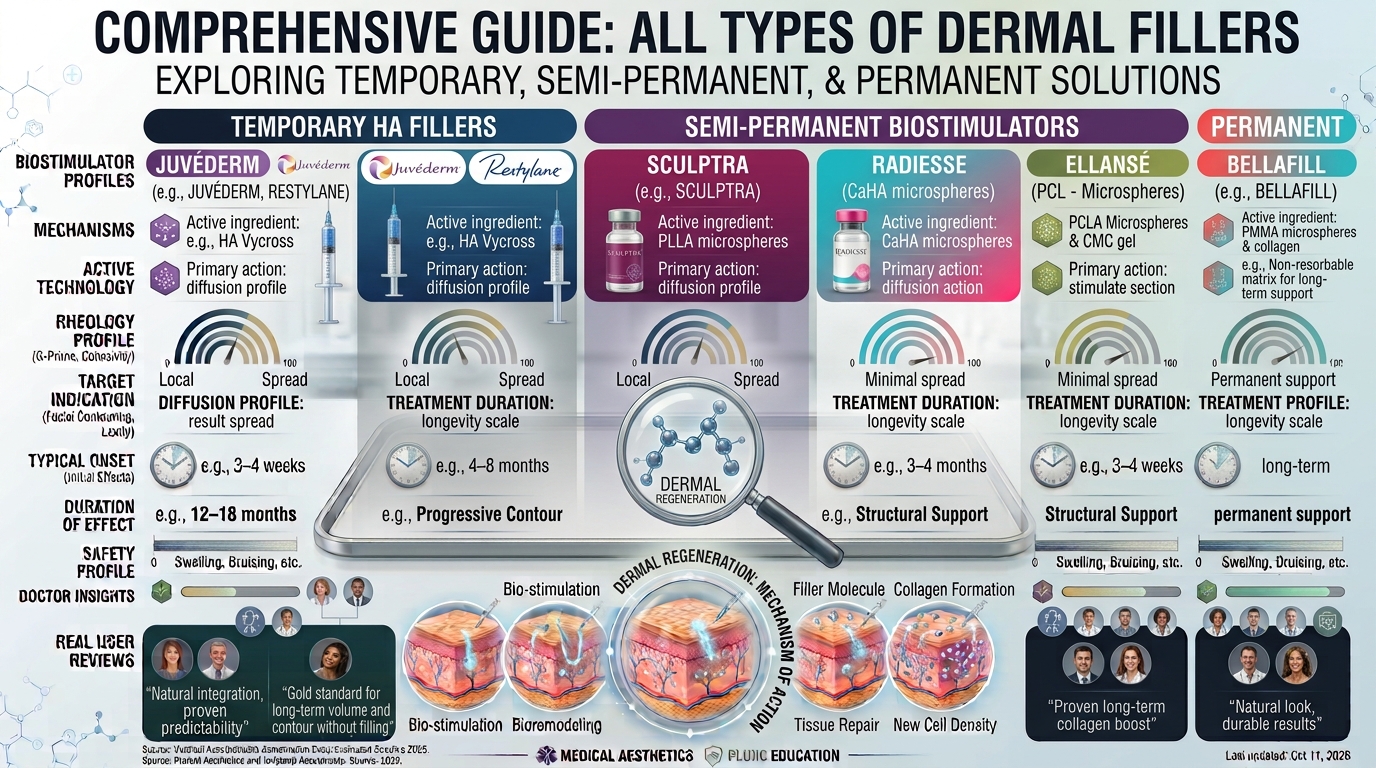

The world of dermal fillers has evolved dramatically over the past three decades. What began with simple collagen injections has expanded into a sophisticated landscape of temporary hyaluronic acid gels, long-lasting biostimulators, and controversial permanent implants. For aesthetic practitioners and clinic owners, understanding the fundamental differences between these categories is essential for patient safety, expectation management, and ethical practice.
This comprehensive clinical guide categorizes every major type of dermal filler available today, compares the leading brands within each category, and provides evidence-based recommendations for treatment planning.
⚠️ IMPORTANT MEDICAL & B2B DISCLAIMER
Dermal fillers are medical devices or prescription medicines intended for use only by licensed healthcare professionals. This article is for educational and B2B informational purposes. As a trusted B2B wholesale supplier, we provide these products exclusively to verified, licensed clinics and practitioners. This content does not replace official product labeling, clinical training, or professional medical judgment.
📑 Table of Contents
- The Three Main Categories of Dermal Fillers
- Category 1: Temporary / Non-Permanent Fillers (HA-Based)
- Category 2: Semi-Permanent Biostimulators (1–5 Years)
- Category 3: Permanent Fillers (5+ Years / Lifelong)
- Comprehensive Comparison Matrix
- Clinical Decision Guide: Which Type to Choose?
- Safety Considerations by Category
- Trusted B2B Sourcing & Supply Chain Verification
- Frequently Asked Questions (FAQ)
- Conclusion
1. The Three Main Categories of Dermal Fillers
Before exploring specific brands, practitioners must understand the fundamental classification system used in aesthetic medicine:
| Category | Duration | Mechanism | Reversible? | Clinical Status |
|---|---|---|---|---|
| Temporary / Non-Permanent | 6–24 months | Physical volumization (HA gel) | Yes (Hyaluronidase) | Gold standard, first-line |
| Semi-Permanent / Biostimulators | 1–5 years | Neocollagenesis (collagen stimulation) | No | Widely accepted, growing |
| Permanent | 5+ years / lifelong | Non-biodegradable scaffold | No | Controversial, limited use |
↔ Scroll horizontally to view the full table
2. Category 1: Temporary / Non-Permanent Fillers (HA-Based)
Hyaluronic acid (HA) fillers represent approximately 80% of the global dermal filler market. They are the undisputed first-line treatment due to their safety profile, reversibility, and predictable outcomes.
Why HA Fillers Dominate:
- Biocompatibility: HA is a naturally occurring substance in human skin.
- Reversibility: Can be dissolved with hyaluronidase in case of complications or patient dissatisfaction.
- Versatility: Available in various G-prime levels for different anatomical zones (lips, cheeks, tear troughs, jawline).
- Safety Profile: Decades of clinical data with low complication rates when administered properly.
Leading HA Filler Brands by Sub-Category:
| Brand Family | Manufacturer | Key Technology | Popular Variants | Longevity |
|---|---|---|---|---|
| Juvéderm | Allergan / AbbVie (USA) | Vycross® / Hylacross® | Voluma, Volux, Volbella, Ultra | 12–24 months |
| Restylane | Galderma (Sweden) | NASHA™ / OBT™ | Lyft, Defyne, Refyne, Kysse, Silk | 9–18 months |
| Teosyal | Teoxane (Switzerland) | RHA (Resilient HA) | RHA 1-4, Ultra Deep, Redensity | 9–18 months |
| Belotero | Merz (Germany) | CPM® Technology | Balance, Soft, Intense, Revive | 6–12 months |
| Revolax | Across Co. (South Korea) | High cross-linking, monophasic | Deep, Sub-Q, Fine | 12–18 months |
| Neuramis | Medytox (South Korea) | SHAPE™ Technology | Volume, Deep, Light | 9–15 months |
↔ Scroll horizontally to view the full table
Detailed Brand Profiles:
🏆 Juvéderm Family (Allergan / AbbVie)
Clinical Consensus: 📜 ⭐⭐⭐⭐⭐ | 💡 ⭐⭐⭐⭐⭐ | 💰 ⭐⭐⭐
Best For: Comprehensive facial treatment with product-specific variants for every zone. Voluma (cheeks), Volux (jawline), Volbella (lips/tear troughs), Ultra (versatile).
Expert Insight: “Juvéderm’s Vycross technology provides the most predictable, long-lasting HA results in my practice. The low hydrophilicity means minimal swelling, which patients love.” — Dr. Mauricio de Maio, Brazil.
🏆 Restylane Family (Galderma)
Clinical Consensus: 📜 ⭐⭐⭐⭐⭐ | 💡 ⭐⭐⭐⭐⭐ | 💰 ⭐⭐⭐⭐
Best For: Patients seeking natural movement and flexibility. Defyne/Refyne for dynamic areas, Kysse for lips, Lyft for structural lifting.
Expert Insight: “Restylane’s OBT technology creates fillers that move with the face. For patients who smile a lot or talk extensively for work, Defyne is unmatched.” — Dr. Tim Pearce, UK.
💎 Korean HA Fillers (Revolax, Neuramis)
Clinical Consensus: 📜 ⭐⭐⭐ | 💡 ⭐⭐⭐⭐ | 💰 ⭐⭐⭐⭐⭐
Best For: Cost-effective treatments without sacrificing quality. Excellent for high-volume clinics or price-sensitive markets.
Community Feedback: “Revolax Sub-Q gives me Voluma-like results at half the cost. My patients can’t tell the difference, and my margins are much healthier.” — Aesthetic Clinic Owner, Reddit.
3. Category 2: Semi-Permanent Biostimulators (1–5 Years)
Biostimulators represent the cutting edge of regenerative aesthetics. Rather than simply filling space, these products stimulate the body’s own collagen production, providing gradual, natural-looking results that can last significantly longer than HA fillers.
The Four Main Biostimulator Categories:
| Type | Active Ingredient | Leading Brands | Duration | Key Benefit |
|---|---|---|---|---|
| PLLA | Poly-L-Lactic Acid | Sculptra, AestheFill | 24+ months | Global volume restoration |
| CaHA | Calcium Hydroxylapatite | Radiesse | 12–18 months | Immediate lift + collagen |
| PCL | Polycaprolactone | Ellansé, Gouri | 1–4 years | Customizable longevity |
| PN/PDRN | Polynucleotides | Rejuran, Plinest, Nucleofill | 6–12 months | Cellular regeneration |
↔ Scroll horizontally to view the full table
Detailed Brand Profiles:
🏆 Sculptra (Galderma) – PLLA
Clinical Consensus: 📜 ⭐⭐⭐⭐⭐ | 💡 ⭐⭐⭐⭐ | 💰 ⭐⭐⭐⭐⭐
Best For: Global facial volume loss, temple hollowing, and patients seeking long-term “collagen banking.”
Expert Insight: “Sculptra is not a filler; it’s a collagen stimulator. For patients with diffuse volume loss, it provides a natural rebuild that HA fillers cannot match long-term.” — Dr. Sabrina Fabi, USA.
Community Feedback: “The 5-5-5 massage rule is annoying, but worth it. At month 4, my hollow temples were completely filled with my own collagen.” — RealSelf Review.
🏆 Radiesse (Merz) – CaHA
Clinical Consensus: 📜 ⭐⭐⭐⭐⭐ | 💡 ⭐⭐⭐⭐ | 💰 ⭐⭐⭐⭐
Best For: Jawline contouring, chin projection, hand rejuvenation, and hyper-diluted skin tightening.
Expert Insight: “Radiesse provides immediate structural lift plus long-term collagen stimulation. It’s the dual-action workhorse of my practice.” — Dr. Rebecca Fitzgerald, USA.
🏆 Ellansé (Sinclair) – PCL
Clinical Consensus: 📜 ⭐⭐⭐⭐ | 💡 ⭐⭐⭐⭐⭐ | 💰 ⭐⭐⭐⭐⭐
Best For: Patients seeking customizable longevity (1, 2, 3, or 4 years) for cheeks, jawline, and chin.
Community Feedback: “I chose Ellansé-L for my jawline. Three years later, the results are still excellent, and I haven’t needed a touch-up.” — Reddit User.
🏆 Rejuran / Plinest / Nucleofill – PN/PDRN
Clinical Consensus: 📜 ⭐⭐⭐⭐ | 💡 ⭐⭐⭐⭐⭐ | 💰 ⭐⭐⭐⭐
Best For: Thin, crepey skin (especially under-eyes), scalp rejuvenation, acne scarring, and sensitive skin.
Expert Insight: “Polynucleotides repair the cellular environment without adding volume. For the under-eye area, they’re unmatched.” — Dr. Uliana Gout, UK.
4. Category 3: Permanent Fillers (5+ Years / Lifelong)
⚠️ CRITICAL WARNING: PERMANENT FILLERS
Permanent fillers are highly controversial in modern aesthetic medicine. While they offer lifelong results, they carry significant risks including late-onset granulomas, migration, and the inability to reverse complications. Most aesthetic societies recommend against their routine use. They should only be considered by highly experienced practitioners for specific indications (e.g., deep acne scars) after thorough patient counseling.
Types of Permanent Fillers:
| Type | Brand Examples | FDA Status | Clinical Acceptance | Key Risks |
|---|---|---|---|---|
| PMMA | Bellafill | FDA-approved (limited indications) | Accepted for deep acne scars, nasolabial folds | Granulomas, requires skin testing |
| Liquid Silicone | Various (historical) | Not FDA-approved for cosmetic injection | Largely abandoned | Migration, granulomas, embolism |
| Polyacrylamide | Aquamid | Not FDA-approved | Controversial, limited use | Late infection, migration |
| ePTFE | Gore-Tex (surgical implant) | FDA-approved (surgical) | Surgical augmentation only | Infection, extrusion |
↔ Scroll horizontally to view the full table
Bellafill: The Only FDA-Approved Permanent Filler
🏆 Bellafill (Suneva Medical) – PMMA
Clinical Consensus: 📜 ⭐⭐⭐⭐⭐ | ⚠️ Risk Profile: ⭐⭐ (Requires strict protocol)
Composition: 20% PMMA microspheres + 80% bovine collagen carrier.
Best For: Deep, tethered acne scars and nasolabial folds in carefully selected patients.
Critical Requirements:
- Mandatory skin testing (two negative tests, one month apart) due to bovine collagen allergy risk.
- Deep dermal or subcutaneous placement only; superficial injection guarantees visible nodules.
- Non-reversible; complications require surgical excision or steroid injections.
Expert Insight: “Bellafill is a game-changer for the right patient with deep acne scars. The 5-year durability data is unmatched. However, it demands absolute respect and meticulous technique.” — Dr. Doris Day, USA.
Community Feedback: “It’s the only thing that finally worked for my deep rolling scars after years of failed laser treatments.” — RealSelf Review.
5. Comprehensive Comparison Matrix
| Feature | HA Fillers (Temporary) | Biostimulators (Semi-Permanent) | Permanent Fillers |
|---|---|---|---|
| Duration | 6–24 months | 1–5 years | 5+ years / lifelong |
| Reversibility | Yes (Hyaluronidase) | No | No |
| Onset of Results | Immediate | Gradual (6–12 weeks) | Immediate (carrier) + gradual |
| Safety Profile | Excellent (decades of data) | Very good (requires expertise) | Controversial (higher complication risk) |
| Cost Over Time | Higher (frequent maintenance) | Moderate (less frequent touch-ups) | Lower (one-time treatment) |
| Clinical Recommendation | First-line for most indications | Excellent for long-term rejuvenation | Limited, specific indications only |
↔ Scroll horizontally to view the full table
6. Clinical Decision Guide: Which Type to Choose?
Choose Temporary HA Fillers If:
- The patient is new to injectables and wants to “test the waters.”
- Reversibility is a priority (safety net for complications or dissatisfaction).
- The treatment area requires precise, adjustable results (lips, tear troughs).
- The patient prefers flexibility to change their look over time.
Choose Semi-Permanent Biostimulators If:
- The patient seeks long-term results without frequent maintenance visits.
- The goal is natural collagen remodeling rather than artificial volume.
- The patient has global volume loss or skin thinning (Sculptra, Ellansé).
- The patient wants immediate lift plus long-term collagen benefits (Radiesse).
- The treatment area is the under-eyes, scalp, or compromised skin (PN/PDRN).
Choose Permanent Fillers (Rarely) If:
- The patient has deep, tethered acne scars unresponsive to other treatments (Bellafill).
- The patient has passed mandatory skin testing (for Bellafill).
- The patient fully understands the risks and irreversibility.
- The injector is highly experienced with permanent filler complications.
7. Safety Considerations by Category
Temporary HA Fillers:
- Lowest Risk Profile: Reversible with hyaluronidase, decades of safety data.
- Common Side Effects: Mild swelling, bruising, redness (resolve in 24–72 hours).
- Rare Complications: Vascular occlusion (requires immediate hyaluronidase), Tyndall effect (bluish discoloration if placed superficially).
Semi-Permanent Biostimulators:
- Moderate Risk Profile: Non-reversible, but excellent safety when used correctly.
- Common Side Effects: Swelling, papules (PN), delayed onset frustration (Sculptra).
- Rare Complications: Nodule formation (if improperly diluted or placed superficially), granulomas.
- Critical: Requires advanced anatomical knowledge and strict adherence to protocols (e.g., Sculptra’s 5-5-5 massage rule).
Permanent Fillers:
- Highest Risk Profile: Non-reversible, lifelong presence, higher complication rates.
- Common Side Effects: Initial swelling, bruising.
- Serious Complications: Late-onset granulomas (can occur years later), migration, chronic inflammation, infection.
- Critical: Should only be used by highly experienced practitioners for specific indications. Thorough patient counseling is mandatory.
8. Trusted B2B Sourcing & Supply Chain Verification
The dermal filler market is heavily targeted by counterfeiters. Using fake or improperly stored products can lead to severe complications, including granulomas, necrosis, and permanent disfigurement.
As a dedicated B2B wholesale supplier, we specialize in equipping licensed aesthetic clinics, medspas, and hospitals with 100% authentic, temperature-controlled, and legally compliant dermal fillers. We bypass unauthorized gray markets to ensure your clinic’s safety, regulatory compliance, and reputation.
We proudly supply verified, wholesale stock across all three filler categories to qualified professionals:
- 🔹 Aesthetic Supply Store: Complete Dermal Fillers Catalog (Wholesale)
Browse our comprehensive inventory spanning temporary HA fillers (Juvéderm, Restylane, Teosyal, Belotero, Revolax, Neuramis), semi-permanent biostimulators (Sculptra, Radiesse, Ellansé, Rejuran, Plinest, Nucleofill), and select permanent options. All products are sourced through authorized distribution channels with full batch traceability.
Our B2B Guarantee: All orders require valid medical licensure verification. We provide full documentation, including Certificates of Analysis (CoA), batch numbers, and climate-controlled shipping to guarantee product authenticity and efficacy upon arrival at your clinic.
9. Frequently Asked Questions (FAQ)
❓ Which type of filler is safest?
Temporary HA fillers have the safest profile due to their reversibility and decades of clinical data. Semi-permanent biostimulators are also very safe when used by experienced practitioners. Permanent fillers carry the highest risk and should be used sparingly.
❓ Can I switch from a permanent filler to a temporary one?
Yes, but it requires careful planning. A skilled injector will assess the remaining permanent filler and tissue response before layering a temporary HA filler on top. It is generally recommended to wait until the permanent filler has significantly settled (if possible) before introducing new products.
❓ Why are permanent fillers controversial?
Permanent fillers cannot be removed if complications arise. Late-onset granulomas can occur years after injection, and migration can distort facial features over time. Most aesthetic societies recommend reversible, temporary options as the standard of care.
❓ Which filler lasts the longest?
Bellafill (PMMA) is the only FDA-approved permanent filler, lasting 5+ years. Among semi-permanent options, Ellansé offers up to 4 years of results depending on the variant. Sculptra consistently lasts 24+ months.
❓ Are biostimulators better than HA fillers?
Neither is universally “better”; they serve different purposes. HA fillers provide immediate, adjustable volume and are ideal for first-time patients. Biostimulators offer long-term collagen remodeling and are excellent for patients seeking natural, gradual rejuvenation. Many practitioners combine both for comprehensive results.
❓ Is it safe to buy dermal fillers wholesale online?
Only if purchased from a verified, authorized wholesale distributor that requires proof of medical licensure. Reputable suppliers ensure authentic packaging, regulatory compliance, and proper cold-chain logistics. Always verify the supplier’s credentials before purchasing.
❓ Can I use different types of fillers in the same patient?
Yes, and it’s often recommended. For example, a practitioner might use Sculptra for global midface volume, Juvéderm Volux for jawline definition, and Rejuran for under-eye skin quality. However, different fillers should never be mixed in the same syringe.
10. Conclusion: Choosing the Right Filler Type
The dermal filler landscape offers three distinct categories, each with unique advantages and considerations:
- Temporary HA Fillers: The gold standard for safety, reversibility, and versatility. Ideal for most patients and treatment areas.
- Semi-Permanent Biostimulators: The future of regenerative aesthetics, offering long-term collagen remodeling and natural results.
- Permanent Fillers: Highly controversial, limited to specific indications, and requiring exceptional practitioner expertise.
For practitioners, mastering the distinct properties of each filler type allows for highly customized, safe, and satisfying patient outcomes. For clinic owners, stocking authentic, high-demand products from a reliable B2B wholesale partner is the foundation of patient safety and practice success.
The key to success lies not in choosing the “best” filler type universally, but in selecting the right filler type for the right patient, the right indication, and the right practitioner.
📚 Official Sources and Further Reading
- FDA Drugs@FDA Database – Official U.S. prescribing information for all filler categories.
- PubMed – Dermal Filler Classification Review – Peer-reviewed systematic reviews comparing temporary, semi-permanent, and permanent fillers.
- PubMed – Permanent Filler Complications – Clinical research on the risks and management of permanent filler adverse events.
- EUDAMED – European medical device regulatory verification database.
Editorial note: Medical regulations, product formulations, and clinical guidelines can change. Review the latest official documentation and local regulatory updates before publication or clinical application. As a B2B supplier, we advise all clients to adhere strictly to their local medical board regulations regarding the purchase and use of these products.