No products added!
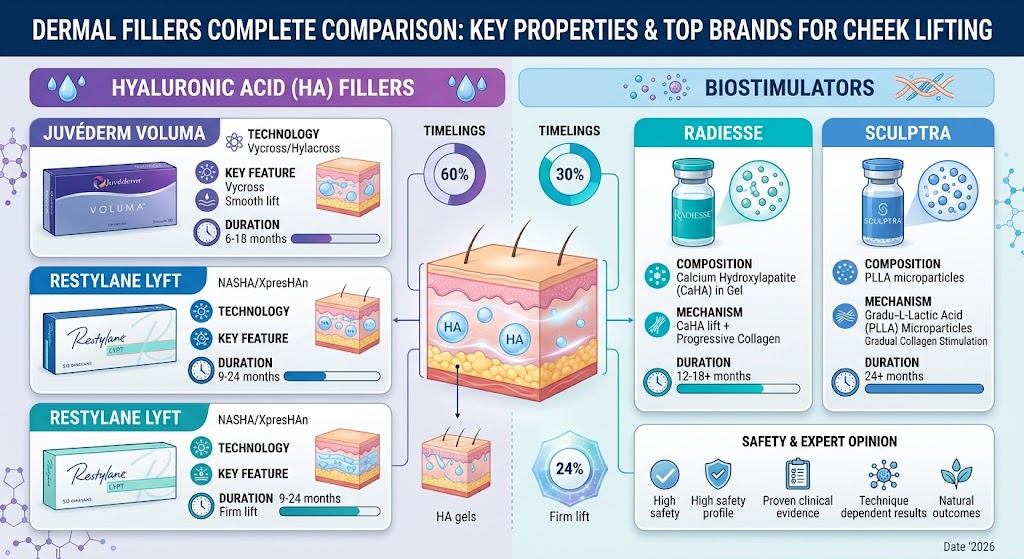

Cheek fillers represent one of the most technically demanding and rewarding areas of aesthetic medicine. Unlike lip fillers that require soft, flexible formulations, cheek fillers must provide structural support, lifting capacity, and the ability to recreate the appearance of youthful bone structure. This requires specific rheological properties — typically a high G-prime (firmness) with excellent cohesivity and lifting capacity.
The ideal cheek filler must be injected deep (supraperiosteal or submuscular) to provide structural support, resist the forces of facial movement and gravity, and maintain its position without migrating. The result should be a natural-looking restoration of youthful cheek volume and projection, not an obvious “filled” appearance.
The market offers numerous hyaluronic acid fillers and biostimulators that can be used for cheek augmentation, but only certain products are specifically formulated and optimized for the unique requirements of midface structural volumizing. Understanding these distinctions is essential for achieving natural-looking, long-lasting results.
This guide compares eight of the most widely used and clinically validated cheek filler brands: Juvéderm Voluma, Restylane Lyft, Radiesse, Ellansé, Sculptra, Teosyal Ultra Deep, Revolax Sub-Q, and Neuramis Volume. It focuses on formulation, clinical evidence, longevity, lifting capacity, safety profiles, regulatory considerations, and real-world feedback from both practitioners and patients.
⚠️ IMPORTANT MEDICAL DISCLAIMER
Cheek fillers are medical devices (or prescription medicines, depending on the jurisdiction) that must be handled, prescribed, and administered only by appropriately qualified healthcare professionals. Cheek augmentation requires advanced anatomical knowledge and specific injection techniques. This article is for educational purposes and does not replace official product labeling or clinical training.
📑 Table of Contents
- Quick Comparison
- What Makes a Good Cheek Filler? (vs. Other Fillers)
- How to Compare Cheek Filler Brands
- Leading Brands: Individual Profiles
- Longevity and Treatment Protocols
- Safety Considerations and Risk Management
- Regulatory Status and Supply Chain Verification
- Frequently Asked Questions (FAQ)
- Conclusion
1. Quick Comparison
The following table provides a high-level overview of the leading cheek filler brands. Always confirm the specific product variant and its local regulatory authorization for cheek augmentation.
| Brand | Active Ingredient | Key Technology | Primary Benefit for Cheeks | Origin |
|---|---|---|---|---|
| Juvéderm Voluma | Hyaluronic Acid | Vycross® (high G-prime) | Maximum lifting capacity, structural support | 🇺🇸 USA / 🇫🇷 France |
| Restylane Lyft | Hyaluronic Acid | NASHA™ (high G-prime) | Excellent lifting, midface volumizing | 🇸🇪 Sweden / 🇨🇭 Switzerland |
| Radiesse | Calcium Hydroxylapatite | CaHA microspheres in gel | Immediate volume + collagen stimulation | 🇩🇪 Germany / 🇺🇸 USA |
| Ellansé | Polycaprolactone | PCL microspheres in CMC gel | Long-term volume (1-4 years) | 🇳🇱 Netherlands |
| Sculptra | Poly-L-Lactic Acid | PLLA microparticles | Gradual collagen stimulation, global volume | 🇫🇷 France / 🇨🇭 Switzerland |
| Teosyal Ultra Deep | Hyaluronic Acid | High G-prime, cohesive gel | Deep structural volumizing | 🇨🇭 Switzerland |
| Revolax Sub-Q | Hyaluronic Acid | High cross-linking, monophasic | High volume, cost-effective | 🇰🇷 South Korea |
| Neuramis Volume | Hyaluronic Acid | SHAPE™ Technology | Good lifting, affordable | 🇰🇷 South Korea |
↔ Scroll horizontally to view the full table
2. What Makes a Good Cheek Filler? (vs. Other Fillers)
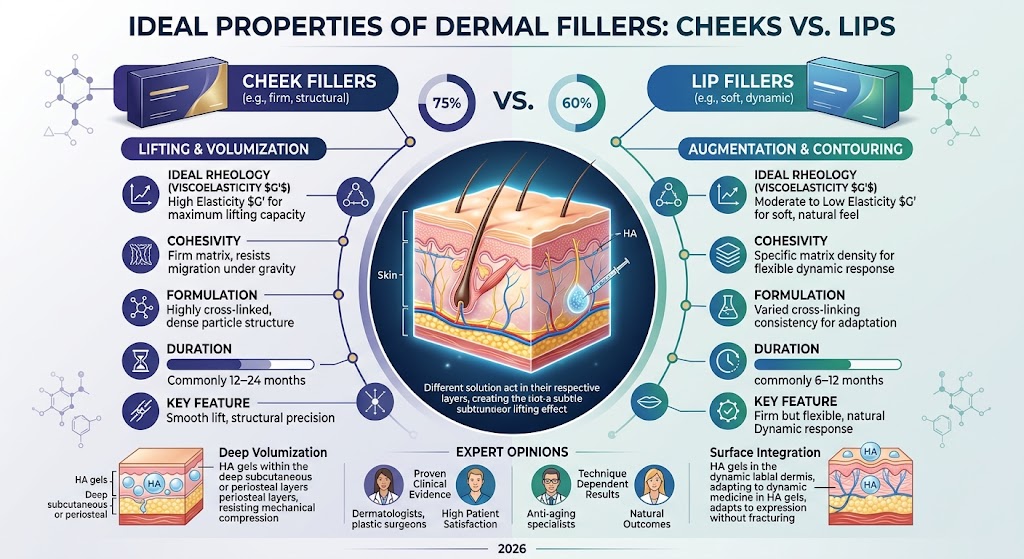
Not all hyaluronic acid fillers are suitable for cheek augmentation. The cheeks have unique anatomical and functional requirements that demand specific filler properties.
Key Requirements for Cheek Fillers:
- High G-Prime: Cheeks require firm, structural fillers that can provide lifting capacity and resist the forces of gravity. Low G-prime fillers (used for lips) are too soft and will not provide adequate structural support.
- High Cohesivity: The filler must stay where it’s placed without migrating, maintaining its structural position over time.
- Deep Injection Capability: Cheek fillers must be injected deep (supraperiosteal or submuscular) to provide structural support and recreate the appearance of bone projection.
- Lifting Capacity: The filler must be able to lift and support overlying tissues, creating a more youthful contour.
- Longevity: Cheek fillers should last longer than lip fillers due to deeper placement and lower mobility (typically 12-24 months for HA fillers).
Why Lip Fillers Don’t Work Well for Cheeks:
Fillers designed for lip augmentation (like Juvéderm Volbella or Restylane Kysse) have low G-prime and are too soft for cheek volumizing. Using them in the cheeks can result in:
- Insufficient lifting capacity
- Product migration from injection site
- Unnatural, puffy appearance
- Shorter duration due to lower structural integrity
- Inability to recreate youthful bone structure
3. How to Compare Cheek Filler Brands
A meaningful comparison requires understanding the science behind each formulation. Clinicians evaluate cheek fillers based on:
- 🧬 G-Prime (Firmness): Higher G-prime = more lifting capacity. Ideal for cheeks is typically high G-prime.
- 🔗 Cross-Linking Technology: Affects longevity, lifting capacity, and tissue integration. Different technologies produce different rheological properties.
- 💧 Water Absorption: Lower water absorption = less swelling and more predictable results.
- ⏱️ Longevity: How long the filler maintains volume and lifting capacity in the cheek area.
- 🎯 Lifting Capacity: The ability to provide structural support and lift overlying tissues.
- 🛡️ Safety Profile: Risk of vascular complications, nodules, migration, and reversibility.
- 🌍 Regulatory Status: FDA clearance (USA), CE Mark (Europe), or local health authority approval specifically for cheek augmentation.
4. Leading Brands: Individual Profiles
Editorial note: The following sections summarize product characteristics, clinical consensus, expert opinions, and real-world market feedback. They do not constitute a ranking of clinical superiority.
1. Juvéderm Voluma (Allergan Aesthetics / AbbVie)
Clinical Consensus Metrics:
📜 Track Record & Data: ⭐⭐⭐⭐⭐
💡 Innovation: ⭐⭐⭐⭐
💰 Cost-Efficiency: ⭐⭐⭐
✅ Key Advantages (Pros)
- Vycross® technology provides high G-prime for maximum lifting capacity and structural support.
- FDA-approved specifically for cheek augmentation (mid-face) with extensive clinical data.
- Excellent cohesivity prevents migration and maintains position over time.
- Longevity up to 18-24 months in cheeks (longer than most HA fillers).
- Contains lidocaine for enhanced patient comfort.
- Fully reversible with hyaluronidase.
- Gold standard for cheek volumizing with predictable, natural-looking results.
⚠️ Important Considerations (Cons)
- Premium pricing — among the most expensive cheek fillers globally.
- High G-prime requires deep injection technique to avoid visibility or palpability.
- Some patients report mild swelling for 1-2 weeks post-treatment.
- Not ideal for patients seeking subtle enhancement (better for significant volume restoration).
👨⚕️ Expert Practitioner Opinions
Dr. Mauricio de Maio — 🇧🇷 Brazil | Plastic Surgeon | Creator of MD Codes™
Dr. de Maio developed the MD Codes™ injection methodology in partnership with Allergan and is one of the world’s leading experts on facial volumizing. In his published lectures and official training materials, he advocates for Juvéderm Voluma for structural facial recontouring, emphasizing that the Vycross® technology’s high cohesivity and G-prime allow for precise, predictable lifting at the supraperiosteal level. He has stated that “Voluma is the gold standard for cheek augmentation — its lifting capacity and longevity are unmatched among HA fillers. When injected properly at the correct depth, it provides beautiful, natural-looking structural support that can last up to 2 years.”
Dr. Arthur Swift — 🇨🇦 Canada | Plastic Surgeon | McGill University
Co-developer of the MD Codes™ and a leading voice in facial beautification, Dr. Swift has published extensively on the use of Juvéderm Voluma for midface volumizing. In his clinical presentations, he highlights the product’s ability to recreate youthful cheek projection and provide structural lifting. He has stated that “Voluma’s high G-prime allows us to inject deep on the bone, creating the illusion of higher, more projecting cheekbones — it’s like non-surgical facial sculpting.”
💬 Community & Patient Feedback Trends
RealSelf (USA): Juvéderm Voluma maintains a “Worth It” rating above 90% for cheek augmentation. Patients most frequently praise the “natural-looking lift” — many report that their cheeks look “higher and more defined” without looking “filled.” A recurring positive comment is that the results are “subtle but transformative” and that Voluma “restored my youthful cheekbones.” Some patients note mild swelling for the first week, but most acknowledge it resolves completely.
Reddit (r/Fillers, r/PlasticSurgery): Voluma is frequently discussed as the “gold standard” for cheek augmentation. Users who have tried it report that the results are “beautiful and natural” — perfect for patients seeking significant volume restoration. A recurring theme is that Voluma is “ideal for patients over 40 who have lost midface volume.” Some users note that the price is high, but most agree it’s “worth it for the longevity and results.”
Practitioner Forums: Voluma is widely regarded as the most predictable and well-studied cheek filler available. Many injectors appreciate the high lifting capacity and longevity, which allows for fewer maintenance sessions. A common sentiment is that Voluma “rewards deep injection technique” — practitioners who inject at the correct depth achieve the most dramatic, natural-looking results.
2. Restylane Lyft (Galderma)
Clinical Consensus Metrics:
📜 Track Record & Data: ⭐⭐⭐⭐⭐
💡 Innovation: ⭐⭐⭐⭐
💰 Cost-Efficiency: ⭐⭐⭐⭐
✅ Key Advantages (Pros)
- NASHA™ technology provides high G-prime for excellent lifting capacity.
- FDA-approved for cheek augmentation and hand rejuvenation.
- Excellent cohesivity and structural support for midface volumizing.
- Longevity up to 12-18 months in cheeks.
- Contains lidocaine for enhanced patient comfort.
- Fully reversible with hyaluronidase.
- Extensive clinical data and global regulatory approvals.
⚠️ Important Considerations (Cons)
- Premium pricing comparable to Juvéderm Voluma.
- Some practitioners report slightly more swelling compared to Voluma.
- High G-prime requires deep injection technique.
- Not ideal for patients seeking very subtle enhancement.
👨⚕️ Expert Practitioner Opinions
Dr. Tim Pearce — 🇬🇧 United Kingdom | Aesthetic Doctor | eLearning Educator
One of the most followed aesthetic educators in the English-speaking world, Dr. Pearce regularly discusses Restylane Lyft in his online training content. He has publicly stated that “Lyft remains my preferred product for midface volumizing due to its high G-prime and reliable lifting capacity. The NASHA™ technology provides excellent structural support when injected deep on the bone, creating beautiful cheek projection.” He emphasizes that proper injection technique is essential to avoid visible lumps and ensure natural-looking results.
Dr. Uliana Gout — 🇬🇧 United Kingdom | Aesthetic Physician | Member of the British College of Aesthetic Medicine
Dr. Gout is a prominent UK-based aesthetic physician known for her conservative, anatomy-driven approach. In her clinical commentary, she highlights Restylane Lyft’s excellent lifting capacity as a key advantage. She has stated that “Lyft provides beautiful structural support for the midface — when injected at the correct depth, it creates natural-looking cheek projection that can last up to 18 months.” She notes that the product is particularly effective for patients with significant midface volume loss.
💬 Community & Patient Feedback Trends
RealSelf (USA): Restylane Lyft holds a “Worth It” rating of approximately 89-91% for cheek augmentation. Patients frequently praise the “beautiful lift and definition” — many report that their cheeks look “higher and more sculpted.” The most common positive comment is that Lyft “restored my youthful cheekbones” with “natural-looking results.” Some patients note slightly more swelling compared to Voluma, but most acknowledge it resolves within a week.
Reddit (r/Fillers): Restylane Lyft is frequently discussed as an excellent alternative to Voluma for cheek augmentation. Users who have tried it report that the results are “beautiful and natural” — perfect for patients seeking significant volume restoration. A recurring theme is that Lyft is “ideal for patients who want dramatic lifting capacity.” Some users note that it may cause slightly more swelling than Voluma, but most agree the results are worth it.
3. Radiesse (Merz Aesthetics)
Clinical Consensus Metrics:
📜 Track Record & Data: ⭐⭐⭐⭐⭐
💡 Innovation: ⭐⭐⭐⭐
💰 Cost-Efficiency: ⭐⭐⭐⭐
✅ Key Advantages (Pros)
- Calcium Hydroxylapatite (CaHA) provides immediate volume plus long-term collagen stimulation.
- Excellent for deep structural support in cheeks with dual-action benefits.
- FDA-approved for facial lipoatrophy and hand rejuvenation.
- Results typically last 12-18 months, with some patients reporting benefits beyond 2 years due to collagen production.
- Hyper-diluted Radiesse can be used for skin tightening and quality improvement.
- Good lifting capacity for midface volumizing.
⚠️ Important Considerations (Cons)
- NOT reversible with hyaluronidase.
- Should never be injected superficially (high risk of visible nodules).
- Requires advanced anatomical knowledge due to non-reversibility.
- Must be injected deep (supraperiosteal or submuscular) for safety.
- Risk of vascular occlusion (though lower than some HA fillers due to injection depth).
👨⚕️ Expert Practitioner Opinions
Dr. Sabrina Fabi — 🇺🇸 USA | Board-Certified Dermatologist | San Diego, California
Dr. Fabi is one of the world’s leading experts on biostimulatory fillers and has published extensively on Radiesse. In her clinical lectures and peer-reviewed publications, she advocates for Radiesse as a “dual-action” treatment for cheek augmentation — providing immediate structural support plus long-term collagen stimulation. She has stated that “Radiesse is not just a filler — it’s a regenerative medicine tool that reprograms the skin’s extracellular matrix. When injected deep in the cheeks, it provides beautiful structural support while stimulating the body’s own collagen production for long-term improvement.” She emphasizes that proper dilution ratios and injection depth are critical to avoiding complications.
Dr. Steven Dayan — 🇺🇸 USA | Facial Plastic Surgeon | Chicago, Illinois
Dr. Dayan, a board-certified facial plastic surgeon and clinical researcher, has published studies on the use of Radiesse for facial contouring. In his clinical presentations, he emphasizes that Radiesse’s dual-action mechanism makes it uniquely suited for patients seeking both immediate correction and long-term improvement. He has stated that “Radiesse provides the structural support of a traditional filler with the regenerative benefits of a biostimulator — it’s the best of both worlds for cheek augmentation in the right patient.”
💬 Community & Patient Feedback Trends
RealSelf (USA): Radiesse maintains a “Worth It” rating of approximately 87% for cheek augmentation. Patients who received it for cheek volumizing report high satisfaction with the “dual benefit” — immediate volume followed by continued improvement over 3-6 months as collagen builds. The most common praise is that results “just keep getting better” over time. Negative reviews almost exclusively relate to the non-reversibility — patients emphasize the importance of choosing an experienced injector.
Reddit (r/Fillers): Radiesse generates significant discussion due to its non-reversibility. Users frequently warn newcomers: “Make sure you trust your injector 100% before getting Radiesse in your cheeks — there is no undo button.” Patients who received Radiesse for cheek augmentation report “beautiful, natural-looking results” with the added benefit of ongoing collagen stimulation. A recurring theme is that Radiesse “rewards patience” — results continue to improve over months as collagen builds.
4. Ellansé (Sinclair Pharma)
Clinical Consensus Metrics:
📜 Track Record & Data: ⭐⭐⭐⭐
💡 Innovation: ⭐⭐⭐⭐⭐
💰 Cost-Efficiency: ⭐⭐⭐⭐⭐ (long-term)
✅ Key Advantages (Pros)
- Polycaprolactone (PCL) microspheres provide the longest-lasting biostimulation available (1-4 years depending on variant).
- Four variants available: Ellansé-S (1 year), -M (2 years), -L (3 years), -E (4 years) — allowing customized longevity.
- CMC gel carrier provides immediate volume while PCL stimulates long-term collagen production.
- Excellent for deep structural volumizing in cheeks with extended longevity.
- CE-marked for use in Europe and many international markets.
- PCL is biocompatible and fully metabolized over time — no permanent residue.
⚠️ Important Considerations (Cons)
- NOT reversible with hyaluronidase.
- Not FDA-approved in the United States — primarily available in Europe, Asia, and select international markets.
- Requires advanced injection technique — must be placed deep to avoid nodules.
- Long-term presence means complications (if they occur) are more challenging to manage.
- Higher cost per syringe compared to HA fillers (though cost-per-year may be lower).
👨⚕️ Expert Practitioner Opinions
Dr. Tapan Patel — 🇬🇧 United Kingdom | Aesthetic Doctor | PHI Clinic, London
Dr. Patel is one of the UK’s most prominent aesthetic physicians and a leading expert on advanced injectable treatments. In his clinical presentations and published commentary, he describes Ellansé as “a game-changer for patients seeking long-term structural improvement in the cheeks without the commitment of permanent fillers.” He emphasizes that the ability to choose between 1, 2, 3, or 4 years of longevity allows practitioners to customize treatment based on patient preferences. He has stated that “Ellansé provides the immediate satisfaction of a traditional filler with the long-term benefits of collagen stimulation — it’s ideal for patients who want to reduce the frequency of maintenance treatments.”
💬 Community & Patient Feedback Trends
RealSelf (Europe/Middle East): Ellansé has a growing review base, particularly from patients in the UK, Turkey, and the Middle East. The “Worth It” rating hovers around 88-91%, with the most common praise being the “incredible longevity” — patients appreciate not needing touch-ups for 2-3 years. Those who received Ellansé-M or Ellansé-L for cheek augmentation report results comparable to surgical implants but with a more natural appearance. Negative reviews are rare but typically relate to the initial cost or the inability to reverse the product if dissatisfied.
Reddit (r/Fillers, r/AestheticMedicine): Ellansé is frequently discussed as the “long-term solution” for patients tired of frequent HA filler maintenance. Users who have tried it report that the results “just keep getting better” over the first 3-6 months as collagen production increases. A recurring discussion point is the importance of choosing an experienced injector — several users emphasize that Ellansé “rewards expertise” and that poor technique can lead to complications that are difficult to manage due to the product’s non-reversibility.
5. Sculptra (Galderma)
Clinical Consensus Metrics:
📜 Track Record & Data: ⭐⭐⭐⭐⭐
💡 Innovation: ⭐⭐⭐⭐
💰 Cost-Efficiency: ⭐⭐⭐⭐⭐ (long-term)
✅ Key Advantages (Pros)
- Poly-L-Lactic Acid (PLLA) stimulates robust collagen production over 3-6 months.
- Results can last up to 2 years or more, offering exceptional long-term value.
- Ideal for global midface volume loss and structural restoration.
- FDA-approved for facial lipoatrophy with extensive clinical data.
- Provides natural-looking, gradual improvement as collagen builds.
- Can be used for comprehensive facial rejuvenation when combined with other treatments.
⚠️ Important Considerations (Cons)
- NOT reversible and provides no immediate volumizing effect (requires patience).
- Requires meticulous reconstitution (often 24+ hours in advance) and strict post-treatment massage.
- Requires initial series of 3 treatments (4-6 weeks apart) for optimal results.
- Risk of delayed-onset nodules if reconstitution or injection technique is suboptimal.
- Results are gradual — not for patients seeking immediate correction.
Dr. Rebecca Fitzgerald — 🇺🇸 USA | Board-Certified Dermatologist | Los Angeles, California
Dr. Fitzgerald is a leading authority on facial rejuvenation and has spoken extensively about Sculptra at AAD meetings. She advocates for Sculptra as a “foundation treatment” for patients over 40 experiencing global midface volume loss, often combining it with HA fillers for immediate correction. In her clinical commentary, she emphasizes that “Sculptra is not a quick fix — it’s an investment in your skin’s structural future. Patients who understand the timeline are almost universally thrilled with the results.” She notes that proper dilution ratios are critical to minimizing nodule risk.
💬 Community & Patient Feedback Trends
RealSelf (USA): Sculptra holds a “Worth It” rating of approximately 85% for cheek augmentation, slightly lower than HA fillers primarily due to the delayed gratification factor. Patients who complete the full 3-session series report extremely high satisfaction, with comments like “I look 5 years younger and nobody can tell I’ve had anything done.” The most common negative reviews come from patients who expected immediate results and were disappointed after the first session.
Reddit (r/Fillers, r/PlasticSurgery): Sculptra is frequently described as a “marathon, not a sprint.” Long-term users (2+ years) are among the most vocal advocates, with many stating they will “never go back to just HA fillers.” The most discussed concern is nodule formation — experienced users strongly advise choosing an injector who follows the latest dilution protocols and who emphasizes the importance of the post-treatment massage regimen.
6. Teosyal Ultra Deep (Teoxane)
Clinical Consensus Metrics:
📜 Track Record & Data: ⭐⭐⭐⭐
💡 Innovation: ⭐⭐⭐⭐⭐
💰 Cost-Efficiency: ⭐⭐⭐⭐
✅ Key Advantages (Pros)
- Resilient Hyaluronic Acid (RHA) technology with high G-prime for excellent lifting capacity.
- Designed for deep structural volumizing in cheeks and other areas requiring significant lifting.
- Preserves more of the natural HA structure, resulting in less post-treatment swelling.
- Excellent cohesivity prevents migration and maintains position over time.
- Longevity up to 12-18 months in cheeks.
- Fully reversible with hyaluronidase.
- CE-marked and widely available in Europe and international markets.
⚠️ Important Considerations (Cons)
- Not FDA-approved in the United States — primarily available in Europe and select international markets.
- Less brand recognition compared to Juvéderm or Restylane in some markets.
- Requires deep injection technique for optimal results.
- Premium pricing comparable to other high-end cheek fillers.
Dr. Souphiyeh Samizadeh — 🇬🇧 United Kingdom | Aesthetic Dentist & Facial Aesthetics Specialist
Dr. Samizadeh, a published researcher in facial aesthetics, has incorporated Teosyal Ultra Deep into her practice for cheek augmentation. In her clinical commentary, she highlights the product’s high G-prime and RHA technology as key advantages. She has stated that “Teosyal Ultra Deep provides excellent structural support for the midface — the RHA technology’s ability to withstand repetitive facial movements while maintaining lifting capacity makes it uniquely suited for cheek augmentation.” She notes that the minimal swelling profile is a significant advantage for patients who cannot afford social downtime.
💬 Community & Patient Feedback Trends
RealSelf (Europe): Teosyal Ultra Deep has a growing review base, particularly from patients in the UK and Europe. The “Worth It” rating averages around 88-90%. Patients frequently praise the “beautiful lifting capacity” and “minimal swelling” compared to other cheek fillers. The most common positive comment is that Ultra Deep “provides natural-looking cheek projection with minimal downtime.” Negative reviews typically mention the limited availability in some markets.
Reddit (r/AestheticMedicine): Teosyal Ultra Deep is increasingly discussed as an excellent alternative to Juvéderm Voluma for patients in Europe. Users who have tried it report that the results are “comparable to Voluma” but with “less swelling and more natural feel.” A recurring theme is that Ultra Deep is “ideal for patients who want significant lifting capacity but cannot afford the downtime associated with other high G-prime fillers.”
7. Revolax Sub-Q (Across Co., Ltd.)
Clinical Consensus Metrics:
📜 Track Record & Data: ⭐⭐⭐
💡 Innovation: ⭐⭐⭐⭐
💰 Cost-Efficiency: ⭐⭐⭐⭐⭐
✅ Key Advantages (Pros)
- Highly cross-linked, monophasic HA gel providing strong lifting capacity and structural support.
- Exceptional cost-to-performance ratio — significantly more affordable than European/US premium brands.
- Excellent for deep structural volumizing in cheeks at a fraction of the cost.
- Contains lidocaine (0.3%) for patient comfort.
- Fully reversible with hyaluronidase.
- Widely available in Asian and European markets.
⚠️ Important Considerations (Cons)
- Not FDA-approved in the United States; primarily CE-marked for European and Asian markets.
- Higher viscosity can make injection more technique-sensitive.
- Supply chain verification is critical — counterfeit Revolax is prevalent in unauthorized channels.
- Fewer independent, peer-reviewed Western clinical studies compared to legacy brands.
- Less brand recognition outside of Asia and Eastern Europe.
Dr. Kyoung-Tae Suk — 🇰🇷 South Korea | Dermatologist | Seoul
Dr. Suk is a prominent South Korean dermatologist specializing in injectable treatments and has contributed to clinical evaluations of Korean-manufactured HA fillers. In his published commentary on the Korean aesthetic market, he notes that products like Revolax Sub-Q have achieved widespread adoption due to their consistent manufacturing quality and competitive pricing. He emphasizes that “Korean HA fillers have closed the quality gap with Western brands significantly over the past decade, and their rheological profiles are now comparable to many established European products for cheek augmentation.”
💬 Community & Patient Feedback Trends
RealSelf (Europe/Middle East): Revolax Sub-Q has a growing review base, particularly from patients in the UK, Turkey, and the Middle East. The “Worth It” rating hovers around 82-86%, with the most common praise being the “incredible value for money.” Patients who received Revolax Sub-Q for cheek augmentation report results comparable to Juvéderm Voluma at a fraction of the cost. Negative reviews frequently mention slightly more swelling in the first 48-72 hours compared to premium brands.
Reddit (r/Fillers, r/AestheticMedicine): Revolax Sub-Q is one of the most discussed “budget-friendly” cheek fillers on Reddit. Users in the UK and Europe frequently share before-and-after photos with positive outcomes, particularly for cheek volumizing. A recurring discussion point is the importance of verifying the product’s CE mark and batch number — several users have warned about counterfeit Revolax being sold on social media platforms. The community consensus is: “Great product if authentic, but do your due diligence on the supplier.”
8. Neuramis Volume (Medytox Inc.)
Clinical Consensus Metrics:
📜 Track Record & Data: ⭐⭐⭐
💡 Innovation: ⭐⭐⭐⭐
💰 Cost-Efficiency: ⭐⭐⭐⭐⭐
✅ Key Advantages (Pros)
- SHAPE™ (Stabilized Hyaluronic Acid and Purification Enhancement) technology ensures high purity and consistent cross-linking.
- High G-prime formulation provides excellent lifting capacity for cheek augmentation.
- Excellent tissue integration with minimal swelling and a natural feel.
- Highly competitive pricing with strong manufacturing quality control.
- Fully reversible with hyaluronidase.
- Widely available in Asian and European markets.
⚠️ Important Considerations (Cons)
- Not FDA-approved in the United States; primarily available in Asian, European, and Middle Eastern markets.
- Limited long-term (10+ year) clinical data in Western populations compared to Juvéderm or Restylane.
- Brand recognition among patients in Western markets is still developing.
- As with all Korean fillers, supply chain authenticity must be rigorously verified.
Dr. Jong-Ho Lee — 🇰🇷 South Korea | Plastic Surgeon | Seoul National University
Dr. Lee is a respected academic plastic surgeon who has contributed to clinical research on HA filler safety and efficacy in the Korean market. In his published work, he has noted that Neuramis Volume demonstrates favorable rheological properties for cheek augmentation, particularly in terms of lifting capacity and tissue integration. He has highlighted that the SHAPE™ purification process results in a gel with low residual BDDE levels, which is an important safety consideration for long-term tissue biocompatibility.
💬 Community & Patient Feedback Trends
RealSelf (Asia/Europe): Neuramis Volume has a strong review presence in South Korea, Japan, and increasingly in the UK and Turkey. The “Worth It” rating averages around 84-88%. Patients particularly praise Neuramis Volume for cheek augmentation, with many describing the result as “beautiful lifting capacity with natural-looking results.” The most common positive comment is the “excellent value for money” compared to premium Western brands. Negative reviews typically mention slightly shorter longevity compared to Juvéderm Voluma — some patients report noticeable fading at the 12-month mark, compared to 18-24 months for premium brands.
Reddit (r/Fillers, r/KoreanBeauty): Neuramis Volume is frequently discussed in the context of “K-beauty aesthetics” and is popular among users who travel to South Korea for treatments. Many report that Korean clinics use Neuramis Volume as their standard cheek filler, and the results are “indistinguishable from what I got with Juvéderm Voluma back home, but at half the price.” A recurring concern on Reddit is the prevalence of counterfeit Neuramis on unauthorized websites — experienced users strongly advise purchasing only from verified medical professionals.
5. Longevity and Treatment Protocols
Duration varies significantly between cheek filler brands and depends on the product’s rheology, injection depth, and the patient’s individual metabolism. The following table provides general guidelines, but individual results may vary.