No products added!
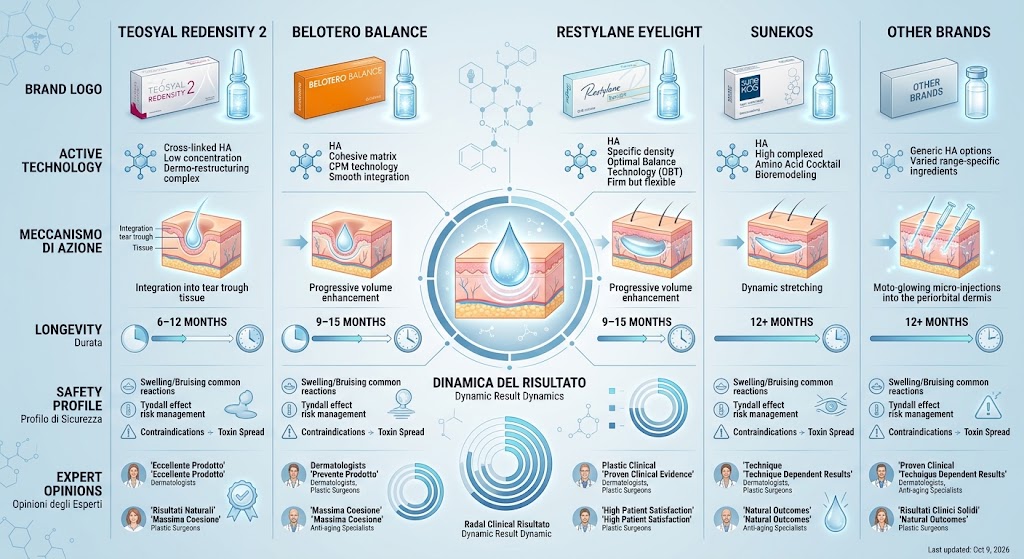

The under-eye area (tear trough) is widely considered one of the most technically demanding and unforgiving areas in aesthetic medicine. Unlike the lips or cheeks, the periorbital skin is extremely thin, highly mobile, and sits directly over delicate vascular and lymphatic structures. A filler that performs beautifully in the cheeks can look disastrous under the eyes — causing visible lumps, bluish discoloration (Tyndall effect), or chronic puffiness.
The ideal under-eye filler must possess a unique combination of properties: extremely low G-prime (softness), minimal water absorption (to prevent swelling), seamless tissue integration, and a near-zero risk of the Tyndall effect. Only a handful of products on the market are truly optimized for this delicate area, and even among those, proper patient selection and injection technique remain paramount.
This guide compares eight of the most widely used and clinically validated under-eye filler brands: Teosyal Redensity 2, Belotero Balance, Restylane Eyelight, Sunekos 120, Juvéderm Volbella, Neuramis Light, Rejuran Healer, and Profhilo. It focuses on formulation, safety profiles, integration characteristics, longevity, regulatory considerations, and real-world feedback from both practitioners and patients.
⚠️ IMPORTANT MEDICAL DISCLAIMER
Under-eye fillers are medical devices that must be handled, prescribed, and administered only by appropriately qualified healthcare professionals with advanced anatomical knowledge of the periorbital region. The tear trough area carries elevated risks including vascular occlusion (which can cause blindness), Tyndall effect, and chronic edema. This article is for educational purposes and does not replace official product labeling or clinical training.
📑 Table of Contents
- Quick Comparison
- What Makes a Good Under-Eye Filler? (vs. Other Fillers)
- How to Compare Under-Eye Filler Brands
- Leading Brands: Individual Profiles
- Longevity and Treatment Protocols
- Safety Considerations and Risk Management
- Regulatory Status and Supply Chain Verification
- Frequently Asked Questions (FAQ)
- Conclusion
1. Quick Comparison
The following table provides a high-level overview of the leading under-eye filler brands. Always confirm the specific product variant and its local regulatory authorization for periorbital use.
| Brand | Active Ingredient | Key Technology | Primary Benefit for Under-Eye | Origin |
|---|---|---|---|---|
| Teosyal Redensity 2 | HA + Amino Acids + Antioxidants | Periorbital-specific formulation | Tear trough correction + skin quality | 🇨🇭 Switzerland |
| Belotero Balance | Hyaluronic Acid | CPM® Technology | Seamless integration, low Tyndall risk | 🇩🇪 Germany |
| Restylane Eyelight | Hyaluronic Acid | NASHA™ (optimized particle size) | Specifically designed for tear troughs | 🇸🇪 Sweden / 🇨🇭 Switzerland |
| Sunekos 120 | HA + 6 Amino Acids | Directional amino acid synergy | Skin quality + subtle volume | 🇮🇹 Italy |
| Juvéderm Volbella | Hyaluronic Acid | Vycross® (low G-prime) | Off-label use, subtle enhancement | 🇺🇸 USA / 🇫🇷 France |
| Neuramis Light | Hyaluronic Acid | SHAPE™ Technology | Soft integration, cost-effective | 🇰🇷 South Korea |
| Rejuran Healer | Polynucleotides (PN) | c-PDRN® Technology | Tissue regeneration (not volume) | 🇰🇷 South Korea |
| Profhilo | High/Low MW HA | NAHYCO® Hybrid Technology | Skin quality improvement (not volume) | 🇮🇹 Italy / 🇨🇭 Switzerland |
↔ Scroll horizontally to view the full table
2. What Makes a Good Under-Eye Filler? (vs. Other Fillers)
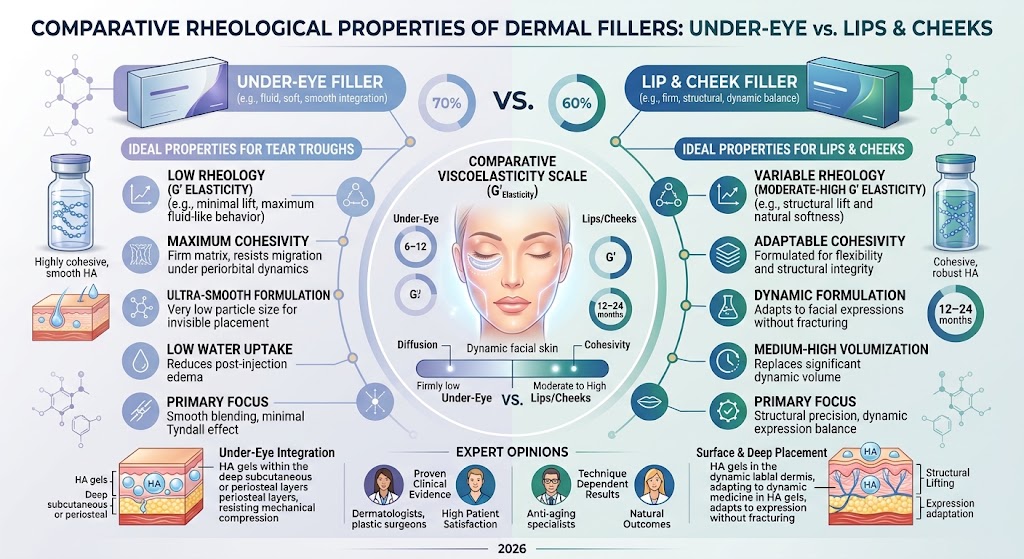
The periorbital region has unique anatomical characteristics that demand specific filler properties. A filler that performs beautifully in the lips or cheeks can produce visible lumps, bluish discoloration, or chronic puffiness when used under the eyes.
Key Requirements for Under-Eye Fillers:
- Extremely Low G-Prime: The under-eye skin is the thinnest on the body (0.5mm). Fillers must be exceptionally soft to avoid visible lumps or palpability.
- Minimal Water Absorption (Low Hydrophilicity): The periorbital area is prone to lymphatic congestion. Fillers that attract water can cause chronic puffiness or “bags” under the eyes.
- Seamless Tissue Integration: The filler must blend invisibly with native tissue to avoid visible edges or the Tyndall effect (bluish discoloration when light hits the filler).
- Low Risk of Tyndall Effect: Some HA fillers scatter light when placed superficially, creating an unnatural blue hue. Under-eye fillers must minimize this risk.
- Appropriate Injection Depth: Most under-eye fillers must be placed deep (pre-periosteal or sub-orbicularis) to avoid visibility. Superficial placement dramatically increases complication risk.
Why Most Fillers Don’t Work Well Under the Eyes:
Fillers designed for other areas (like Juvéderm Voluma for cheeks or Restylane Kysse for lips) have properties that make them unsuitable for the tear trough:
- High G-prime fillers feel firm and look unnatural in thin periorbital skin
- Highly hydrophilic fillers attract water, causing chronic puffiness
- Fillers with larger particle sizes increase Tyndall effect risk
- Fillers designed for dynamic areas (lips) may migrate in the relatively static under-eye region
3. How to Compare Under-Eye Filler Brands
A meaningful comparison requires understanding the unique requirements of the periorbital region. Clinicians evaluate under-eye fillers based on:
- 🧬 G-Prime (Firmness): Lower G-prime = softer feel. Ideal for under-eye is extremely low G-prime.
- 💧 Hydrophilicity (Water Absorption): Lower hydrophilicity = less risk of chronic puffiness. Critical for under-eye area.
- 🔬 Particle Size: Smaller, more uniform particles reduce Tyndall effect risk.
- 🎯 Tissue Integration: How seamlessly the filler blends with native tissue.
- ⏱️ Longevity: How long the filler maintains results in the under-eye area (typically 9-18 months).
- 🛡️ Safety Profile: Risk of Tyndall effect, edema, lumps, and vascular complications.
- 🌍 Regulatory Status: Whether the product is specifically approved for periorbital use or used off-label.
4. Leading Brands: Individual Profiles
Editorial note: The following sections summarize product characteristics, clinical consensus, expert opinions, and real-world market feedback. They do not constitute a ranking of clinical superiority. Under-eye filler selection is highly patient-specific and depends on anatomy, skin thickness, and the practitioner’s expertise.
1. Teosyal Redensity 2 (Teoxane)
Clinical Consensus Metrics:
📜 Track Record & Data: ⭐⭐⭐⭐⭐
💡 Innovation: ⭐⭐⭐⭐⭐
💰 Cost-Efficiency: ⭐⭐⭐⭐
✅ Key Advantages (Pros)
- Specifically formulated for the periorbital area — the only HA filler designed exclusively for tear troughs.
- Contains amino acids, antioxidants, and minerals in addition to HA for comprehensive skin quality improvement.
- Extremely low G-prime and low hydrophilicity minimize swelling and lump risk.
- Very low risk of Tyndall effect due to optimized particle size.
- Contains lidocaine for enhanced patient comfort.
- CE-marked and widely available in Europe and international markets.
- Extensive clinical data specifically for tear trough correction.
⚠️ Important Considerations (Cons)
- Not FDA-approved in the United States — primarily available in Europe, Asia, and select international markets.
- Premium pricing comparable to other high-end under-eye fillers.
- Results are subtle — not suitable for patients seeking dramatic volume restoration.
- Requires advanced injection technique despite being “designed” for the area.
- Less brand recognition in some conservative markets compared to Belotero.
👨⚕️ Expert Practitioner Opinions
Dr. Tapan Patel — 🇬🇧 United Kingdom | Aesthetic Doctor | PHI Clinic, London
Dr. Patel is one of the UK’s most prominent aesthetic physicians and a leading expert on periorbital rejuvenation. In his clinical presentations and published commentary, he describes Teosyal Redensity 2 as “the gold standard for tear trough correction.” He emphasizes that the product’s unique formulation — combining HA with amino acids and antioxidants — provides both subtle volume restoration and comprehensive skin quality improvement. He has stated that “Redensity 2 is the only filler I trust completely for the under-eye area. Its low hydrophilicity means minimal swelling risk, and its seamless integration virtually eliminates the Tyndall effect. When injected properly, the results are undetectable — patients simply look more rested.”
Dr. Steven Dayan — 🇺🇸 USA | Facial Plastic Surgeon | Chicago, Illinois
Dr. Dayan, a board-certified facial plastic surgeon and clinical researcher, has discussed Teosyal Redensity 2 in his clinical presentations. He highlights the product’s periorbital-specific formulation as a key advantage. He has stated that “Redensity 2 was designed from the ground up for the unique challenges of the tear trough — low G-prime, low hydrophilicity, and optimized particle size. It’s the closest thing we have to a purpose-built under-eye filler.” He notes that the product is particularly effective for patients with mild to moderate tear trough deformities and good skin quality.
💬 Community & Patient Feedback Trends
RealSelf (Europe): Teosyal Redensity 2 has a growing review base, particularly from patients in the UK, Europe, and the Middle East. The “Worth It” rating hovers around 90-93%, with the most common praise being the “undetectable results” — patients frequently report that they “look more rested” without looking “done.” The most common positive comment is the “natural, subtle improvement” with “no visible lumps or bluish discoloration.” Negative reviews typically mention the premium pricing or the subtle nature of results (some patients expected more dramatic volume restoration).
Reddit (r/Fillers, r/AestheticMedicine): Teosyal Redensity 2 is frequently discussed as the “go-to” under-eye filler among experienced practitioners. Users who have tried it report that the results are “beautifully subtle” — perfect for patients seeking natural-looking improvement. A recurring theme is that Redensity 2 is “ideal for patients with mild to moderate tear troughs who want undetectable results.” Some users note that it may not provide enough volume for patients with severe tear trough deformities or significant fat pad herniation.
Practitioner Forums: Redensity 2 is widely regarded as the most predictable and safest under-eye filler available. Many injectors appreciate that the product was specifically designed for the periorbital region, reducing the guesswork involved in off-label use of other fillers. A common sentiment is that Redensity 2 “rewards conservative injection techniques” — practitioners who use small volumes and inject deeply achieve the most natural-looking results.
2. Belotero Balance (Merz Aesthetics)
Clinical Consensus Metrics:
📜 Track Record & Data: ⭐⭐⭐⭐⭐
💡 Innovation: ⭐⭐⭐⭐
💰 Cost-Efficiency: ⭐⭐⭐⭐
✅ Key Advantages (Pros)
- CPM® (Cohesive Polydensified Matrix) technology allows seamless integration into superficial skin layers.
- Extremely low risk of Tyndall effect — can be placed more superficially than most other HA fillers.
- Excellent for fine lines, tear troughs, and delicate periorbital areas.
- Low hydrophilicity minimizes swelling risk.
- FDA-approved for moderate-to-severe wrinkles (used off-label for under-eye).
- Contains lidocaine for enhanced patient comfort.
- Extensive clinical data and global regulatory approvals.
⚠️ Important Considerations (Cons)
- Not specifically approved for tear trough use — used off-label by experienced practitioners.
- Lower G-prime means less lifting capacity — not suitable for deep tear troughs requiring significant volume.
- Results are subtle — not for patients seeking dramatic volume restoration.
- Requires advanced injection technique despite low Tyndall risk.
- May require more frequent touch-ups compared to higher G-prime fillers.
👨⚕️ Expert Practitioner Opinions
Dr. Steven Dayan — 🇺🇸 USA | Facial Plastic Surgeon | Chicago, Illinois
Dr. Dayan, a board-certified facial plastic surgeon and clinical researcher, has published studies on the use of Belotero for superficial periorbital lines and tear trough correction. In his clinical presentations, he emphasizes that Belotero’s unique CPM® technology allows it to be placed in the superficial dermis — a depth where most other HA fillers would create visible lumps or the Tyndall effect. He has described it as “the only filler I trust for the most delicate areas of the face, including the under-eye region.” He notes that the product is particularly effective for patients with fine periorbital lines and mild tear trough deformities.
Dr. Uliana Gout — 🇬🇧 United Kingdom | Aesthetic Physician | Member of the British College of Aesthetic Medicine
Dr. Gout is a prominent UK-based aesthetic physician known for her conservative, anatomy-driven approach. In her clinical commentary, she highlights Belotero’s excellent safety profile for under-eye use. She has stated that “Belotero’s CPM® technology provides seamless tissue integration with virtually no risk of Tyndall effect — it’s my go-to for patients with thin periorbital skin who need subtle correction.” She emphasizes that proper patient selection is critical — Belotero works best for mild to moderate tear troughs, not for patients with significant fat pad herniation or severe volume loss.
💬 Community & Patient Feedback Trends
RealSelf (USA): Belotero is the most reviewed filler specifically for tear trough (under-eye) treatments, with a “Worth It” rating of approximately 89%. Patients consistently praise the subtlety of the results — the most common positive comment is “I look rested, not done.” The most frequent praise is the “natural, undetectable improvement” with “no visible lumps or bluish discoloration.” Negative reviews typically relate to longevity, with some patients reporting that the under-eye results fade within 6-9 months, faster than expected.
Reddit (r/Fillers): Belotero is frequently recommended by experienced users to newcomers specifically for under-eye correction. A recurring piece of advice is “If your injector suggests Juvéderm for tear troughs, get a second opinion — Belotero is the safer choice.” Users also appreciate its use for fine periorbital lines, where thicker fillers would look unnatural. Some users note that Belotero may not provide enough volume for severe tear troughs, requiring combination with other treatments.
Practitioner Forums: Belotero is widely regarded as the safest HA filler for under-eye use among US-based practitioners, particularly for patients with thin periorbital skin. Many injectors appreciate the low Tyndall risk, which allows for more flexible injection depths. A common sentiment is that Belotero “rewards conservative techniques” — practitioners who use small volumes and inject superficially achieve the most natural-looking results.
3. Restylane Eyelight (Galderma)
Clinical Consensus Metrics:
📜 Track Record & Data: ⭐⭐⭐⭐
💡 Innovation: ⭐⭐⭐⭐⭐
💰 Cost-Efficiency: ⭐⭐⭐⭐
✅ Key Advantages (Pros)
- Specifically designed for tear trough correction — part of the Restylane family optimized for periorbital use.
- NASHA™ technology with optimized particle size for seamless integration.
- Low G-prime and low hydrophilicity minimize swelling and lump risk.
- Very low risk of Tyndall effect.
- Contains lidocaine for enhanced patient comfort.
- Extensive clinical data from the Restylane family.
- CE-marked and widely available in Europe and international markets.
⚠️ Important Considerations (Cons)
- Not FDA-approved in the United States — primarily available in Europe, Asia, and select international markets.
- Premium pricing comparable to other high-end under-eye fillers.
- Results are subtle — not suitable for patients seeking dramatic volume restoration.
- Requires advanced injection technique despite being “designed” for the area.
- Less brand recognition compared to Teosyal Redensity 2 in some markets.
Dr. Tim Pearce — 🇬🇧 United Kingdom | Aesthetic Doctor | eLearning Educator
One of the most followed aesthetic educators in the English-speaking world, Dr. Pearce regularly discusses Restylane Eyelight in his online training content. He has publicly stated that “Eyelight is specifically engineered for the tear trough — the NASHA™ technology’s optimized particle size provides seamless integration with minimal Tyndall risk.” He emphasizes that the product is particularly effective for patients with mild to moderate tear trough deformities who want natural-looking results. He notes that Eyelight “rewards conservative injection techniques” and that practitioners should use small volumes injected deeply for optimal outcomes.
💬 Community & Patient Feedback Trends
RealSelf (Europe): Restylane Eyelight has a growing review base, particularly from patients in the UK and Europe. The “Worth It” rating averages around 88-91%. Patients frequently praise the “natural, undetectable results” — many report that they “look more rested” without looking “done.” The most common positive comment is the “subtle improvement” with “no visible lumps or bluish discoloration.” Negative reviews typically mention the premium pricing or the subtle nature of results.
Reddit (r/Fillers): Restylane Eyelight is less frequently discussed than Teosyal Redensity 2 but receives positive feedback from users who have tried it. Patients appreciate the seamless integration and natural look. A recurring comment is that Eyelight is “ideal for patients with mild to moderate tear troughs who want undetectable results.” Some users note that it may not provide enough volume for severe tear troughs.
4. Sunekos 120 (ABR — Aesthetic Bioregenerative Research)
Clinical Consensus Metrics:
📜 Track Record & Data: ⭐⭐⭐⭐
💡 Innovation: ⭐⭐⭐⭐⭐
💰 Cost-Efficiency: ⭐⭐⭐⭐⭐
✅ Key Advantages (Pros)
- Combines non-cross-linked HA with a specific complex of 6 amino acids (directional amino acid synergy).
- Amino acids are specifically selected to stimulate fibroblast activity and ECM remodeling in the periorbital area.
- Excellent for skin quality improvement + subtle volume restoration.
- Very low risk of Tyndall effect and minimal swelling.
- Excellent cost-to-performance ratio — more affordable than Teosyal Redensity 2.
- CE-marked and widely available in Europe and international markets.
- Can be used for face, neck, and periorbital areas.
⚠️ Important Considerations (Cons)
- Not specifically approved for tear trough use — used off-label by experienced practitioners.
- Provides subtle volume — not suitable for patients seeking dramatic tear trough correction.
- Requires initial series of 2-4 treatments (2-3 weeks apart) for optimal results.
- Results are more about skin quality improvement than volume restoration.
- Less brand recognition outside of Europe.
- Longevity is shorter than cross-linked HA fillers (typically 6-9 months).
Dr. Wassim Taktouk — 🇬🇧 United Kingdom | Aesthetic Doctor | London
Dr. Taktouk, a well-known London-based aesthetic physician, has discussed Sunekos in industry publications. He has noted that Sunekos offers “a compelling combination of quality and affordability” for periorbital rejuvenation. He emphasizes that the directional amino acid complex provides targeted fibroblast stimulation, making it particularly effective for patients seeking comprehensive skin quality improvement in the under-eye area at a more accessible price point than Teosyal Redensity 2. He notes that Sunekos is “ideal for patients with mild tear troughs who prioritize skin quality over volume restoration.”
💬 Community & Patient Feedback Trends
RealSelf (Europe): Sunekos holds a “Worth It” rating of approximately 85-88% for periorbital use. Patients frequently report improvements in skin texture, firmness, and overall appearance around the eyes. The most common praise is the “excellent value for money” — patients appreciate comprehensive skin quality improvement at a more affordable price point compared to Teosyal Redensity 2.
Reddit (r/SkincareAddiction): Sunekos is frequently discussed as a “budget-friendly alternative to Teosyal Redensity 2” for periorbital rejuvenation. Users who have tried it report positive outcomes, particularly for improving skin texture and firmness around the eyes. A recurring comment is that Sunekos “provides similar skin quality benefits to Redensity 2 but at a fraction of the cost.” Some users note that it requires multiple sessions to achieve optimal results.
5. Juvéderm Volbella (Allergan Aesthetics / AbbVie)
Clinical Consensus Metrics:
📜 Track Record & Data: ⭐⭐⭐⭐⭐
💡 Innovation: ⭐⭐⭐⭐
💰 Cost-Efficiency: ⭐⭐⭐
✅ Key Advantages (Pros)
- Vycross® technology provides low G-prime for soft, natural feel.
- Low hydrophilicity minimizes swelling risk compared to other Juvéderm products.
- FDA-approved for lips and perioral lines (used off-label for under-eye).
- Contains lidocaine for enhanced patient comfort.
- Extensive clinical data and global regulatory approvals.
- Fully reversible with hyaluronidase.
- Good longevity (typically 9-12 months in under-eye area).
⚠️ Important Considerations (Cons)
- Not specifically approved for tear trough use — used off-label by experienced practitioners.
- Higher hydrophilicity than Teosyal Redensity 2 or Belotero — increased risk of swelling in some patients.
- Some practitioners report higher Tyndall risk compared to Belotero or Redensity 2.
- Requires advanced injection technique and deep placement to avoid complications.
- Not ideal for patients with very thin periorbital skin or significant lymphatic congestion.
- Premium pricing comparable to other high-end under-eye fillers.
Dr. Mauricio de Maio — 🇧🇷 Brazil | Plastic Surgeon | Creator of MD Codes™
Dr. de Maio, while primarily known for his work with facial fillers, has discussed Juvéderm Volbella in the context of periorbital rejuvenation. He has stated that “Volbella can be used off-label for tear trough correction in carefully selected patients with good skin thickness and minimal lymphatic congestion.” He emphasizes that proper patient selection is critical — Volbella works best for patients with mild to moderate tear troughs who don’t have significant swelling tendencies. He notes that the product must be injected deeply (pre-periosteal) to minimize Tyndall risk and swelling.
💬 Community & Patient Feedback Trends
RealSelf (USA): Juvéderm Volbella is less frequently reviewed specifically for tear trough use compared to Belotero, but receives mixed feedback. Some patients report “beautiful, natural results” with “minimal swelling,” while others note more puffiness than expected. The “Worth It” rating for off-label under-eye use averages around 82-85%, lower than Belotero’s rating.
Reddit (r/Fillers): Volbella is frequently discussed as a “controversial” choice for under-eye use. Many experienced practitioners advise against it, preferring Belotero or Teosyal Redensity 2. Users who have tried it report mixed results — some note “beautiful, subtle improvement” while others complain of “persistent puffiness” or “bluish discoloration.” A recurring theme is that Volbella “requires very careful patient selection and deep injection technique” to avoid complications.
6. Neuramis Light (Medytox Inc.)
Clinical Consensus Metrics:
📜 Track Record & Data: ⭐⭐⭐
💡 Innovation: ⭐⭐⭐⭐
💰 Cost-Efficiency: ⭐⭐⭐⭐⭐
✅ Key Advantages (Pros)
- SHAPE™ (Stabilized Hyaluronic Acid and Purification Enhancement) technology ensures high purity and consistent cross-linking.
- Low G-prime formulation suitable for delicate under-eye area.
- Excellent tissue integration with minimal swelling.
- Highly competitive pricing — significantly more affordable than European/US premium brands.
- Fully reversible with hyaluronidase.
- Widely available in Asian and European markets.
⚠️ Important Considerations (Cons)
- Not FDA-approved in the United States; primarily available in Asian, European, and Middle Eastern markets.
- Not specifically approved for tear trough use — used off-label.
- Limited long-term (10+ year) clinical data in Western populations compared to Belotero or Teosyal.
- Brand recognition among patients in Western markets is still developing.
- As with all Korean fillers, supply chain authenticity must be rigorously verified.
- Some practitioners report slightly higher Tyndall risk compared to Belotero.
Dr. Jong-Ho Lee — 🇰🇷 South Korea | Plastic Surgeon | Seoul National University
Dr. Lee is a respected academic plastic surgeon who has contributed to clinical research on HA filler safety and efficacy in the Korean market. In his published work, he has noted that Neuramis Light demonstrates favorable rheological properties for under-eye use, particularly in terms of tissue integration and minimal swelling. He has highlighted that the SHAPE™ purification process results in a gel with low residual BDDE levels, which is an important safety consideration for long-term tissue biocompatibility in the delicate periorbital region.
💬 Community & Patient Feedback Trends
RealSelf (Asia/Europe): Neuramis Light has a strong review presence in South Korea, Japan, and increasingly in the UK and Turkey. The “Worth It” rating averages around 84-87% for under-eye use. Patients particularly praise the “excellent value for money” compared to premium Western brands. The most common positive comment is “natural-looking results with minimal swelling.” Negative reviews typically mention slightly shorter longevity compared to Belotero or Teosyal Redensity 2.
Reddit (r/Fillers, r/KoreanBeauty): Neuramis Light is frequently discussed in the context of “K-beauty aesthetics” and is popular among users who travel to South Korea for treatments. Many report that Korean clinics use Neuramis Light as their standard under-eye filler, and the results are “indistinguishable from what I got with Belotero back home, but at half the price.” A recurring concern on Reddit is the prevalence of counterfeit Neuramis on unauthorized websites — experienced users strongly advise purchasing only from verified medical professionals.
7. Rejuran Healer (PharmaResearch)
Clinical Consensus Metrics:
📜 Track Record & Data: ⭐⭐⭐⭐
💡 Innovation: ⭐⭐⭐⭐⭐
💰 Cost-Efficiency: ⭐⭐⭐⭐
✅ Key Advantages (Pros)
- Contains polynucleotides (PN) derived from salmon DNA — unique mechanism of action.
- c-PDRN® technology stimulates tissue regeneration, wound healing, and collagen production at the cellular level.
- Excellent for periorbital skin quality improvement, fine lines, and dark circles.
- Anti-inflammatory properties make it suitable for sensitive or compromised periorbital skin.
- No risk of Tyndall effect (not a traditional HA filler).
- Minimal downtime and low risk of swelling or bruising.
- Gaining significant popularity in Asian markets and increasingly in Europe.
⚠️ Important Considerations (Cons)
- Not a traditional filler — does not provide significant volume restoration for deep tear troughs.
- Not FDA-approved in the United States; primarily available in Asian and European markets.
- Requires initial series of 3-4 treatments (3-4 weeks apart) for optimal results.
- Results are more about skin quality improvement than volume restoration.
- Less brand recognition in Western markets compared to HA fillers.
- Supply chain verification is critical — counterfeit Rejuran is prevalent in unauthorized channels.
- Longevity is shorter than HA fillers (typically 6-9 months).
Dr. Tijion Esho — 🇬🇧 United Kingdom | Cosmetic Doctor | The ESHO Clinic, London & Newcastle
Known as “The Lip Doctor” and one of the UK’s most high-profile aesthetic practitioners, Dr. Esho has publicly discussed the growing presence of Korean skin boosters in the European market. While he primarily uses European brands in his own practice, he has acknowledged in industry interviews that “Rejuran Healer represents a unique approach to periorbital rejuvenation — its polynucleotide-based mechanism offers benefits that HA-based products cannot provide, particularly for patients with sensitive or compromised skin around the eyes.” He emphasizes that Rejuran is “ideal for patients who want skin quality improvement rather than volume restoration.”
💬 Community & Patient Feedback Trends
RealSelf (Asia/Europe): Rejuran Healer has a strong review presence in South Korea, Japan, and increasingly in the UK and Europe. The “Worth It” rating averages around 86-89% for periorbital use. Patients particularly praise its effectiveness for improving periorbital skin texture, fine lines, and dark circles. The most common positive comment is that Rejuran “heals the skin around the eyes from within” — patients report that their periorbital skin looks healthier, more resilient, and less tired over time.
Reddit (r/KoreanBeauty, r/SkincareAddiction): Rejuran Healer is frequently discussed in the context of “K-beauty aesthetics” and is popular among users who travel to South Korea for treatments. Many report that Korean clinics use Rejuran as their standard periorbital treatment, and the results are “transformative for dark circles and fine lines.” A recurring concern on Reddit is the prevalence of counterfeit Rejuran on unauthorized websites — experienced users strongly advise purchasing only from verified medical professionals.
8. Profhilo (IBSA / IBSA Farmaceutici)
Clinical Consensus Metrics:
📜 Track Record & Data: ⭐⭐⭐⭐⭐
💡 Innovation: ⭐⭐⭐⭐⭐
💰 Cost-Efficiency: ⭐⭐⭐⭐
✅ Key Advantages (Pros)
- NAHYCO® Hybrid Technology combines high and low molecular weight HA without chemical cross-linking (BDDE-free).
- High concentration (64mg/2ml) provides deep hydration and skin remodeling.
- Stimulates 4 types of collagen and elastin production.
- Excellent for periorbital skin quality improvement, fine lines, and crepiness.
- Minimal downtime and low risk of swelling or bruising.
- Unique BAP (Bio Aesthetic Points) injection technique ensures even distribution.
- CE-marked and widely available globally.
⚠️ Important Considerations (Cons)
- Not a traditional filler — does not provide significant volume restoration for deep tear troughs.
- Premium pricing — among the most expensive skin boosters globally.
- Requires initial series of 2 treatments (4 weeks apart) for optimal results.
- Results are more about skin quality improvement than volume restoration.
- Not suitable for patients seeking dramatic tear trough correction.
- Counterfeit Profhilo is prevalent in unauthorized channels.
Dott. Alberto Di Guida — 🇮🇹 Italy | Dermatologist | Rome
Dr. Di Guida is a renowned Italian dermatologist who has contributed to clinical research on Profhilo. In his published work, he highlights the product’s ability to improve periorbital skin elasticity and firmness, particularly in patients with mild skin laxity and crepiness around the eyes. He has stated that “Profhilo represents the evolution of biorevitalization for the periorbital area — it is not about adding volume, but about remodeling the skin’s extracellular matrix and stimulating collagen production.” He emphasizes that Profhilo is “ideal for patients who want skin quality improvement around the eyes rather than tear trough volume restoration.”
💬 Community & Patient Feedback Trends
RealSelf (Global): Profhilo consistently maintains a “Worth It” rating above 92% for skin quality improvement, including periorbital use. Patients frequently describe the results as a “glow from within” and report that their periorbital skin feels “plumper, smoother, and more hydrated.” The most common praise is the natural-looking improvement — patients appreciate that they “look refreshed, not done.” Negative reviews are rare and typically relate to the cost or the need for multiple sessions to see full results.
Reddit (r/SkincareAddiction, r/AestheticMedicine): Profhilo is frequently discussed as the “gold standard” for periorbital skin quality improvement. Users who have tried it report significant improvements in skin texture, fine lines, and overall radiance around the eyes. A recurring theme is that results are “subtle but transformative” — patients notice that their periorbital skin looks healthier and more resilient, even without makeup.
5. Longevity and Treatment Protocols
Duration varies significantly between under-eye filler brands and depends on the product’s rheology, injection depth, and the patient’s individual metabolism. The following table provides general guidelines, but individual results may vary.
| Brand | Type | Initial Protocol | Duration of Results | Reversible? |
|---|---|---|---|---|
| Teosyal Redensity 2 | HA Filler | 1-2 sessions | 9-12 months | Yes |
| Belotero Balance | HA Filler | 1-2 sessions | 6-9 months | Yes |
| Restylane Eyelight | HA Filler | 1-2 sessions | 9-12 months | Yes |
| Sunekos 120 | HA + Amino Acids | 2-4 sessions | 6-9 months | Yes |
| Juvéderm Volbella | HA Filler | 1-2 sessions | 9-12 months | Yes |
| Neuramis Light | HA Filler | 1-2 sessions | 6-9 months | Yes |
| Rejuran Healer | Polynucleotides | 3-4 sessions | 6-9 months | No |
| Profhilo | Skin Booster | 2 sessions | 6-9 months | Yes |
↔ Scroll horizontally to view the full table
6. Safety Considerations and Risk Management
⚠️ CRITICAL SAFETY WARNING: PERIORBITAL VASCULAR OCCLUSION
The under-eye area carries elevated risk of vascular occlusion due to the dense vascular network surrounding the orbit. Accidental injection into a blood vessel can cause tissue necrosis or, in rare cases, blindness. Practitioners must have extensive knowledge of periorbital anatomy, use appropriate injection techniques (deep placement, aspiration before injection), and have an emergency protocol in place, including immediate access to hyaluronidase (for HA fillers).
Key Safety Considerations for Under-Eye Fillers:
- Tyndall Effect: Bluish discoloration when filler is placed too superficially or in patients with very thin skin. Risk varies by product — Belotero and Teosyal Redensity 2 have the lowest risk.
- Chronic Edema (Puffiness): Fillers with high hydrophilicity can attract water, causing persistent under-eye bags. Low-hydrophilicity fillers (Teosyal Redensity 2, Belotero) minimize this risk.
- Visible Lumps/Irregularities: Can occur if filler is placed too superficially or in excessive volumes. Low G-prime fillers reduce this risk.
- Vascular Occlusion: Rare but serious complication. Requires immediate treatment with hyaluronidase (for HA fillers) and emergency protocols.
- Patient Selection: Not all patients are suitable candidates. Patients with significant fat pad herniation, severe skin laxity, or active skin conditions may not benefit from under-eye fillers.
Contraindications:
- Active infection or skin disease in the treatment area
- Known allergy to any component of the product
- History of severe allergic reactions or anaphylaxis
- Bleeding disorders or use of anticoagulants
- Unrealistic expectations or body dysmorphic disorder
- Significant fat pad herniation (may require surgical intervention)
- Severe skin laxity (fillers may not provide satisfactory results)
7. Regulatory Status and Supply Chain Verification
The under-eye filler market is unfortunately plagued by counterfeit products and unregulated imports. For clinics and distributors, verifying the supply chain is a matter of patient safety and legal compliance.
Before purchasing, verify the following:
- Regulatory Approval: Ensure the product has a valid CE Mark (Europe), FDA clearance (USA), or equivalent local health authority approval. Note that many under-eye fillers are used off-label — verify that the practitioner is experienced with off-label use.
- Authorized Distributors: Purchase only directly from the manufacturer or their explicitly authorized national distributors.
- Authentication Features: Check for holographic seals, unique QR codes, or scratch-off verification labels on the packaging.
- Temperature Control: Most HA fillers require refrigerated storage (2–8°C). Verify that the supplier maintains proper cold-chain logistics.
Never purchase under-eye fillers from unauthorized online marketplaces, social media sellers, or unverified third-party wholesalers. Counterfeit Teosyal Redensity 2, Belotero, and Korean fillers are among the most common fake products on the black market.
8. Frequently Asked Questions (FAQ)
❓ Which under-eye filler is the best?
There is no universally “best” under-eye filler — the optimal choice depends on the patient’s specific anatomy, skin thickness, tear trough severity, and the practitioner’s expertise. Teosyal Redensity 2 is widely regarded as the gold standard for tear trough correction due to its periorbital-specific formulation. Belotero Balance is the most commonly used HA filler for under-eye use in the US due to its low Tyndall risk. For patients seeking skin quality improvement rather than volume restoration, Rejuran Healer and Profhilo offer unique benefits.
❓ What is the difference between under-eye fillers and skin boosters?
Under-eye fillers (like Teosyal Redensity 2, Belotero) provide subtle volume restoration to correct tear trough deformities. Skin boosters (like Profhilo, Rejuran Healer) improve skin quality, hydration, and texture without adding significant volume. Fillers are ideal for patients with visible tear troughs, while skin boosters are ideal for patients with fine lines, crepiness, or dark circles due to poor skin quality.
❓ Are Korean under-eye fillers (Neuramis, Rejuran) as good as European brands?
Clinical data and practitioner feedback suggest that authentic, properly regulated Korean under-eye products offer comparable safety and efficacy to premium Western brands for most indications. Neuramis Light provides excellent tissue integration at a lower cost, while Rejuran Healer offers unique polynucleotide-based benefits for skin quality improvement. The key is ensuring product authenticity through authorized supply chains.
❓ How long do under-eye filler results last?
Duration varies by product and individual factors. HA fillers typically last 6-12 months in the under-eye area. Skin boosters like Profhilo and Rejuran typically last 6-9 months. Individual results vary significantly based on metabolism, lifestyle, and the specific product used.
❓ Can under-eye fillers be dissolved?
Only HA-based fillers can be dissolved using hyaluronidase. Polynucleotide-based products (Rejuran Healer) cannot be dissolved and must naturally metabolize over time. This makes proper product selection and injection technique critical for under-eye treatments.
❓ What is the Tyndall effect and how can it be avoided?
The Tyndall effect is a bluish discoloration that occurs when HA filler is placed too superficially in thin skin, causing light to scatter. It can be avoided by using fillers with low Tyndall risk (Belotero, Teosyal Redensity 2), injecting at the correct depth (deep, pre-periosteal), and using conservative volumes. If Tyndall effect occurs, it can be treated with hyaluronidase.
❓ Are under-eye fillers painful?
Most patients report mild to moderate discomfort during under-eye filler injections. Most products contain lidocaine for enhanced comfort. Practitioners may also use topical anesthetics or ice to minimize discomfort. The under-eye area is sensitive, but most patients tolerate the procedure well.
❓ What is the downtime after under-eye filler treatment?
Most under-eye fillers have minimal downtime. Patients may experience mild swelling, redness, or bruising at injection sites, which typically resolves within 24-72 hours. Products like Teosyal Redensity 2 and Belotero are particularly known for their minimal downtime, allowing patients to resume normal activities immediately after treatment.
9. Conclusion: Choosing an Under-Eye Filler Based on Evidence
Teosyal Redensity 2, Belotero Balance, Restylane Eyelight, Sunekos 120, Juvéderm Volbella, Neuramis Light, Rejuran Healer, and Profhilo each offer distinct advantages for periorbital rejuvenation. The choice should be driven by the patient’s specific concerns (tear trough volume vs. skin quality), anatomy, skin thickness, and the practitioner’s expertise — not by marketing trends or brand prestige alone.
A reliable approach prioritizes:
- Matching the product’s properties (G-prime, hydrophilicity, particle size) to the patient’s specific periorbital anatomy and concerns.
- Understanding whether the patient needs volume restoration (HA fillers) or skin quality improvement (skin boosters/polynucleotides).
- Sourcing exclusively from authorized, traceable supply chains — especially for Korean-manufactured products.
- Ensuring the procedure is performed by a qualified, anatomically trained medical professional with extensive experience in periorbital injections.
- Proper patient selection — not all patients are suitable candidates for under-eye fillers.
For healthcare professionals and qualified buyers, the strongest decisions are supported by verifiable clinical data, rigorous safety protocols, and legitimate supply chains.
📚 Official Sources and Further Reading
- PubMed – Tear Trough Filler Studies – Peer-reviewed clinical studies on tear trough filler safety and efficacy.
- PubMed – Under-Eye Filler Complications – Clinical studies on periorbital filler complications and management.
- EUDAMED – European medical device regulatory verification for under-eye filler products.
- Teoxane Professional – Official product information for Teosyal Redensity 2.
- Merz Aesthetics Professional – Official product information for Belotero Balance.
Editorial note: Medical device regulations, product formulations, and clinical guidelines can change. Review the latest official documentation and local regulatory updates before publication or clinical application.