No products added!
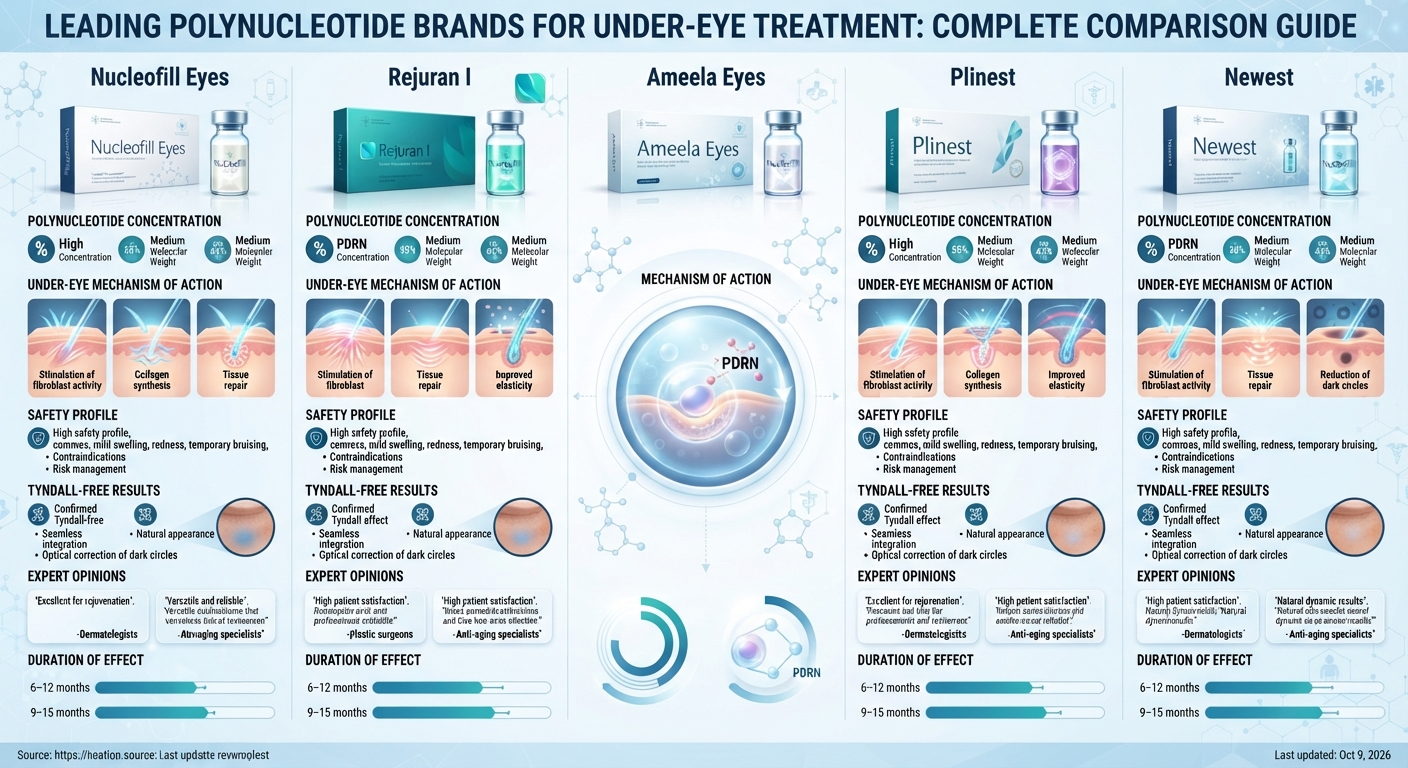

The under-eye area (tear trough) is the most technically demanding region in aesthetic medicine. With skin only 0.5mm thick, a dense vascular network, and constant lymphatic movement, traditional hyaluronic acid (HA) fillers — while effective — carry inherent risks including the Tyndall effect (bluish discoloration), chronic edema, and visible lumps.
Polynucleotides (PN) and Polydeoxyribonucleotides (PDRN) have emerged as a revolutionary alternative for under-eye rejuvenation. Unlike HA fillers that physically fill the tear trough, polynucleotides work at the cellular level — binding to adenosine A2A receptors to stimulate fibroblast activity, thicken the dermis, improve microcirculation, and reduce dark circles caused by thin skin and vascular visibility. Crucially, polynucleotides carry zero risk of Tyndall effect, making them the safest injectable option for this delicate area.
This guide compares six of the most widely used and clinically validated polynucleotide brands specifically indicated or optimized for under-eye treatment: Nucleofill Eyes, Rejuran I, Ameela Eyes, Plinest Fast, Newest, and Vitaran PDRN. It focuses on formulation, periocular safety, mechanism of action, clinical efficacy, and real-world feedback from both practitioners and patients.
⚠️ IMPORTANT MEDICAL DISCLAIMER
Medical-grade polynucleotide products are classified as medical devices (or prescription medicines, depending on the jurisdiction). Periorbital injections must be performed only by appropriately qualified healthcare professionals with advanced knowledge of orbital anatomy. The under-eye area carries elevated risks including vascular occlusion (which can cause blindness). This article is for educational purposes and does not replace official product labeling, clinical training, or professional medical judgment.
📑 Table of Contents
- Quick Comparison
- Why Polynucleotides Are Ideal for the Under-Eye Area
- How to Compare Polynucleotide Brands for Under-Eye Use
- Leading Brands: Individual Profiles
- Under-Eye Treatment Protocols
- Safety Considerations and Periorbital Risk Management
- Regulatory Status and Supply Chain Verification
- Frequently Asked Questions (FAQ)
- Conclusion
1. Quick Comparison
The following table provides a high-level overview of the leading polynucleotide brands used for under-eye rejuvenation. Always confirm the specific product variant and its local regulatory authorization for periorbital use.
| Brand | Active Ingredient | Key Technology | Primary Benefit for Under-Eyes | Origin |
|---|---|---|---|---|
| Nucleofill Eyes | High MW Polynucleotides | Periorbital-specific formulation | Lifting + dermal thickening | 🇮🇹 Italy |
| Rejuran I (Healer I) | c-PDRN (2%) | Low-MW cleaved salmon DNA | Gold standard for dark circles & skin repair | 🇰🇷 South Korea |
| Ameela Eyes | PDRN + HA | Periorbital-specific hybrid | Hydration + tissue repair | 🇰🇷 South Korea |
| Plinest Fast | Highly purified PN | Advanced purification, low viscosity | Zero downtime, ideal for sensitive skin | 🇮🇹 Italy |
| Newest | PN + HA | Synergistic regenerative complex | Immediate hydration + gradual regeneration | 🇮🇹 Italy |
| Vitaran PDRN | PDRN + Non-crosslinked HA | Integrated regenerative formula | Cost-effective healing and brightening | 🇰🇷 South Korea |
↔ Scroll horizontally to view the full table
2. Why Polynucleotides Are Ideal for the Under-Eye Area
Unlike HA fillers, which physically occupy space, polynucleotides work by regenerating the tissue itself. This makes them uniquely suited for the periorbital region, where traditional fillers carry significant risks.
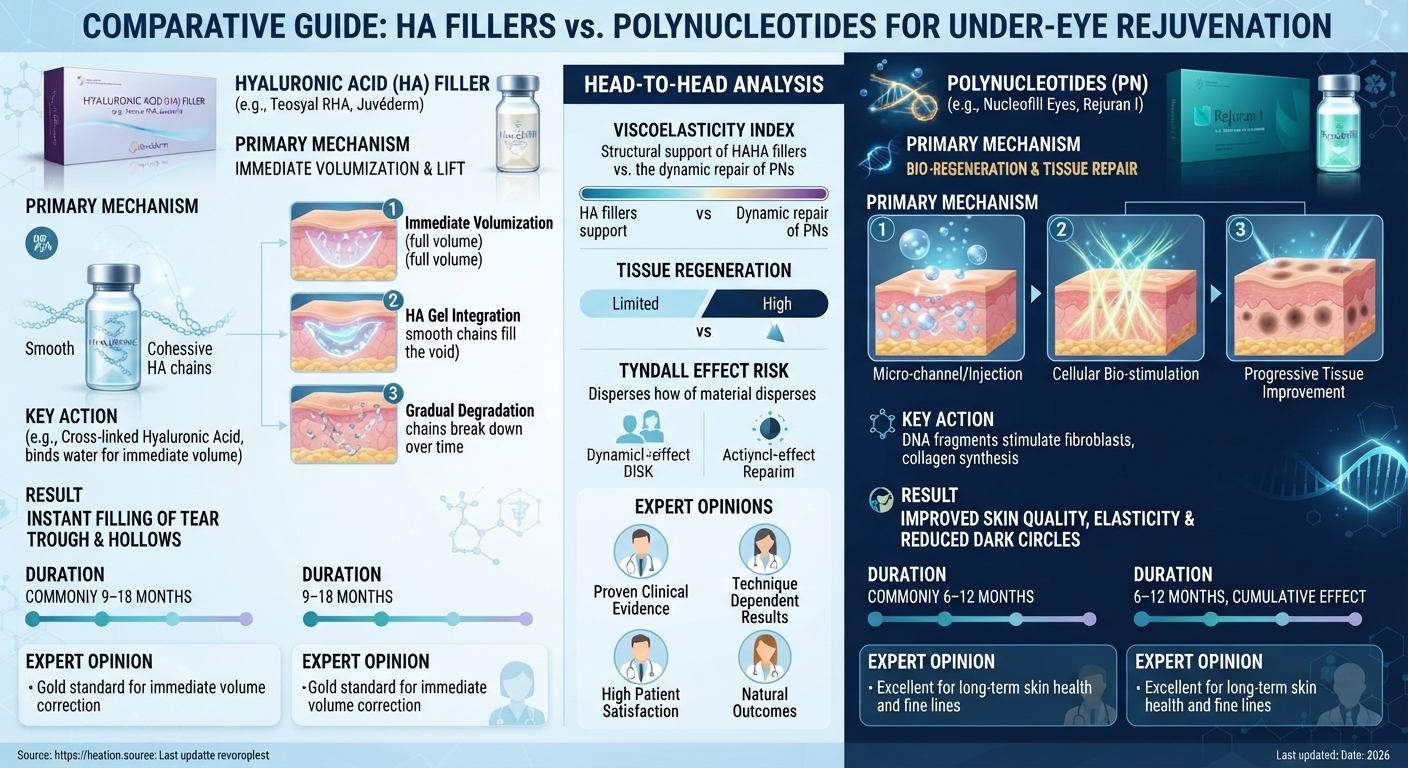
Key Advantages of Polynucleotides for Under-Eyes:
- Zero Tyndall Effect Risk: Unlike HA fillers, PN does not scatter light when placed superficially. No risk of bluish discoloration — a critical advantage in the thinnest skin on the body.
- No Chronic Edema: PN is not hydrophilic (does not attract water), eliminating the risk of persistent under-eye puffiness or “bags” that can occur with HA fillers.
- Dermal Thickening: PN stimulates fibroblasts to produce new collagen, physically thickening the under-eye skin and reducing the visibility of underlying blood vessels (a primary cause of dark circles).
- Improved Microcirculation: PDRN promotes angiogenesis, improving blood flow and reducing the appearance of vascular dark circles.
- Anti-Inflammatory Properties: PN reduces inflammation, making it ideal for patients with sensitive, reactive, or rosacea-prone periorbital skin.
- Natural-Looking Results: No risk of overfilling or “puffy” appearance. Results are subtle, progressive, and undetectable.
When HA Fillers Are Still Preferred:
Polynucleotides are not volumizers. For patients with deep, structural tear trough hollows requiring significant projection, HA fillers (like Teosyal Redensity 2 or Belotero Balance) may still be the first-line treatment. PN is ideal for patients with:
- Thin, crepey under-eye skin
- Dark circles due to vascular visibility or skin thinness
- Fine periorbital lines
- Mild to moderate tear troughs where skin quality improvement is the primary goal
- Patients who have experienced complications with HA fillers (Tyndall, edema, lumps)
3. How to Compare Polynucleotide Brands for Under-Eye Use
Not all PN products are suitable for the delicate periorbital area. Clinicians evaluate under-eye PN products based on:
- 🧬 Molecular Weight: Lower molecular weight (like c-PDRN) penetrates thin periorbital skin more effectively and carries a lower risk of inflammatory reactions.
- ⚗️ Purity and Endotoxin Levels: The under-eye area is highly sensitive. Ultra-pure formulations with low endotoxin levels minimize swelling and irritation.
- 💧 Viscosity: Low-viscosity products integrate more smoothly into thin periorbital tissue without causing visible bumps or papules.
- 🎯 Periorbital-Specific Formulation: Some brands offer variants specifically designed for the eye area (e.g., Nucleofill Eyes, Rejuran I, Ameela Eyes), with optimized concentration and injection protocols.
- 🛡️ Safety Profile: Absence of cross-linking agents, minimal hydrophilicity, and rigorous sterilization processes.
- 🌍 Regulatory Status: CE Mark (Europe), MFDS approval (South Korea), or local health authority clearance specifically for periorbital use.
4. Leading Brands: Individual Profiles
Editorial note: The following sections summarize product characteristics, clinical consensus, expert opinions, and real-world market feedback. They do not constitute a ranking of clinical superiority. Under-eye treatment requires exceptional anatomical knowledge and should only be performed by experienced practitioners.
1. Nucleofill Eyes (Promoitalia)
Clinical Consensus Metrics:
📜 Track Record & Data: ⭐⭐⭐⭐⭐
💡 Innovation: ⭐⭐⭐⭐⭐
💰 Cost-Efficiency: ⭐⭐⭐⭐
✅ Key Advantages (Pros)
- Specifically formulated for the periorbital area — one of the few PN products with a dedicated under-eye variant.
- Contains high-molecular-weight polynucleotides optimized for dermal thickening and lifting in thin skin.
- Strongly stimulates fibroblast activity, improving skin elasticity and reducing fine periorbital lines.
- Excellent for patients with dark circles caused by thin, translucent skin.
- Zero Tyndall effect risk — completely safe for superficial periorbital injection.
- CE-marked medical device with robust clinical backing.
- Minimal downtime and low risk of swelling or bruising.
⚠️ Important Considerations (Cons)
- Not FDA-approved in the United States — primarily available in Europe and select international markets.
- Does not provide significant volumizing — best for skin quality improvement, not deep hollow correction.
- Requires initial series of 2–3 treatments (3–4 weeks apart) for optimal results.
- Results are gradual and subtle — not for patients seeking dramatic, immediate change.
- Premium pricing comparable to other high-end under-eye treatments.
👨⚕️ Expert Practitioner Opinions
Dr. Uliana Gout — 🇬🇧 United Kingdom | Aesthetic Physician | Member of the British College of Aesthetic Medicine
Dr. Gout is a prominent UK-based aesthetic physician known for her conservative, anatomy-driven approach. In her clinical commentary, she highlights Nucleofill Eyes as a breakthrough for periorbital rejuvenation. She has stated that “Nucleofill Eyes is specifically engineered for the unique challenges of the under-eye area. Its high-molecular-weight polynucleotides thicken the dermis and improve skin quality without the risks associated with HA fillers — no Tyndall effect, no chronic edema. It’s my go-to for patients with thin, crepey under-eye skin and vascular dark circles.”
💬 Community & Patient Feedback Trends
RealSelf (Europe): Nucleofill Eyes has a growing review base, particularly from patients in the UK, Italy, and Eastern Europe. The “Worth It” rating averages around 89-92%. Patients particularly praise the “noticeable lifting and brightening” without the risk of bluish discoloration. The most common positive comment is that Nucleofill Eyes “healed my under-eye skin from within” — patients report that their under-eyes look healthier, more resilient, and less tired over time.
Reddit (r/SkincareAddiction, r/AestheticMedicine): Nucleofill Eyes is frequently discussed as a “game-changer” for patients who have experienced complications with HA fillers (Tyndall effect, chronic puffiness). Users report that the results are “subtle but transformative” — their under-eye skin looks thicker, brighter, and more youthful. A recurring theme is that Nucleofill Eyes is “ideal for patients who want natural-looking improvement without the ‘done’ look.”
2. Rejuran I / Rejuran Healer I (PharmaResearch)
Clinical Consensus Metrics:
📜 Track Record & Data: ⭐⭐⭐⭐⭐
💡 Innovation: ⭐⭐⭐⭐⭐
💰 Cost-Efficiency: ⭐⭐⭐
✅ Key Advantages (Pros)
- The periorbital-specific variant of the legendary Rejuran Healer — optimized for the delicate under-eye area.
- Contains 2% c-PDRN (cleaved PDRN), the lowest molecular weight form for rapid cellular absorption in thin skin.
- Exceptional at repairing damaged skin barriers, reducing dark circles, and improving periorbital skin quality.
- Anti-inflammatory properties make it ideal for sensitive, reactive, or rosacea-prone under-eye skin.
- Zero Tyndall effect risk and minimal swelling.
- Extensive clinical data from over two decades of use in South Korea.
- Highly biocompatible with minimal risk of allergic reaction.
⚠️ Important Considerations (Cons)
- Premium pricing — among the most expensive PN products globally.
- Historically known for a distinct, slightly unpleasant odor (characteristic of salmon DNA), though newer batches have improved.
- Counterfeit Rejuran is highly prevalent; rigorous supply chain verification is mandatory.
- Requires multiple sessions (typically 3–4, spaced 3–4 weeks apart) for optimal results.
- Does not provide volumizing — best for skin quality improvement, not deep hollow correction.
Dr. Barbara Paldini — 🇮🇹 Italy | Aesthetic Doctor & Regenerative Medicine Specialist
Dr. Paldini is a prominent European expert in regenerative aesthetics. She states, “Rejuran I is the gold standard for under-eye skin repair. Its c-PDRN technology has unmatched clinical data for dark circles, fine lines, and compromised skin barriers. While it doesn’t provide volume like HA fillers, it thickens and strengthens the skin from within, creating a natural, healthy appearance that patients love.”
💬 Community & Patient Feedback Trends
RealSelf (Global): Rejuran I holds a “Worth It” rating above 91%. Patients consistently praise the “healthy glow” and improvement in under-eye skin texture. Reviews frequently highlight significant improvements in dark circles, fine lines, and overall skin resilience.
Reddit (r/SkincareAddiction, r/KoreanBeauty): Rejuran I is legendary in skincare communities. A common warning is to “only get it from a licensed clinic that can prove the product’s authenticity via the official QR code,” due to the high rate of fakes. Users report that results are “subtle but transformative” — their under-eye skin looks healthier, brighter, and more youthful.
3. Ameela Eyes (Ameela Co., Ltd.)
Clinical Consensus Metrics:
📜 Track Record & Data: ⭐⭐⭐⭐
💡 Innovation: ⭐⭐⭐⭐
💰 Cost-Efficiency: ⭐⭐⭐⭐⭐
✅ Key Advantages (Pros)
- Specifically formulated for the periorbital area — a dedicated under-eye variant in the Ameela line.
- Combines PDRN with Hyaluronic Acid (HA) for a dual-action approach: immediate hydration plus long-term tissue repair.
- Provides the regenerative benefits of PDRN alongside the immediate, plumping hydration of HA.
- Excellent viscosity for smooth injection into thin periorbital tissue.
- Highly cost-effective compared to standalone premium PN brands.
- Minimal odor and very low irritation potential.
- Zero Tyndall effect risk due to the PDRN component.
⚠️ Important Considerations (Cons)
- The PDRN concentration may be slightly lower than dedicated medical-grade products like Rejuran I or Nucleofill Eyes.
- Less extensive long-term clinical data compared to legacy brands.
- Primarily popular in Asian and Middle Eastern markets, with growing but limited availability in the West.
- Because it contains HA, there is a small risk of HA-related side effects (though rare).
💬 Community & Patient Feedback Trends
Reddit (r/SkincareAddiction): Ameela Eyes is frequently praised as the “best of both worlds” for under-eye treatment. Users love that it doesn’t just heal the skin (like pure PDRN) but also leaves it deeply hydrated and plump (thanks to the HA). It is often recommended as a “budget-friendly Rejuran I alternative” that still delivers impressive results for dark circles and fine lines.
4. Plinest Fast (Mastelli)
Clinical Consensus Metrics:
📜 Track Record & Data: ⭐⭐⭐⭐⭐
💡 Innovation: ⭐⭐⭐⭐⭐
💰 Cost-Efficiency: ⭐⭐⭐⭐
✅ Key Advantages (Pros)
- Italian-made, highly purified polynucleotide technology with rigorous European manufacturing standards.
- Plinest Fast is optimized for faster results, lower viscosity, and more superficial application — ideal for the delicate under-eye area.
- Known for causing virtually no post-treatment swelling, bruising, or papules.
- Odorless and painless: Advanced purification eliminates the characteristic salmon odor and injection sting.
- Excellent for sensitive skin, rosacea, and post-laser healing in the periorbital region.
- CE-marked as a medical device, ensuring high safety and quality control.
- Zero Tyndall effect risk.
⚠️ Important Considerations (Cons)
- Premium European pricing.
- Less brand recognition in Asian markets compared to Rejuran.
- Plinest Fast, while excellent for superficial rejuvenation, may require more frequent maintenance sessions than the standard Plinest.
- Not specifically marketed as an “under-eye” product, though widely used off-label for periorbital treatment.
Dr. Tim Pearce — 🇬🇧 United Kingdom | Aesthetic Doctor & Complication Expert
Dr. Pearce frequently incorporates Plinest Fast into his periorbital protocols. He notes, “Plinest Fast is a game-changer for under-eye treatment. Its high purity and specific molecular weight allow it to integrate effortlessly with minimal inflammatory response. It is my go-to for patients with reactive, rosacea-prone under-eye skin or those who cannot tolerate any social downtime.”
💬 Community & Patient Feedback Trends
RealSelf (Europe): Plinest Fast receives exceptional reviews for its “zero downtime” profile. Patients appreciate that they can undergo under-eye treatment and return to work the next day with only mild, easily concealable redness.
Reddit (r/AestheticMedicine): Practitioners and patients alike praise Plinest Fast for its consistency and lack of odor. It is frequently recommended as the “most comfortable” PN treatment for the under-eye area.
5. Newest (Newest S.r.l.)
Clinical Consensus Metrics:
📜 Track Record & Data: ⭐⭐⭐⭐
💡 Innovation: ⭐⭐⭐⭐⭐
💰 Cost-Efficiency: ⭐⭐⭐⭐
✅ Key Advantages (Pros)
- Innovative Italian brand that combines Polynucleotides with Hyaluronic Acid (and sometimes amino acids) in a single syringe.
- Provides a true dual-action: the immediate, plumping hydration of HA alongside the long-term cellular regeneration of PN.
- Excellent viscosity for smooth injection, minimizing the “papule” effect in thin periorbital skin.
- Ideal for patients who want the benefits of a traditional skin booster (glow, hydration) plus the regenerative power of PN.
- CE-marked and manufactured under strict European pharmaceutical standards.
- Zero Tyndall effect risk due to the PN component.
⚠️ Important Considerations (Cons)
- Because it contains HA, it is not suitable for patients with specific HA sensitivities (though rare).
- The PN concentration may be slightly lower than dedicated, pure PN products like Plinest or Rejuran.
- Less historical clinical data compared to legacy brands like Rejuran.
- Not specifically marketed as an “under-eye” product, though widely used off-label for periorbital treatment.
💬 Community & Patient Feedback Trends
Practitioner Forums: Newest is frequently praised as the “best of both worlds” for under-eye treatment. Injectors love that it doesn’t just heal the skin (like pure PN) but also leaves it deeply hydrated and plump immediately after treatment. It is highly recommended for “dehydrated, aging under-eye skin” that needs a comprehensive reboot.
6. Vitaran PDRN (Various Korean Manufacturers)
Clinical Consensus Metrics:
📜 Track Record & Data: ⭐⭐⭐
💡 Innovation: ⭐⭐⭐⭐
💰 Cost-Efficiency: ⭐⭐⭐⭐⭐
✅ Key Advantages (Pros)
- Combines PDRN with non-crosslinked Hyaluronic Acid, offering a synergistic regenerative and hydrating effect.
- Highly cost-effective compared to premium European or flagship Korean brands.
- Excellent versatility: widely used for both manual injection and professional microneedling protocols in the under-eye area.
- Minimal odor and very low irritation potential.
- Widely available in Asian, Middle Eastern, and increasingly European markets.
- Zero Tyndall effect risk due to the PDRN component.
⚠️ Important Considerations (Cons)
- Not FDA-approved in the United States; regulatory status varies by country.
- Less extensive long-term, peer-reviewed clinical data in Western populations compared to Plinest or Rejuran.
- The market has multiple manufacturers producing “Vitaran”-style products, making rigorous supply chain verification absolutely critical to avoid counterfeits.
- Not specifically marketed as an “under-eye” product, though widely used off-label for periorbital treatment.
💬 Community & Patient Feedback Trends
Reddit (r/SkincareAddiction, r/KoreanBeauty): Vitaran PDRN is frequently discussed as a “budget-friendly Rejuran alternative” for under-eye treatment. Users report excellent results for “glow,” mild texture improvement, and accelerated healing, especially when combined with microneedling. Experienced users strongly caution to “only buy from verified medical suppliers,” as the low price point attracts counterfeiters.
5. Under-Eye Treatment Protocols
Polynucleotides for under-eye rejuvenation are typically administered via manual intradermal injection using a fine-gauge needle (30G or 32G) or a blunt-tipped cannula (25G or 27G) for enhanced safety. The following table provides general guidelines, but individual protocols should be determined by a qualified practitioner.
| Brand | Injection Technique | Initial Protocol | Time to See Results | Duration of Results |
|---|---|---|---|---|
| Nucleofill Eyes | Superficial intradermal (30G needle or 27G cannula) | 2-3 sessions, 3-4 weeks apart | 4-6 weeks | 9-12 months |
| Rejuran I | Superficial intradermal (30G needle or 27G cannula) | 3-4 sessions, 3-4 weeks apart | 4-8 weeks | 6-9 months |
| Ameela Eyes | Superficial intradermal (30G needle or 27G cannula) | 3 sessions, 3-4 weeks apart | 2-4 weeks | 6-9 months |
| Plinest Fast | Superficial intradermal (30G needle or 27G cannula) | 2-3 sessions, 3 weeks apart | 2-4 weeks | 6-12 months |
| Newest | Superficial intradermal (30G needle or 27G cannula) | 3 sessions, 3-4 weeks apart | 2-4 weeks | 6-9 months |
| Vitaran PDRN | Superficial intradermal or via Microneedling | 3-4 sessions, 3-4 weeks apart | 2-4 weeks | 6-9 months |
↔ Scroll horizontally to view the full table
💡 Pro-Tip for Practitioners:
For under-eye PN treatment, many experts recommend using a blunt-tipped cannula (25G or 27G) rather than a sharp needle. The cannula significantly reduces the risk of vascular occlusion and bruising in the highly vascular periorbital area. The product is injected in small aliquots (0.05–0.1mL per injection point) in the superficial suborbicularis plane, avoiding the orbital septum.
6. Safety Considerations and Periorbital Risk Management
⚠️ CRITICAL SAFETY WARNING: PERIORBITAL VASCULAR OCCLUSION
The under-eye area carries elevated risk of vascular occlusion due to the dense vascular network surrounding the orbit (angular artery, infraorbital artery). Accidental injection into a blood vessel can cause tissue necrosis or, in rare cases, blindness. Practitioners must have extensive knowledge of periorbital anatomy, use appropriate injection techniques (cannula preferred, aspiration before injection, slow injection with low pressure), and have an emergency protocol in place. While polynucleotides cannot be dissolved with hyaluronidase (unlike HA fillers), their non-hydrophilic nature significantly reduces the risk of chronic complications.
Key Safety Considerations for Under-Eye PN Treatment:
- Vascular Occlusion: The periorbital region has a complex vascular network. Use of a blunt-tipped cannula significantly reduces this risk. Aspiration before injection is recommended, though not foolproof.
- Transient Papules: Intradermal injection of PN can cause small, mosquito-bite-like bumps that typically resolve within 12–24 hours. This is normal and expected.
- Infection Risk: Strict aseptic technique is mandatory. The skin must be thoroughly cleansed, and the injection device must be sterile and single-use.
- Post-Procedure Care: Patients must avoid sun exposure, harsh actives (retinoids, AHAs/BHAs), saunas, and heavy makeup for 24–48 hours post-treatment.
- Salmon Allergy: Although highly purified, patients with severe, anaphylactic seafood or salmon allergies should be screened carefully. Patch testing is recommended for high-risk individuals.
Contraindications:
- Active infection or skin disease in the treatment area
- Known allergy to any component of the product (including salmon/seafood allergies)
- History of severe allergic reactions or anaphylaxis
- Autoimmune disorders or immunosuppression
- Bleeding disorders or use of anticoagulants
- Unrealistic expectations or body dysmorphic disorder
- Pregnancy and breastfeeding
7. Regulatory Status and Supply Chain Verification
The polynucleotide market, particularly Korean brands like Rejuran and Vitaran, is heavily targeted by counterfeiters. For clinics and distributors, verifying the supply chain is a matter of patient safety and legal compliance.
- Regulatory Approval: Ensure the product has a valid CE Mark (Europe), MFDS approval (South Korea), or equivalent local health authority approval. Note that many PN products are used off-label for under-eye treatment — verify practitioner experience.
- Authorized Distributors: Purchase only directly from the manufacturer or their explicitly authorized national distributors.
- Authentication Features: Check for holographic seals, unique QR codes, or scratch-off verification labels on the packaging (e.g., Rejuran’s official verification website).
- Temperature Control: Most PN products require refrigerated storage (2–8°C). Verify that the supplier maintains proper cold-chain logistics.
Never purchase polynucleotides from unauthorized online marketplaces, social media sellers, or unverified third-party wholesalers. Counterfeit Rejuran, Nucleofill, and Korean PN products are among the most common fake products on the black market.
8. Frequently Asked Questions (FAQ)
❓ Which polynucleotide brand is the best for under-eyes?
There is no universally “best” brand — the optimal choice depends on the patient’s specific concerns, skin thickness, and the practitioner’s expertise. Nucleofill Eyes is specifically formulated for the periorbital area and is widely regarded as the gold standard for under-eye skin quality improvement. Rejuran I is the gold standard for dark circles and skin repair. Ameela Eyes offers a hybrid approach with immediate hydration. Plinest Fast is ideal for sensitive skin and zero downtime. For budget-conscious patients, Vitaran PDRN offers excellent value.
❓ Are polynucleotides safer than HA fillers for under-eyes?
Yes, in many ways. Polynucleotides carry zero risk of Tyndall effect (bluish discoloration) and zero risk of chronic edema (puffiness) — two of the most common complications with HA fillers in the under-eye area. However, unlike HA fillers, polynucleotides cannot be dissolved with hyaluronidase if complications occur. The choice depends on the patient’s anatomy, concerns, and risk tolerance.
❓ Can polynucleotides fix deep tear trough hollows?
No. Polynucleotides are not volumizers. They work by improving skin quality, thickening the dermis, and reducing dark circles — but they do not provide significant structural volume. For deep tear trough hollows, HA fillers (like Teosyal Redensity 2 or Belotero Balance) or surgical options (fat grafting, lower blepharoplasty) are more appropriate. Polynucleotides are ideal for patients with mild to moderate tear troughs where skin quality improvement is the primary goal.
❓ How long does it take to see results from under-eye polynucleotides?
Unlike HA fillers, polynucleotides work at the cellular level. Patients may notice improved hydration and a “brighter” appearance within a few days, but significant improvements in skin thickness, elasticity, and dark circles typically become visible 4–6 weeks after the first session, peaking after a full course of 2–4 treatments.
❓ Can polynucleotides be dissolved if I don’t like the results?
No. Polynucleotides cannot be dissolved with hyaluronidase. They are biocompatible and gradually metabolized by the body over 6–12 months. This makes proper product selection and injection technique critical. However, because PN works by regenerating tissue rather than physically filling space, the risk of “overcorrection” or unnatural results is extremely low.
❓ Are Korean polynucleotides (Rejuran I, Vitaran) as good as European brands?
Clinical data and practitioner feedback suggest that authentic, properly regulated Korean polynucleotides offer comparable safety and efficacy to premium Western brands for under-eye treatment. Rejuran I, in particular, has over two decades of clinical data and is considered the gold standard in Asia. The key is ensuring product authenticity through authorized supply chains.
❓ Is under-eye polynucleotide treatment painful?
Most patients report mild to moderate discomfort during under-eye polynucleotide injections. Topical numbing cream is routinely applied to maximize comfort. The under-eye area is sensitive, but most patients tolerate the procedure well. Some products (like Plinest Fast) are specifically formulated to be virtually painless.
❓ What is the downtime after under-eye polynucleotide treatment?
Most polynucleotide treatments have minimal downtime. Patients may experience mild swelling, redness, or small papules at injection sites, which typically resolve within 12–24 hours. Products like Plinest Fast and Rejuran I are particularly known for their minimal downtime, allowing patients to resume normal activities immediately after treatment.
❓ Can polynucleotides be combined with other under-eye treatments?
Yes, polynucleotides are highly synergistic. They can be combined with HA fillers (for patients who need both volume and skin quality improvement), microneedling, PRP (Platelet-Rich Plasma), or low-energy laser therapies. Many practitioners recommend a combination approach for comprehensive under-eye rejuvenation. However, timing and sequencing should be determined by a qualified professional.
9. Conclusion: Choosing a Polynucleotide for Under-Eyes Based on Evidence
Nucleofill Eyes, Rejuran I, Ameela Eyes, Plinest Fast, Newest, and Vitaran PDRN each offer distinct advantages for under-eye rejuvenation. The choice should be driven by the patient’s specific concerns (dark circles, fine lines, skin thinness, mild hollows), skin sensitivity, budget, and the practitioner’s expertise — not by marketing trends alone.
A reliable approach prioritizes:
- Matching the polynucleotide’s formulation and molecular weight to the patient’s specific periorbital concerns.
- Understanding that polynucleotides improve skin quality, not volume — they are not a substitute for HA fillers in deep tear troughs.
- Sourcing exclusively from authorized, traceable supply chains — especially for Korean-manufactured products.
- Ensuring the procedure is performed by a qualified, anatomically trained medical professional with extensive experience in periorbital injections.
- Proper patient selection and realistic expectation management.
For healthcare professionals and qualified buyers, the strongest decisions are supported by verifiable clinical data, rigorous safety protocols, and legitimate supply chains.
📚 Official Sources and Further Reading
- PubMed – Polynucleotide Periorbital Studies – Peer-reviewed clinical studies on polynucleotide use in the periorbital area.
- PubMed – PDRN for Dark Circles – Clinical research on PDRN efficacy for periorbital hyperpigmentation and skin thinning.
- EUDAMED – European medical device regulatory verification for polynucleotide products.
- MFDS (South Korea) – Korean Ministry of Food and Drug Safety for Rejuran and related product verification.
- Promoitalia Official – Official product information for Nucleofill Eyes.
Editorial note: Medical device regulations, product formulations, and clinical guidelines can change. Review the latest official documentation and local regulatory updates before publication or clinical application.