No products added!

Atrophic acne scars—characterized by depressed, pitted, or rolling textures on the skin—can have a profound impact on a patient’s self-esteem. While topical treatments and lasers address surface texture and pigmentation, they often cannot resolve the underlying structural deficit: the loss of subcutaneous fat and collagen that tethers the skin downward.
This is where dermal fillers and biostimulators become transformative. By physically lifting the depressed scar tissue and stimulating the body’s own collagen production, injectables can smooth the skin’s surface, restoring a youthful, even contour. However, treating acne scars is fundamentally different from standard facial volumizing. It requires a deep understanding of scar morphology (rolling, boxcar, or ice pick) and the precise rheological properties of the chosen product.
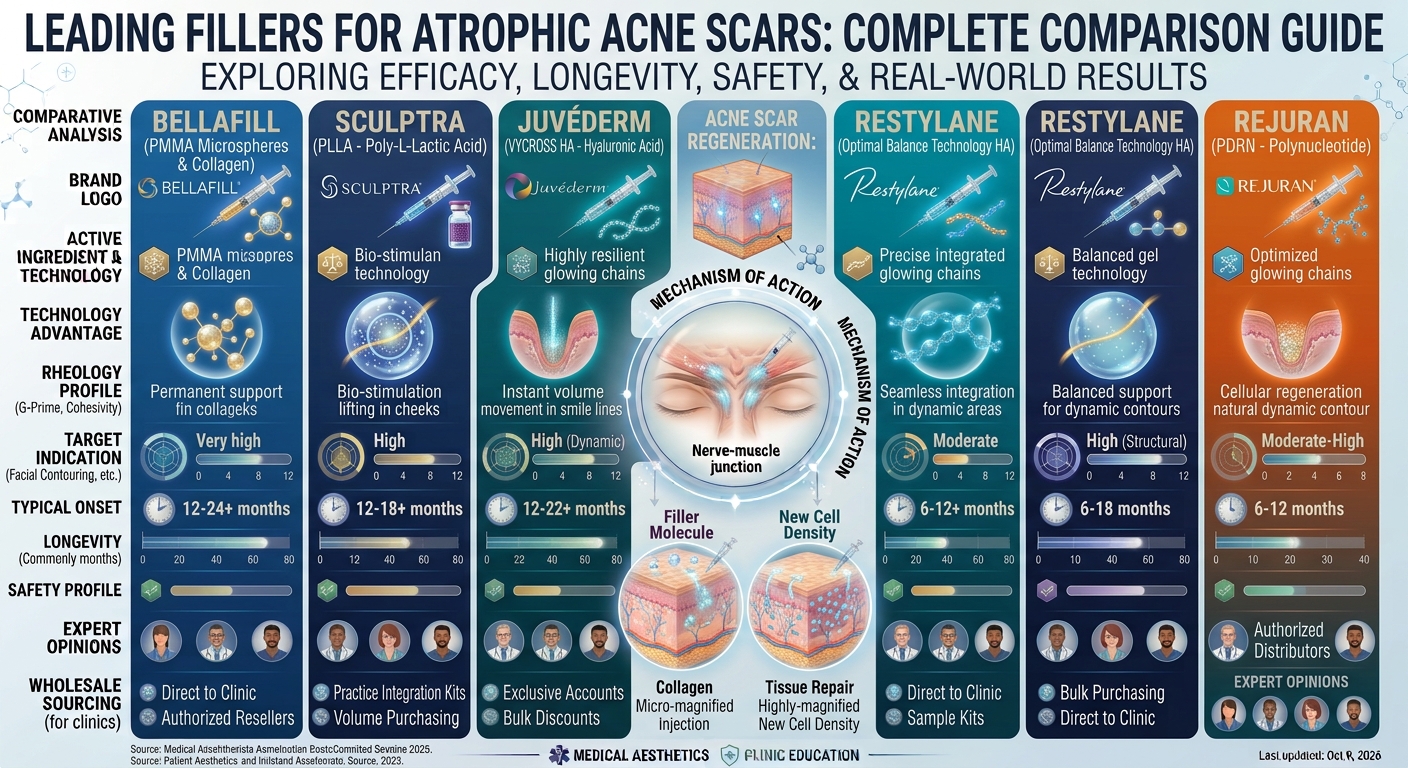
This comprehensive guide compares the most effective and clinically validated injectable treatments for acne scars: Bellafill, Sculptra, Radiesse, Juvéderm Voluma, Restylane Defyne, and Rejuran Healer. It includes expert practitioner insights, real-world patient feedback, and evidence-based treatment protocols.
⚠️ IMPORTANT MEDICAL DISCLAIMER
Dermal fillers and biostimulators are medical devices that must be administered only by appropriately qualified healthcare professionals. Acne scar treatment often requires advanced techniques like subcision. This article is for educational purposes and does not replace official product labeling, clinical training, or professional medical judgment.
📑 Table of Contents
- Quick Comparison
- The Clinical Challenge: Understanding Acne Scar Morphology
- Leading Injectables: Individual Clinical Profiles
- The “Layered” Treatment Protocol: Fillers + Subcision
- Safety Considerations and Risk Management
- Wholesale Sourcing and Supply Chain Verification
- Frequently Asked Questions (FAQ)
- Conclusion
1. Quick Comparison
The following table provides a high-level overview of the leading injectable options for atrophic acne scars. Always confirm the specific product variant and its local regulatory authorization.
| Brand | Active Ingredient | Key Technology | Best For Scar Type | Longevity |
|---|---|---|---|---|
| Bellafill | PMMA microspheres + Bovine Collagen | Permanent collagen scaffold | Deep rolling & boxcar scars | Up to 5 years |
| Sculptra | Poly-L-Lactic Acid (PLLA) | Biostimulatory neocollagenesis | Broad, shallow rolling scars | 24+ months |
| Radiesse | Calcium Hydroxylapatite (CaHA) | Immediate volume + collagen stimulation | Deep, tethered rolling scars | 12–18 months |
| Juvéderm Voluma | Hyaluronic Acid (HA) | Vycross® (High G-prime) | Deep structural lifting under scars | 18–24 months |
| Restylane Defyne | Hyaluronic Acid (HA) | XpresHAn™ (Flexible) | Dynamic areas (cheeks when smiling) | 12 months |
| Rejuran Healer | Polynucleotides (PDRN) | Cellular regeneration & repair | Shallow scars, skin texture, and quality | 6–9 months |
↔ Scroll horizontally to view the full table
2. The Clinical Challenge: Understanding Acne Scar Morphology
Not all acne scars respond to fillers. A successful outcome begins with accurate diagnosis of the scar type:
- Rolling Scars: Broad, shallow depressions with sloping edges, caused by fibrous bands tethering the dermis to the subcutaneous tissue. These are the most responsive to fillers, especially when combined with subcision.
- Boxcar Scars: Wider depressions with sharp, defined vertical edges. Shallow boxcar scars respond well to HA fillers or biostimulators; deep boxcar scars often require surgical excision, TCA CROSS, or aggressive laser resurfacing first.
- Ice Pick Scars: Deep, narrow, V-shaped tracts extending into the deep dermis. Fillers are generally ineffective for ice pick scars. TCA CROSS or punch excision is the gold standard.
The Golden Rule of Scar Fillers: Injecting filler into a tethered scar without first releasing the fibrous bands (via subcision) is like putting a mattress over a nail. The scar will simply pull the filler down, resulting in poor outcomes and wasted product.
3. Leading Injectables: Individual Clinical Profiles
Editorial note: The following sections summarize product characteristics, clinical consensus, expert opinions, and real-world market feedback. They do not constitute a ranking of clinical superiority.
1. Bellafill (Suneva Medical)
Clinical Consensus Metrics:
📜 Track Record & Data: ⭐⭐⭐⭐⭐
⏱️ Longevity: ⭐⭐⭐⭐⭐
⚠️ Risk Profile: ⭐⭐⭐ (Requires strict protocol)
✅ Key Advantages (Pros)
- The Only FDA-Approved Filler for Acne Scars: Backed by a rigorous 5-year clinical trial specifically for atrophic facial acne scars.
- Semi-Permanent Results: Contains 20% polymethylmethacrylate (PMMA) microspheres that create a permanent collagen scaffold, with results lasting up to 5 years or more.
- Immediate + Long-Term Effect: The 80% bovine collagen carrier provides instant volume, while the PMMA stimulates the patient’s own collagen over time.
⚠️ Important Considerations (Cons)
- Mandatory Skin Testing: Requires two negative bovine collagen skin tests, one month apart, prior to treatment due to allergy risk.
- Non-Reversible: Unlike HA fillers, PMMA cannot be dissolved with hyaluronidase. Nodules or overcorrection require surgical excision or steroid injections.
- Technique-Sensitive: Must be placed deeply; superficial placement guarantees visible, permanent nodules.
👨⚕️ Expert Practitioner Opinions
Dr. Doris Day — 🇺🇸 USA | Board-Certified Dermatologist
“Bellafill is a game-changer for the right patient with deep, rolling acne scars. The 5-year durability data is unmatched in the filler world. However, it demands absolute respect. I only use it in patients who have passed the skin test, and I place it strictly in the deep dermis or subcutaneous plane after thorough subcision. When done correctly, it is truly life-changing for scar patients.”
💬 Community & Patient Feedback Trends
RealSelf: Bellafill holds a “Worth It” rating of ~85% for acne scars. Patients frequently describe it as “the only thing that finally worked” after years of failed laser treatments. The most common complaint is the initial swelling (which can last 1-2 weeks) and the frustration of the 2-month skin testing protocol.
Reddit (r/AcneScars): Highly polarized. Success stories praise the permanent improvement in deep rolling scars. However, users strongly warn against inexperienced injectors, sharing cautionary tales of permanent lumps when the product was placed too superficially.
2. Sculptra (Galderma)
Clinical Consensus Metrics:
📜 Track Record & Data: ⭐⭐⭐⭐⭐
🔄 Natural Regeneration: ⭐⭐⭐⭐⭐
⏱️ Onset Speed: ⭐⭐
✅ Key Advantages (Pros)
- Broad Area Remodeling: Ideal for diffuse, shallow rolling scars and overall skin thinning caused by severe acne.
- Neocollagenesis: Stimulates the body to produce its own Type I collagen, creating a natural, integrated improvement rather than a “filled” look.
- Longevity: Results can last 2 years or more, acting as a “collagen bank” for the skin.
⚠️ Important Considerations (Cons)
- Delayed Results: No immediate volume. Patients must wait 6–12 weeks to see significant improvement.
- Nodule Risk: Requires meticulous reconstitution (often 24+ hours in advance) and strict post-treatment massage (“5-5-5 rule”) to prevent granulomas.
- Not for Deep, Isolated Scars: Better for broad textural improvement than lifting a single deep, tethered scar.
Dr. Sabrina Fabi — 🇺🇸 USA | Board-Certified Dermatologist
“For patients with widespread, shallow rolling scars and overall skin thinning, Sculptra is my top choice. It doesn’t just fill a hole; it rebuilds the dermal architecture. I often hyper-dilute it and use it in combination with microneedling or subcision for a synergistic, natural-looking rejuvenation that patients absolutely love.”
💬 Community & Patient Feedback Trends
RealSelf: Patients praise the “invisible” nature of the results. A common review theme is, “My skin just looks healthier and thicker, and the scars are much less noticeable, but no one can tell I had ‘work’ done.”
3. Radiesse (Merz Aesthetics)
Clinical Consensus Metrics:
📜 Track Record & Data: ⭐⭐⭐⭐⭐
🏗️ Structural Lift: ⭐⭐⭐⭐⭐
🔄 Reversibility: ⭐ (Non-reversible)
✅ Key Advantages (Pros)
- Dual Action: The CMC gel carrier provides immediate lifting of the depressed scar, while the CaHA microspheres stimulate long-term collagen production.
- High Viscosity: Excellent for deep, tethered rolling scars that require significant structural support to stay elevated.
- Hyper-dilution Capability: Can be diluted (1:3 or 1:4 with saline/lidocaine) for broader, superficial skin tightening and textural improvement over scarred areas.
⚠️ Important Considerations (Cons)
- Non-Reversible: Cannot be dissolved with hyaluronidase. Precision is paramount.
- Superficial Risk: Must never be placed in the superficial dermis, as it will cause visible, palpable white nodules.
💬 Community & Patient Feedback Trends
Reddit (r/AcneScars): Frequently discussed as a powerful option for “ice pick-adjacent” or deep boxcar scars when combined with subcision. Users note that the immediate lift is satisfying, and the skin continues to improve in texture over the following months.
4. Juvéderm Voluma (Allergan Aesthetics)
Clinical Consensus Metrics:
📜 Track Record & Data: ⭐⭐⭐⭐⭐
🎯 Precision: ⭐⭐⭐⭐⭐
💰 Cost-Effectiveness: ⭐⭐⭐
✅ Key Advantages (Pros)
- Supreme Lifting Capacity: Its high G-prime makes it the ideal HA filler to place deeply under a tethered scar to physically push it upward.
- Reversible: The ultimate safety net. If the result is uneven or a nodule forms, it can be completely dissolved with hyaluronidase.
- Low Hydrophilicity: Vycross® technology minimizes water absorption, preventing the “puffy” look that can ironically make scars look more prominent.
⚠️ Important Considerations (Cons)
- Temporary: Lasts 12–18 months in scar tissue, which is often shorter than in the cheeks due to the dynamic nature of the scarred tissue.
- Cost: Requires multiple syringes for widespread scarring, making it a significant financial investment over time.
Dr. Tim Pearce — 🇬🇧 United Kingdom | Aesthetic Doctor & Educator
“When I have a deep, rolling scar that has been successfully subcised, I need a filler that will hold its ground. Voluma’s high cohesivity and G-prime make it an excellent ‘prop’ to keep the scar elevated. Plus, the reversibility gives both me and the patient peace of mind.”
5. Restylane Defyne (Galderma)
Clinical Consensus Metrics:
📜 Track Record & Data: ⭐⭐⭐⭐⭐
🤸 Flexibility: ⭐⭐⭐⭐⭐
💰 Cost-Effectiveness: ⭐⭐⭐⭐
✅ Key Advantages (Pros)
- Dynamic Flexibility: XpresHAn™ technology allows the gel to stretch and compress, making it perfect for scars on the cheeks that distort when the patient smiles.
- Smooth Integration: Blends seamlessly into the mid-dermis without creating a rigid, palpable lump.
- Reversible: Like all HA fillers, it can be adjusted or dissolved if necessary.
⚠️ Important Considerations (Cons)
- Lacks the sheer lifting power of Voluma or Radiesse, making it less suitable for very deep, severe tethered scars.
6. Rejuran Healer / Polynucleotides (PharmaResearch)
Clinical Consensus Metrics:
📜 Track Record & Data: ⭐⭐⭐⭐
🧬 Cellular Repair: ⭐⭐⭐⭐⭐
⏱️ Onset Speed: ⭐⭐
✅ Key Advantages (Pros)
- True Regeneration: PDRN (salmon DNA) stimulates fibroblast activity, thickening the dermis and improving the overall quality and elasticity of scarred skin.
- Zero Tyndall or Puffiness Risk: Unlike HA fillers, it does not attract water or add artificial volume, making it incredibly safe for superficial scar treatment.
- Synergy with Microneedling: Frequently used as the “serum” during microneedling sessions to accelerate healing and boost collagen production in scarred tissue.
⚠️ Important Considerations (Cons)
- Not a Volumizer: Will not lift a deep, depressed scar. It is strictly for textural improvement and shallow scarring.
- Requires Multiple Sessions: Typically requires 3–4 sessions spaced a month apart for noticeable results.
💬 Community & Patient Feedback Trends
Reddit (r/SkincareAddiction): Highly praised as an adjunct therapy. Users note that while it didn’t “fill” their deep scars, it dramatically improved the overall smoothness, redness, and “glass skin” appearance of their acne-scarred cheeks, making the scars much less noticeable in normal lighting.
4. The “Layered” Treatment Protocol: Fillers + Subcision
Experienced dermatologists rarely use fillers in isolation for acne scars. The gold standard is a multimodal, layered approach:
- Step 1: Subcision. A blunt cannula or Nokor needle is used to physically break the fibrous bands tethering the scar to the underlying tissue. This creates a small pocket and allows the skin to spring upward.
- Step 2: Filler Placement. Immediately after subcision, the filler (e.g., Voluma, Radiesse, or Bellafill) is injected into the newly created pocket to act as a “spacer,” preventing the fibrous bands from re-attaching and holding the skin in its elevated position.
- Step 3: Surface Resurfacing (Optional but Recommended). After the filler has settled (usually 4–6 weeks later), energy-based devices like CO2 laser, Erbium laser, or radiofrequency microneedling are used to smooth the sharp edges of boxcar scars and improve overall skin texture.
5. Safety Considerations and Risk Management
⚠️ CRITICAL SAFETY WARNING
While the cheeks are generally a safer zone than the nose or glabella, vascular occlusion remains a risk. Furthermore, the scarred tissue itself is unpredictable. Injecting fillers into acne scars carries a higher risk of nodule formation, unevenness, and the Tyndall effect if the wrong product or depth is chosen.
Key Safety Rules for Scar Treatment:
- Never use high G-prime HA or CaHA superficially. This is the leading cause of visible, permanent-looking lumps in scar patients.
- Undercorrect, don’t overcorrect. It is always safer to add a tiny amount of filler at a follow-up visit than to try and dissolve an overfilled, distorted scar.
- Respect the anatomy. Always aspirate before injecting, use a blunt cannula when possible, and inject slowly with low pressure.
- Contraindications: Active cystic acne in the treatment area (fillers can exacerbate inflammation or become infected), history of keloid scarring, and active herpes simplex (requires prophylactic antivirals).
6. Wholesale Sourcing and Supply Chain Verification
The market for dermal fillers is heavily targeted by counterfeiters. Using fake or improperly stored fillers for acne scars can lead to devastating complications, including granulomas, necrosis, and permanent disfigurement.
For medical clinics and authorized distributors, verifying the supply chain is non-negotiable:
- Regulatory Approval: Ensure the product has valid regulatory authorization (FDA, CE Mark, or local equivalent) for the intended use.
- Authorized Wholesale Distributors: Purchase only directly from the manufacturer or their explicitly authorized national wholesale distributors. For verified, medical-grade supplies, licensed clinics and authorized distributors can source premium, authentic products at:
- Authentication Features: Check for holographic seals, unique batch numbers, and scratch-off verification labels on all syringes and boxes.
- Cold Chain Integrity: Verify that the supplier maintains proper temperature controls during transit to prevent degradation of the product’s rheological properties.
Never purchase dermal fillers from unauthorized online marketplaces, social media sellers, or unverified third-party wholesalers.
7. Frequently Asked Questions (FAQ)
❓ Can fillers completely cure acne scars?
No. Fillers are a management tool, not a cure. They significantly improve the appearance of depressed scars by elevating them to the level of the surrounding skin, but they do not change the scar’s fundamental structure. A multimodal approach (subcision + filler + laser) yields the best results.
❓ Which filler is best for ice pick scars?
None. Fillers cannot effectively treat deep, narrow ice pick scars. The gold standard for ice pick scars is TCA CROSS (chemical reconstruction of skin scars) or surgical punch excision.
❓ How long does filler for acne scars last?
It varies by product. HA fillers (Voluma, Defyne) typically last 12–18 months in scar tissue. Biostimulators (Sculptra, Radiesse) last 18–24+ months. Bellafill is the only semi-permanent option, with clinical data showing results lasting up to 5 years.
❓ Does the treatment hurt?
Subcision can be uncomfortable, but the area is thoroughly numbed with local anesthetic (lidocaine injections or nerve blocks). Most modern fillers also contain lidocaine, making the injection process highly tolerable.
❓ Can HA fillers used for scars be dissolved if I don’t like the result?
Yes. This is the primary safety advantage of HA fillers (like Juvéderm and Restylane) over Bellafill or Radiesse. If the result is uneven or a nodule forms, hyaluronidase can be injected to dissolve the HA completely.
❓ Is it safe to buy acne scar fillers wholesale online?
Only if purchased from a verified, authorized wholesale distributor that requires proof of medical licensure. Reputable suppliers ensure cold-chain integrity, authentic packaging, and regulatory compliance. Always verify the supplier’s credentials before purchasing.
8. Conclusion: Choosing the Right Injectable for Acne Scars
Treating acne scars with injectables is a highly specialized skill that requires matching the product’s properties to the scar’s morphology.
- Choose Bellafill for patients seeking a long-term (5-year) solution for deep rolling scars, provided they pass the skin test and are treated by a highly experienced injector.
- Choose Sculptra for broad, shallow rolling scars and overall skin thinning, where gradual, natural collagen remodeling is the goal.
- Choose Radiesse or Juvéderm Voluma for deep, tethered scars that require immediate, robust structural lifting, ideally placed immediately after subcision.
- Choose Restylane Defyne for scars in highly dynamic areas (like the cheeks) that need to move naturally with facial expressions.
- Choose Rejuran / Polynucleotides as an adjunct therapy to improve overall skin texture, thickness, and healing in shallow, widespread scarring.
Ultimately, the success of acne scar treatment relies on the injector’s expertise in subcision, precise product placement, and realistic expectation management. For healthcare professionals, sourcing authentic products from verified, regulated wholesale channels is the foundational step in ensuring patient safety and optimal clinical outcomes.
📚 Official Sources and Further Reading
- FDA Drugs@FDA Database – Official U.S. prescribing information for Bellafill, Sculptra, Radiesse, Juvéderm, and Restylane.
- PubMed – Fillers for Atrophic Acne Scars – Peer-reviewed systematic reviews on the efficacy and safety of various fillers in acne scar management.
- PubMed – Subcision and Filler Synergy – Clinical studies demonstrating the superior outcomes of combining subcision with dermal fillers.
- EUDAMED – European medical device regulatory verification.
Editorial note: Medical regulations, product formulations, and clinical guidelines can change. Review the latest official documentation and local regulatory updates before publication or clinical application.