No products added!

Hyaluronic acid (HA) dermal fillers remain the cornerstone of non-surgical facial rejuvenation. By restoring lost volume, enhancing contours, and smoothing static wrinkles, HA fillers offer immediate, predictable, and reversible results. However, not all HA fillers are created equal.
The aesthetic market features a diverse array of HA filler brands, each utilizing unique cross-linking technologies, particle sizes, and rheological properties (such as G-prime and cohesivity) tailored for specific anatomical planes and treatment goals. Choosing the right product is critical for achieving natural-looking outcomes while minimizing complications.
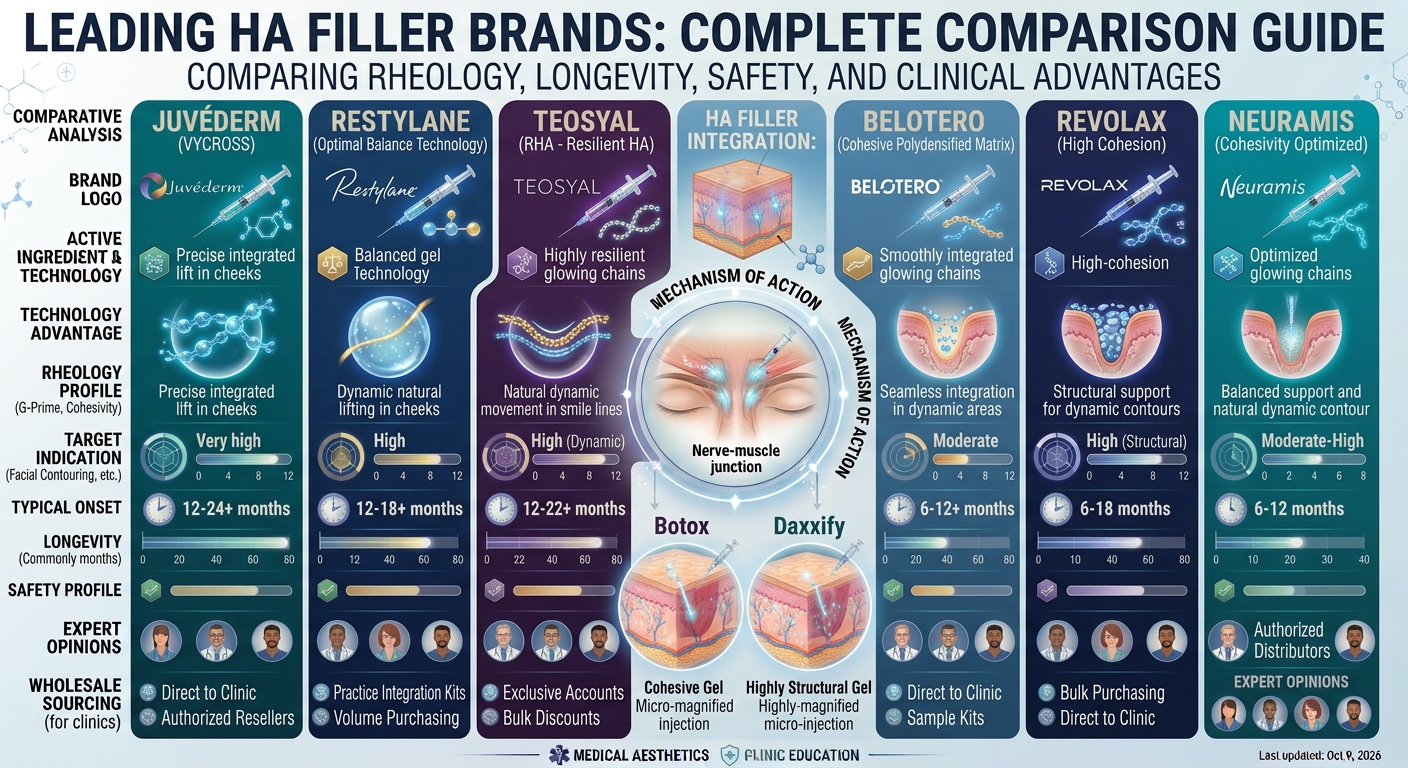
This guide provides a comprehensive, evidence-based comparison of the best hyaluronic acid filler brands available globally: Juvéderm, Restylane, Teosyal, Belotero, Revolax, and Neuramis. It covers formulation science, clinical indications, longevity, safety profiles, and best practices for wholesale sourcing.
⚠️ IMPORTANT MEDICAL DISCLAIMER
Dermal fillers are medical devices (or prescription medicines, depending on the jurisdiction) that must be handled, prescribed, and administered only by appropriately qualified healthcare professionals. This article is for educational purposes and does not replace official product labeling, clinical training, or professional medical judgment.
📑 Table of Contents
- Quick Comparison
- The Science of HA Fillers: Rheology & Cross-Linking
- Leading Brands: Individual Clinical Profiles
- Treatment Protocols: Matching Product to Anatomy
- Safety Considerations and Risk Management
- Wholesale Sourcing and Supply Chain Verification
- Frequently Asked Questions (FAQ)
- Conclusion
1. Quick Comparison
The following table provides a high-level overview of the leading hyaluronic acid filler brands and their signature technologies.
| Brand Family | Key Technology | Primary Strength | Typical Longevity | Origin |
|---|---|---|---|---|
| Juvéderm | Vycross® / Hylacross® | Smooth integration, high lift (Voluma/Volux) | 12–24 months | 🇺🇸 USA / 🇫🇷 France |
| Restylane | NASHA™ / OBT™ | Versatility, structural support (Lyft), flexibility (Defyne) | 9–18 months | 🇸🇪 Sweden / 🇨🇭 Switzerland |
| Teosyal | RHA (Resilient HA) | Dynamic movement, minimal swelling | 9–18 months | 🇨🇭 Switzerland |
| Belotero | CPM® (Cohesive Polydensified Matrix) | Superficial lines, zero Tyndall effect risk | 6–12 months | 🇩🇪 Germany |
| Revolax | High cross-linking, monophasic | Cost-effective, strong lifting capacity | 12–18 months | 🇰🇷 South Korea |
| Neuramis | SHAPE™ Technology | High purity, excellent value, versatile range | 9–15 months | 🇰🇷 South Korea |
↔ Scroll horizontally to view the full table
2. The Science of HA Fillers: Rheology & Cross-Linking
To select the best HA filler, practitioners must understand its rheological properties. These properties dictate how the filler behaves once injected into the tissue.
- G-Prime (Elastic Modulus): Measures the filler’s stiffness and lifting capacity. High G-prime fillers (e.g., Juvéderm Voluma, Restylane Lyft) are firm and ideal for deep structural volumizing (cheeks, chin, jawline). Low G-prime fillers (e.g., Belotero Soft, Restylane Refyne) are soft and ideal for superficial lines and lips.
- Cohesivity: The ability of the filler gel to stick together. High cohesivity prevents the product from migrating or spreading, ensuring it stays exactly where it is placed.
- Viscosity: The resistance of the gel to flow. Highly viscous fillers require more force to inject but provide robust structural support.
- Hydrophilicity (Water Absorption): HA naturally attracts water. Fillers with low hydrophilicity (like Juvéderm’s Vycross line) are preferred for areas prone to swelling, such as the tear troughs or lips, to avoid a puffy appearance.
3. Leading Brands: Individual Clinical Profiles
Editorial note: The following sections summarize product characteristics, clinical consensus, and real-world market feedback. They do not constitute a ranking of clinical superiority.
1. Juvéderm (Allergan Aesthetics / AbbVie)
Clinical Consensus Metrics:
📜 Track Record & Data: ⭐⭐⭐⭐⭐
💡 Innovation: ⭐⭐⭐⭐⭐
💰 Cost-Efficiency: ⭐⭐⭐
✅ Key Advantages
- Vycross® Technology: Blends high and low molecular weight HA, resulting in a smooth, highly cohesive gel with low water absorption and extended longevity (up to 24 months for Voluma/Volux).
- Comprehensive Portfolio: Tailored products for every indication (Volbella for lips/tear troughs, Voluma for cheeks, Volux for jawline/chin).
- Contains lidocaine for enhanced patient comfort.
⚠️ Considerations
- Premium pricing, making it one of the most expensive options on the market.
- High G-prime products require deep, supraperiosteal injection to avoid palpability.
2. Restylane (Galderma)
Clinical Consensus Metrics:
📜 Track Record & Data: ⭐⭐⭐⭐⭐
💡 Innovation: ⭐⭐⭐⭐⭐
💰 Cost-Efficiency: ⭐⭐⭐⭐
✅ Key Advantages
- Dual Technology: NASHA™ (Non-Animal Stabilized Hyaluronic Acid) provides firm, particulate gels for structural lift (Lyft). OBT™ (Optimal Balance Technology) provides flexible, cohesive gels for dynamic areas (Defyne, Refyne, Kysse).
- Exceptional versatility, allowing practitioners to use a single brand family for full-face harmonization.
- Proven long-term safety profile with over two decades of clinical use.
⚠️ Considerations
- NASHA-based products can feel slightly firmer initially and may carry a marginally higher risk of visible nodules if placed too superficially.
3. Teosyal (Teoxane)
Clinical Consensus Metrics:
📜 Track Record & Data: ⭐⭐⭐⭐
💡 Innovation: ⭐⭐⭐⭐⭐
💰 Cost-Efficiency: ⭐⭐⭐⭐
✅ Key Advantages
- RHA (Resilient Hyaluronic Acid) Technology: Preserves the natural, long-chain HA structure, making it highly elastic and resistant to the mechanical forces of facial movement.
- Ideal for dynamic areas like the lips (RHA 2), nasolabial folds (RHA 3), and forehead (RHA 4).
- Notoriously low post-treatment swelling, making it a favorite for patients with minimal downtime tolerance.
⚠️ Considerations
- Not FDA-approved in the United States (though widely available and CE-marked in Europe, Asia, and other global markets).
4. Belotero (Merz Aesthetics)
Clinical Consensus Metrics:
📜 Track Record & Data: ⭐⭐⭐⭐⭐
💡 Innovation: ⭐⭐⭐⭐
💰 Cost-Efficiency: ⭐⭐⭐⭐
✅ Key Advantages
- CPM® Technology: Creates a gel with varying densities, allowing it to integrate seamlessly into the skin at multiple depths.
- Lowest Tyndall Risk: Belotero Balance is widely considered the safest HA filler for superficial injection in the delicate tear trough area and for fine perioral “barcode” lines.
- Soft, natural feel with minimal risk of lumpiness.
⚠️ Considerations
- Low G-prime means it lacks the lifting capacity required for deep volumizing (e.g., cheeks or jawline).
- Shorter duration (6–9 months) compared to highly cross-linked structural fillers.
5. Revolax (Across Co., Ltd.)
Clinical Consensus Metrics:
📜 Track Record & Data: ⭐⭐⭐
💡 Innovation: ⭐⭐⭐⭐
💰 Cost-Efficiency: ⭐⭐⭐⭐⭐
✅ Key Advantages
- Monophasic, highly cross-linked HA gel offering strong lifting capacity (especially the Sub-Q variant).
- Exceptional cost-to-performance ratio, making it highly attractive for high-volume clinics or price-sensitive markets.
- Contains 0.3% lidocaine for patient comfort.
- CE-marked and widely used across Europe, the Middle East, and Asia.
⚠️ Considerations
- Not FDA-approved in the United States.
- Counterfeit products are prevalent; rigorous supply chain verification is absolutely mandatory.
6. Neuramis (Medytox Inc.)
Clinical Consensus Metrics:
📜 Track Record & Data: ⭐⭐⭐
💡 Innovation: ⭐⭐⭐⭐
💰 Cost-Efficiency: ⭐⭐⭐⭐⭐
✅ Key Advantages
- SHAPE™ Technology: (Stabilized Hyaluronic Acid and Purification Enhancement) ensures high purity, low residual BDDE, and consistent cross-linking.
- Available in multiple variants (Light, Deep, Volume) to address different tissue depths.
- Highly cost-effective with a smooth injection profile and minimal post-treatment swelling.
⚠️ Considerations
- Not FDA-approved in the United States.
- Long-term (10+ year) Western clinical data is less extensive compared to legacy brands like Juvéderm or Restylane.
4. Treatment Protocols: Matching Product to Anatomy
Selecting the correct filler is dictated by the anatomical requirements of the treatment area.
| Treatment Area | Required Rheology | Recommended Product Types |
|---|---|---|
| Cheeks / Midface | High G-prime, High Cohesivity | Juvéderm Voluma, Restylane Lyft, Revolax Sub-Q |
| Jawline / Chin | Very High G-prime, High Lift | Juvéderm Volux, Restylane Defyne, Neuramis Volume |
| Lips | Medium G-prime, High Flexibility | Juvéderm Volbella/Ultra, Restylane Kysse, Teosyal RHA 2 |
| Tear Troughs | Low G-prime, Low Hydrophilicity | Belotero Balance, Teosyal Redensity 2 |
| Fine Lines / Perioral | Low G-prime, High Integration | Belotero Soft, Restylane Refyne, Neuramis Light |
↔ Scroll horizontally to view the full table
5. Safety Considerations and Risk Management
⚠️ CRITICAL SAFETY WARNING: VASCULAR OCCLUSION
HA fillers carry a risk of accidental intravascular injection, which can lead to tissue necrosis or, in rare cases, blindness. Practitioners must have extensive knowledge of facial vascular anatomy, use appropriate techniques (aspiration, slow injection, low pressure, cannula use where appropriate), and have an emergency protocol in place, including immediate access to hyaluronidase.
Key Safety Considerations:
- The Tyndall Effect: A bluish discoloration caused by placing HA filler too superficially in thin skin. Mitigated by using low G-prime, highly integrated fillers like Belotero.
- Nodules and Lumps: Often result from improper product selection (e.g., using a high G-prime filler superficially) or poor injection technique. HA fillers are advantageous here because they can be dissolved with hyaluronidase.
- Reversibility: The presence of hyaluronidase is the ultimate safety net for HA fillers, distinguishing them from permanent or biostimulatory fillers.
- Contraindications: Active infection at the injection site, history of severe anaphylaxis, autoimmune disorders, and pregnancy/breastfeeding.
6. Wholesale Sourcing and Supply Chain Verification
The global dermal filler market is highly lucrative and, unfortunately, a prime target for counterfeit, diverted, or improperly stored products. Using compromised fillers can lead to severe complications, including granulomas, necrosis, and permanent scarring.
For medical spas, dermatology clinics, and authorized distributors, verifying the supply chain is a matter of patient safety and legal compliance. Before purchasing, verify the following:
- Regulatory Approval: Ensure the product has valid regulatory authorization (FDA, CE Mark, MFDS, or local equivalent) for the intended use.
- Authorized Wholesale Distributors: Purchase only directly from the manufacturer or their explicitly authorized national wholesale distributors. For verified, medical-grade supplies, licensed clinics and authorized distributors can source premium, authentic products at:
- Authentication Features: Check for holographic seals, unique batch numbers, QR codes, and scratch-off verification labels on all syringes and outer packaging.
- Temperature Control: While HA fillers are generally stable at room temperature, extreme heat during transit can degrade the cross-linking. Verify that the wholesale supplier maintains proper logistics.
Never purchase dermal fillers from unauthorized online marketplaces, social media sellers, or unverified third-party wholesalers.
7. Frequently Asked Questions (FAQ)
❓ Which HA filler brand is the absolute best?
There is no single “best” brand. The best filler is the one whose rheological properties (G-prime, cohesivity, hydrophilicity) precisely match the anatomical requirements of the treatment area and the injector’s technique.
❓ Are Korean fillers (Revolax, Neuramis) as safe as European or US brands?
Yes, when sourced legitimately. Brands like Revolax and Neuramis are CE-marked, manufactured in ISO-certified facilities, and offer excellent safety and efficacy profiles. The critical factor is ensuring product authenticity through authorized supply chains to avoid counterfeits.
❓ How long do HA fillers last?
Longevity depends on the product, injection depth, and the patient’s metabolic rate. Superficial fillers (lips, fine lines) typically last 6–9 months. Deep structural fillers (cheeks, jawline) can last 12–24 months.
❓ Can HA fillers be dissolved?
Yes. This is the primary safety advantage of HA fillers. If a patient is dissatisfied or if a complication (like vascular compromise or lumps) occurs, the filler can be rapidly dissolved using injections of the enzyme hyaluronidase.
❓ Is it safe to buy dermal fillers wholesale online?
Only if purchased from a verified, authorized wholesale distributor that requires proof of medical licensure. Reputable suppliers ensure authentic packaging, regulatory compliance, and proper handling. Always verify the supplier’s credentials before purchasing.
8. Conclusion: Choosing the Right HA Filler Based on Evidence
Juvéderm, Restylane, Teosyal, Belotero, Revolax, and Neuramis each offer distinct technological advantages. The choice should be driven by the patient’s anatomical needs, desired outcomes, budget, and the practitioner’s familiarity with the product’s handling characteristics.
A reliable, evidence-based approach prioritizes:
- Matching the filler’s rheology to the specific tissue plane (e.g., high G-prime for bone, low G-prime for superficial dermis).
- Maintaining a thorough understanding of facial anatomy to prevent vascular complications.
- Sourcing exclusively from authorized, traceable wholesale suppliers to guarantee product authenticity and patient safety.
- Ensuring the procedure is performed by a qualified, anatomically trained medical professional.
For healthcare professionals and qualified buyers, the strongest purchasing and clinical decisions are supported by verifiable clinical data, rigorous safety protocols, and legitimate, traceable supply chains.
📚 Official Sources and Further Reading
- FDA Drugs@FDA Database – Official U.S. prescribing information for Juvéderm, Restylane, and Belotero.
- PubMed – HA Filler Rheology Studies – Peer-reviewed clinical studies comparing G-prime, cohesivity, and longevity of major filler brands.
- PubMed – Vascular Occlusion Management – Clinical guidelines on preventing and treating filler-related vascular complications.
- EUDAMED – European medical device regulatory verification.
Editorial note: Medical regulations, product formulations, and clinical guidelines can change. Review the latest official documentation and local regulatory updates before publication or clinical application.