
No products added!
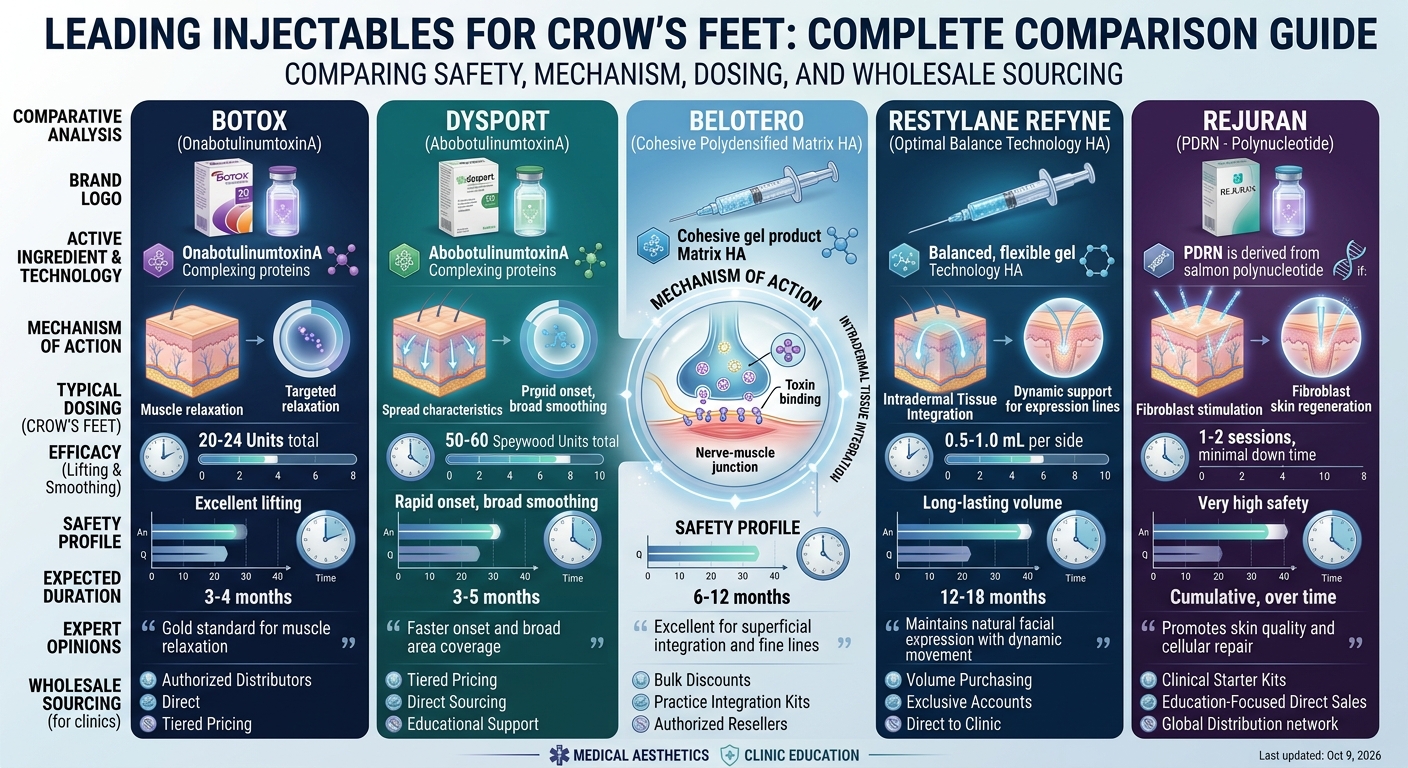

Lateral canthal lines, universally known as “crow’s feet,” are among the most dynamic and earliest signs of facial aging. Caused by the repetitive contraction of the orbicularis oculi muscle during smiling and squinting, combined with progressive skin thinning and sun damage, these radial lines can make a patient appear fatigued or older than they are.
Treating the periorbital area requires a highly nuanced, dual-approach strategy. Neuromodulators (botulinum toxins) are the undisputed first-line treatment to relax the muscle and prevent dynamic wrinkling. However, for deep, static lines that remain at rest, ultra-soft dermal fillers or polynucleotide biostimulators can be used cautiously to restore dermal thickness and smooth the crease.
This guide compares the most effective and safest injectable brands for crow’s feet, including leading neuromodulators, specialized soft fillers, and regenerative skinboosters. It focuses on diffusion profiles, rheology, safety, and real-world clinical feedback.
⚠️ IMPORTANT MEDICAL DISCLAIMER
All injectable products discussed are prescription medicines or medical devices. Treatment of the periorbital area carries elevated risks, including vascular occlusion, lymphatic obstruction (edema), and smiling asymmetry. These procedures must be performed only by appropriately qualified healthcare professionals with advanced anatomical knowledge. This article is for educational purposes and does not replace official product labeling or clinical training.
📑 Table of Contents
- Quick Comparison
- The Clinical Approach: Neuromodulators vs. Fillers
- Leading Neuromodulators for Crow’s Feet
- Leading Soft Fillers & Biostimulators for Static Lines
- Treatment Protocols and Layering Strategies
- Safety Considerations and Risk Management
- Regulatory Status and Wholesale Supply Chain Verification
- Frequently Asked Questions (FAQ)
- Conclusion
1. Quick Comparison
The following table provides a high-level overview of the leading injectable brands indicated or safely used off-label for lateral canthal lines. Always confirm local regulatory authorization.
| Brand | Category | Key Technology | Primary Benefit for Crow’s Feet | Origin |
|---|---|---|---|---|
| Botox Cosmetic | Neuromodulator | Precise, targeted diffusion | Gold standard for controlled muscle relaxation | 🇺🇸 USA / 🇮🇪 Ireland |
| Dysport | Neuromodulator | Wider, broader diffusion | Ideal for broad, fan-like lateral lines | 🇬🇧 UK / 🇫🇷 France |
| Xeomin | Neuromodulator | “Naked” toxin (no complexing proteins) | Lower immunogenicity for long-term users | 🇩🇪 Germany |
| Belotero Balance | Dermal Filler | CPM® Technology | Lowest Tyndall risk for superficial static lines | 🇩🇪 Germany |
| Restylane Refyne | Dermal Filler | XpresHAn™ Technology | High flexibility, moves naturally with smiling | 🇸🇪 Sweden / 🇨🇭 Switzerland |
| Teosyal RHA 1 | Dermal Filler | Resilient HA (RHA) | Designed specifically for superficial, dynamic lines | 🇨🇭 Switzerland |
| Rejuran I / Nucleofill Eyes | Biostimulator | Polynucleotides (PN/PDRN) | Dermal thickening without volume/Tyndall risk | 🇰🇷 South Korea / 🇮🇹 Italy |
↔ Scroll horizontally to view the full table
2. The Clinical Approach: Neuromodulators vs. Fillers
The periorbital area is unforgiving. The skin is the thinnest on the body (approx. 0.5mm), and the orbicularis oculi is a highly active sphincter muscle. Therefore, the treatment hierarchy is strict:
- First-Line: Neuromodulators. Botulinum toxin is the primary treatment. By relaxing the lateral fibers of the orbicularis oculi, dynamic lines are smoothed, and the progression to static lines is halted.
- Second-Line (Cautious): Ultra-Soft Fillers. If deep, etched-in static lines remain after neuromodulator treatment, micro-droplets of highly flexible, low G-prime HA fillers can be used. Thick, high G-prime fillers are strictly contraindicated due to the high risk of the Tyndall effect (bluish discoloration) and visible lumps.
- Alternative/Adjunct: Biostimulators. Polynucleotides (like Rejuran I) are increasingly preferred over HA fillers for this area, as they thicken the dermis and improve skin quality without adding physical volume or risking the Tyndall effect.
3. Leading Neuromodulators for Crow’s Feet
1. Botox Cosmetic (Allergan Aesthetics)
Clinical Consensus Metrics: 📜 ⭐⭐⭐⭐⭐ | 💡 ⭐⭐⭐⭐ | 💰 ⭐⭐⭐
✅ Key Advantages
- Precise, predictable diffusion profile allows for highly targeted treatment of lateral canthal lines.
- Gold standard for preserving the natural “Duchenne” smile while softening wrinkles.
- Extensive clinical data and FDA approval specifically for lateral canthal lines.
⚠️ Considerations
- Premium pricing.
- Slightly slower onset (3–5 days) compared to some competitors.
2. Dysport (Ipsen / Galderma)
Clinical Consensus Metrics: 📜 ⭐⭐⭐⭐⭐ | 💡 ⭐⭐⭐⭐ | 💰 ⭐⭐⭐⭐
✅ Key Advantages
- Smaller protein complex allows for wider, broader diffusion.
- Highly effective for patients with broad, fan-like crow’s feet, as it covers a larger surface area with fewer injection points.
- Notably faster onset of action (often visible within 24–48 hours).
⚠️ Considerations
- Requires meticulous placement to avoid migration toward the zygomaticus major (which can cause an asymmetrical smile).
- Units are not interchangeable with Botox.
4. Leading Soft Fillers & Biostimulators for Static Lines
Critical Note: Only ultra-soft, highly flexible products should be considered for the lateral canthal area. Overfilling or using high G-prime products will result in visible lumps and the Tyndall effect.
1. Belotero Balance (Merz Aesthetics)
Clinical Consensus Metrics: 📜 ⭐⭐⭐⭐⭐ | 💡 ⭐⭐⭐⭐ | 💰 ⭐⭐⭐⭐
✅ Key Advantages
- Lowest Tyndall Risk: CPM® (Cohesive Polydensified Matrix) technology allows seamless integration into the superficial dermis.
- Excellent for etched-in, static lateral canthal lines that persist after botulinum toxin treatment.
- Low hydrophilicity minimizes the risk of post-treatment periorbital edema (swelling).
⚠️ Considerations
- Provides minimal lifting capacity; strictly for superficial line softening, not volume restoration.
- Shorter duration (6–9 months) compared to deeper fillers.
2. Restylane Refyne (Galderma)
Clinical Consensus Metrics: 📜 ⭐⭐⭐⭐⭐ | 💡 ⭐⭐⭐⭐⭐ | 💰 ⭐⭐⭐⭐
✅ Key Advantages
- XpresHAn™ Technology provides exceptional flexibility and elasticity.
- Designed specifically to move naturally with dynamic facial expressions (like smiling), preventing a “stiff” appearance.
- Integrates smoothly into the mid-to-superficial dermis.
⚠️ Considerations
- Requires an injector highly skilled in micro-droplet techniques to avoid visibility.
3. Rejuran I / Nucleofill Eyes (Biostimulators)
Clinical Consensus Metrics: 📜 ⭐⭐⭐⭐ | 💡 ⭐⭐⭐⭐⭐ | 💰 ⭐⭐⭐⭐
✅ Key Advantages
- Zero Tyndall Risk: As polynucleotides, they do not scatter light, making them the safest injectable for thin periorbital skin.
- Stimulates fibroblasts to physically thicken the dermis, reducing the visibility of underlying static lines and vascular dark circles.
- Improves overall skin elasticity and hydration without adding artificial volume.
⚠️ Considerations
- Does not provide immediate volumetric filling; results are gradual (4–8 weeks).
- Requires a series of treatments (typically 3 sessions) for optimal collagen remodeling.
5. Treatment Protocols and Layering Strategies
The most effective and safest approach to crow’s feet is often a staged, layered protocol:
- Step 1: Neuromodulator First. Inject Botox, Dysport, or Xeomin into the lateral orbicularis oculi. Wait 10–14 days for the muscle to fully relax and the dynamic lines to soften.
- Step 2: Reassessment. Evaluate the patient at rest. If deep, static creases remain, proceed to Step 3.
- Step 3: Micro-Filling or Biostimulation. Using a 32G needle or 27G cannula, place micro-droplets (0.02–0.05mL per line) of Belotero Balance, Restylane Refyne, or Rejuran I directly into the dermal crease. Never overfill.
6. Safety Considerations and Risk Management
⚠️ CRITICAL SAFETY WARNING
The lateral canthal area is traversed by the zygomatico-orbital and palpebral branches of the facial artery. While the risk of catastrophic vascular occlusion is lower here than in the glabella or nose, it is not zero. Furthermore, improper filler placement is the leading cause of the Tyndall effect and chronic periorbital edema (lymphatic obstruction).
Key Safety Rules for Crow’s Feet:
- Preserve the Smile: Avoid injecting too close to the zygomaticus major muscle to prevent a crooked or asymmetric smile.
- Superficial Caution: If using HA filler, it must be placed strictly in the superficial dermis. Deep placement is ineffective for fine lines and increases migration risk.
- Conservative Dosing: “Less is more.” It is always easier to add a micro-drop later than to dissolve an overfilled, lumpy crow’s foot.
- Contraindications: Active skin infections, severe dry eye syndrome (neuromodulators can exacerbate this by reducing blink strength), and known hypersensitivity to product components.
7. Regulatory Status and Wholesale Supply Chain Verification
The aesthetic injectables market is heavily targeted by counterfeiters. For medical spas, clinics, and authorized distributors, verifying the supply chain is a matter of patient safety, regulatory compliance, and professional reputation. Using diverted or fake products can lead to severe complications, including necrosis and permanent scarring.
Before purchasing, verify the following:
- Regulatory Approval: Ensure the product has valid regulatory authorization (FDA, EMA, MHRA, or local equivalent) for the intended use.
- Authorized Wholesale Distributors: Purchase only directly from the manufacturer or their explicitly authorized national wholesale distributors. For verified, medical-grade supplies, licensed clinics and authorized distributors can source premium products at:
- Authentication Features: Check for holographic seals, unique batch numbers, and scratch-off verification labels on all vials and boxes.
- Cold Chain Integrity: Verify that the wholesale supplier maintains proper refrigeration (2–8°C) during transit, as heat degradation can render botulinum toxins inactive.
Never purchase injectables from unauthorized online marketplaces, social media sellers, or unverified third-party wholesalers.
8. Frequently Asked Questions (FAQ)
❓ Can dermal fillers make crow’s feet worse?
Yes, if the wrong product or technique is used. Thick, high G-prime fillers (like those used for cheeks or lips) placed in the thin periorbital skin will cause visible lumps, the Tyndall effect (bluish discoloration), and chronic swelling. Only ultra-soft fillers or biostimulators should be used by highly experienced injectors.
❓ Which is better for crow’s feet: Botox or filler?
Botox (neuromodulators) is always the first-line and primary treatment. Fillers are only used as a secondary, cautious addition for deep, static lines that remain after the muscle has been relaxed by Botox.
❓ How long do crow’s feet injections last?
Neuromodulators typically last 3–4 months (up to 6 months for Daxxify). Ultra-soft fillers like Belotero Balance last 6–9 months in this highly mobile area. Biostimulators like Rejuran require a series of treatments but can improve skin quality for 9–12 months.
❓ Is it safe to buy Botox and fillers wholesale online?
It is only safe if purchased from a verified, authorized wholesale distributor that requires proof of medical licensure. Reputable suppliers ensure cold-chain integrity, authentic packaging, and regulatory compliance. Always verify the supplier’s credentials before purchasing.
❓ Can I get Botox for crow’s feet if I have dry eyes?
Patients with severe dry eye syndrome should consult their ophthalmologist first. Relaxing the orbicularis oculi muscle can temporarily reduce blink strength and tear film distribution, potentially exacerbating dry eye symptoms.
9. Conclusion: A Delicate Balance for Optimal Results
Reducing crow’s feet requires a delicate balance of art and science. Neuromodulators like Botox and Dysport remain the undisputed gold standard for halting dynamic wrinkling. For residual static lines, ultra-soft fillers like Belotero Balance or regenerative biostimulators like Rejuran I offer safe, effective solutions when used with extreme precision.
A reliable, evidence-based approach prioritizes:
- Neuromodulators as the primary treatment, with fillers used only as a cautious secondary step.
- Conservative, micro-droplet dosing to preserve natural facial expressions and avoid the Tyndall effect.
- Sourcing exclusively from authorized, verified wholesale suppliers to guarantee product authenticity and patient safety.
- Ensuring the procedure is performed by a qualified, anatomically trained medical professional.
For healthcare professionals and qualified buyers, the strongest purchasing and clinical decisions are supported by verifiable clinical data, rigorous safety protocols, and legitimate, traceable supply chains.
📚 Official Sources and Further Reading
- FDA Drugs@FDA Database – Official U.S. prescribing information for Botox, Dysport, Xeomin, Belotero, and Restylane.
- PubMed – Botulinum Toxin for Lateral Canthal Lines – Peer-reviewed clinical studies on efficacy and dosing.
- PubMed – Periorbital Filler Complications – Clinical research on avoiding the Tyndall effect and edema in the eye area.
- EUDAMED – European medical device and pharmaceutical regulatory verification.
Editorial note: Medical regulations, product formulations, and clinical guidelines can change. Review the latest official documentation and local regulatory updates before publication or clinical application.