No products added!

Masseter muscle hypertrophy is a common concern, manifesting as a wide, square lower face or chronic symptoms of bruxism (teeth grinding) and temporomandibular joint (TMJ) discomfort. Botulinum toxin type A injections have become the gold-standard, non-surgical treatment for relaxing the masseter muscle, inducing targeted atrophy, and creating a softer, more V-shaped jawline.
However, the masseter is a thick, powerful, and broad muscle. Treating it effectively requires a neurotoxin that can adequately penetrate and diffuse through dense muscle tissue. This raises a common clinical question: Is Botox (onabotulinumtoxinA) or Dysport (abobotulinumtoxinA) the superior choice for masseter reduction?
This guide provides a comprehensive, evidence-based comparison of Botox and Dysport specifically for masseter reduction. It covers diffusion profiles, dosing ratios, onset of action, cost-effectiveness, safety, and real-world feedback from both practitioners and patients.
⚠️ IMPORTANT MEDICAL DISCLAIMER
Botulinum toxin injections for masseter reduction are considered an off-label use in many jurisdictions (including by the US FDA), though it is a widely accepted and standard clinical practice globally. These procedures must be performed only by appropriately qualified healthcare professionals with advanced knowledge of facial anatomy to avoid complications like smile asymmetry or chewing dysfunction. This article is for educational purposes and does not replace official product labeling or clinical training.
📑 Table of Contents
- Quick Comparison
- The Clinical Challenge: Why the Masseter is Unique
- Botox for Masseter Reduction: Profile & Efficacy
- Dysport for Masseter Reduction: Profile & Efficacy
- Dosing, Conversion, and Treatment Protocols
- Safety Considerations and Risk Management
- Wholesale Sourcing and Supply Chain Verification
- Frequently Asked Questions (FAQ)
- Conclusion
1. Quick Comparison
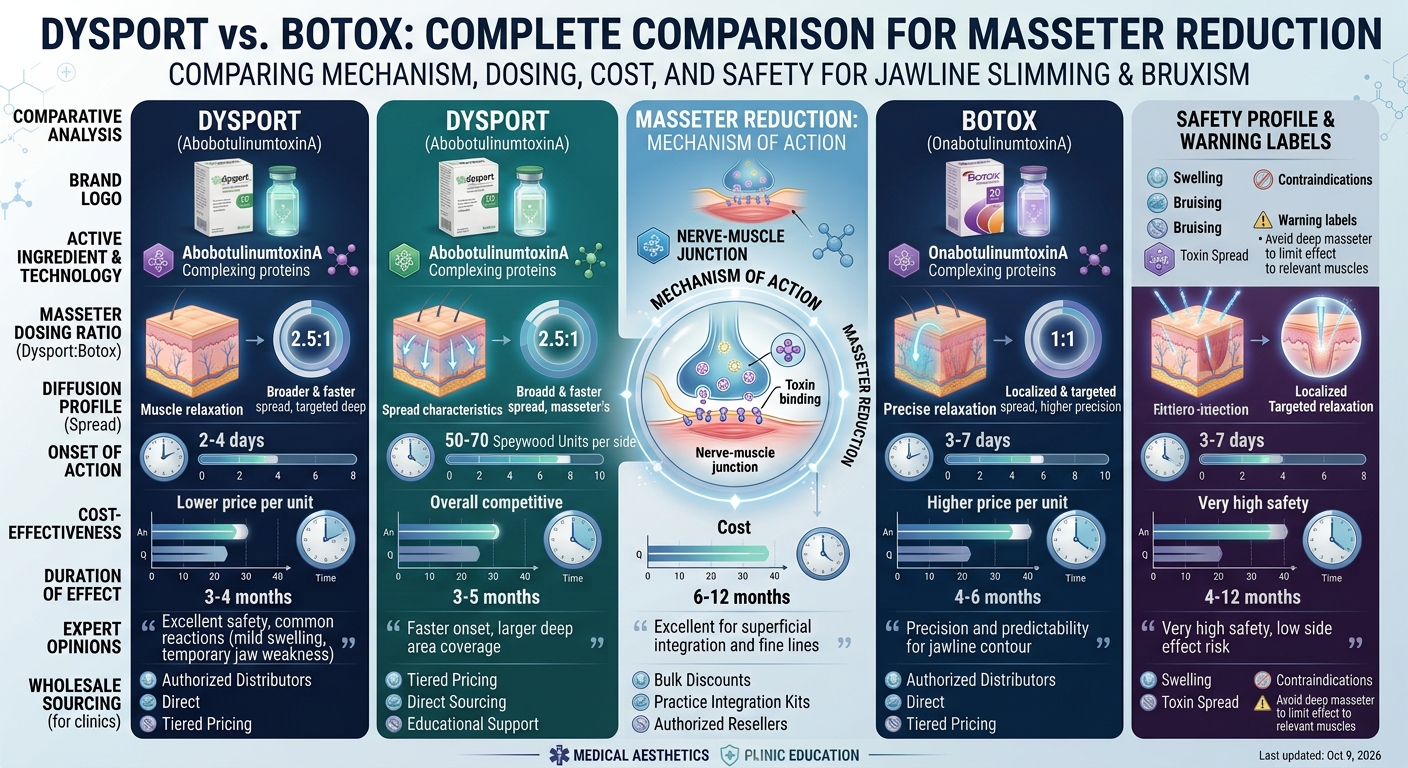
The following table highlights the key clinical differences between Botox and Dysport when used for masseter reduction.
| Feature | Botox (OnabotulinumtoxinA) | Dysport (AbobotulinumtoxinA) |
|---|---|---|
| Molecular Complex Size | Larger (900 kDa) | Smaller (500-900 kDa, more diffuse) |
| Diffusion Profile | Precise, targeted, localized | Wider, broader spread |
| Onset of Action | 3–5 days (peak at 10-14 days) | 1–3 days (peak at 7-10 days) |
| Typical Masseter Dose (Per Side) | 20–30+ Units | 50–75+ Units |
| Cost-Effectiveness for Large Muscles | Premium pricing | Generally more cost-effective per treatment area |
| Risk of Smile Asymmetry | Lower (due to targeted diffusion) | Slightly higher (requires careful placement) |
↔ Scroll horizontally to view the full table
2. The Clinical Challenge: Why the Masseter is Unique
The masseter is not a delicate facial expression muscle; it is a thick, powerful muscle of mastication. Treating it effectively presents unique challenges:
- Muscle Thickness: The muscle can be several centimeters thick in patients with severe hypertrophy, requiring the toxin to diffuse deeply and broadly to achieve uniform relaxation.
- High Unit Requirements: Masseter reduction requires significantly higher doses than cosmetic treatments for the forehead or crow’s feet.
- Proximity to Smile Muscles: The anterior border of the masseter sits dangerously close to the risorius and zygomaticus major muscles. Over-diffusion can lead to a crooked or asymmetric smile.
Because of these factors, the diffusion profile of the chosen neurotoxin becomes a critical deciding factor for the injector.
3. Botox for Masseter Reduction: Profile & Efficacy
Clinical Consensus Metrics:
📜 Track Record & Data: ⭐⭐⭐⭐⭐
🎯 Precision: ⭐⭐⭐⭐⭐
💰 Cost-Effectiveness: ⭐⭐⭐
✅ Key Advantages
- Precise Control: Its larger molecular complex and targeted diffusion allow injectors to place the toxin exactly where needed, minimizing the risk of affecting adjacent smile muscles.
- Extensive Data: Botox has the most robust body of peer-reviewed clinical literature supporting its safety and efficacy for masseter hypertrophy and bruxism.
- Predictability: Highly consistent results with a well-understood duration of 3–4 months (sometimes up to 6 months with repeated treatments).
⚠️ Important Considerations
- Premium Cost: Because it requires higher unit volumes for the masseter, the per-patient cost is significantly higher than with wider-diffusing alternatives.
- More Injection Points: To cover the broad surface area of a large masseter, injectors may need to use more injection points compared to Dysport.
👨⚕️ Expert Practitioner Opinion
“For patients with very prominent, bulky masseters who are prone to smile asymmetry, I prefer Botox. Its predictable, localized diffusion gives me the confidence to treat the posterior belly of the muscle aggressively without worrying about the toxin migrating anteriorly to the risorius.” — Dr. Jean Carruthers, Pioneer in Cosmetic Botulinum Toxin.
4. Dysport for Masseter Reduction: Profile & Efficacy
Clinical Consensus Metrics:
📜 Track Record & Data: ⭐⭐⭐⭐⭐
🌊 Diffusion: ⭐⭐⭐⭐⭐
💰 Cost-Effectiveness: ⭐⭐⭐⭐⭐
✅ Key Advantages
- Superior Diffusion: Dysport’s smaller protein complex spreads more readily through dense tissue, making it highly effective for covering the broad surface area of the masseter with fewer injection points.
- Faster Onset: Patients often report feeling a reduction in jaw clenching and seeing softening within 24–48 hours, compared to 3–5 days for Botox.
- Cost-Effective: Due to its wider spread and lower cost-per-unit, Dysport is frequently more economical for treating large muscle groups like the masseter or calves.
⚠️ Important Considerations
- Migration Risk: The wider diffusion requires meticulous injection placement. Injecting too far anteriorly can easily affect the zygomaticus muscles, causing a temporary asymmetric smile.
- Unit Confusion: Dysport units are not interchangeable with Botox units. Clinics must be rigorously trained on the specific dosing and conversion ratios to avoid under- or over-dosing.
👨⚕️ Expert Practitioner Opinion
“Dysport is my workhorse for masseter reduction and bruxism. Its broader diffusion profile ensures that the entire bulk of the muscle is treated evenly, preventing the ‘lumpy’ relaxation that can sometimes happen with more localized toxins. For the right patient, it offers faster relief and better value.” — Dr. Tim Pearce, Aesthetic Medicine Educator.
5. Dosing, Conversion, and Treatment Protocols
CRITICAL WARNING: Botulinum toxin units are NOT interchangeable. A 1:1 conversion between Botox and Dysport is incorrect and dangerous. While a 1:2.5 or 1:3 ratio is often cited for cosmetic facial areas, masseter dosing requires clinical judgment based on muscle bulk.
| Product | Typical Dose (Per Side) | Injection Points | Depth |
|---|---|---|---|
| Botox | 20 – 30+ Units | 3 – 5 points per side | Deep intramuscular (avoiding superficial layers) |
| Dysport | 50 – 75+ Units | 3 – 5 points per side | Deep intramuscular (avoiding superficial layers) |
↔ Scroll horizontally to view the full table
Note: Dosing must be individualized. Male patients or those with severe bruxism often require higher doses. Ultrasound guidance is increasingly recommended to accurately map muscle thickness and avoid the parotid gland or facial artery.
6. Safety Considerations and Risk Management
⚠️ CRITICAL SAFETY WARNING
Improper injection technique in the masseter can lead to significant functional and aesthetic complications. Practitioners must have a thorough understanding of the superficial musculoaponeurotic system (SMAS) and facial nerve branches in this region.
Key Risks to Mitigate:
- Smile Asymmetry: Caused by anterior diffusion into the risorius or zygomaticus major. Mitigation: Stay in the posterior 2/3 of the masseter, especially when using Dysport. Pinch the muscle to isolate it.
- Chewing Weakness / Fatigue: A common, usually transient side effect in the first 1–2 weeks as the muscle atrophies. Mitigation: Start with conservative dosing and titrate up at follow-up visits.
- Parotid Gland Injury: The parotid gland sits superficial and posterior to the masseter. Mitigation: Inject deeply and avoid the posterior-superior border of the muscle. Ultrasound guidance is highly recommended.
- Bone Resorption: Emerging long-term studies suggest that chronic, high-dose masseter botulinum toxin may lead to mild mandibular bone density changes. Mitigation: Use the lowest effective dose and allow adequate intervals (4-6 months) between treatments.
7. Wholesale Sourcing and Supply Chain Verification
The market for botulinum toxins is highly lucrative and, consequently, a prime target for counterfeit, diverted, or improperly stored products. Using compromised neurotoxins for masseter reduction not only yields poor clinical results but poses severe safety risks to patients.
For medical spas, dental clinics, and authorized distributors, verifying the supply chain is a matter of legal compliance and patient safety. Before purchasing, verify the following:
- Regulatory Approval: Ensure the product has valid regulatory authorization (FDA, EMA, MHRA, or local equivalent).
- Authorized Wholesale Distributors: Purchase only directly from the manufacturer or their explicitly authorized national wholesale distributors. For verified, medical-grade supplies, licensed clinics and authorized distributors can source premium products at:
- Authentication Features: Check for holographic seals, unique batch numbers, and scratch-off verification labels on all vials and boxes.
- Cold Chain Integrity: Verify that the wholesale supplier maintains proper refrigeration (2–8°C) during transit, as heat degradation can render the toxin permanently inactive.
Never purchase botulinum toxins from unauthorized online marketplaces, social media sellers, or unverified third-party wholesalers.
8. Frequently Asked Questions (FAQ)
❓ Is Dysport or Botox better for jawline slimming?
Neither is universally “better”; it depends on the patient and the injector’s technique. Dysport is often preferred for its broader diffusion, which efficiently treats the large surface area of the masseter, and its cost-effectiveness. Botox is preferred when precise, targeted control is needed to avoid affecting adjacent smile muscles, especially in patients with a history of smile asymmetry.
❓ Can I switch from Botox to Dysport for my masseter?
Yes, but your injector must recalculate the dose. You cannot use a 1:1 unit ratio. A typical conversion is 1 unit of Botox to 2.5 or 3 units of Dysport, though masseter protocols may vary based on muscle bulk.
❓ How long does it take to see jawline slimming results?
While muscle relaxation (and bruxism relief) begins within 3–7 days, visible jawline slimming takes time. The muscle must undergo atrophy, which typically becomes noticeable at 4–6 weeks, with peak results at 2–3 months.
❓ Does masseter Botox/Dysport cause a sunken face?
If overdone, or if the patient already has significant midface volume loss, relaxing the masseter can sometimes accentuate jowling or a “sunken” lower face. A skilled injector will assess facial proportions and may recommend combining the treatment with mild cheek filler to support the midface.
❓ Is it safe to buy masseter Botox or Dysport wholesale online?
Only if purchased from a verified, authorized wholesale distributor that requires proof of medical licensure. Reputable suppliers ensure cold-chain integrity, authentic packaging, and regulatory compliance. Always verify the supplier’s credentials before purchasing.
9. Conclusion: Choosing the Right Neurotoxin for the Masseter
Both Botox and Dysport are highly effective, safe, and proven options for masseter reduction and bruxism relief when administered by a skilled professional.
- Choose Botox if you prioritize precise, localized diffusion, have a patient prone to smile asymmetry, or prefer the product with the longest track record of peer-reviewed masseter data.
- Choose Dysport if you are treating a very broad, bulky masseter, want a faster onset of action, or are looking for a more cost-effective solution for high-volume clinic treatments.
Ultimately, the success of masseter reduction relies less on the brand name and more on the injector’s anatomical expertise, proper dosing, and adherence to safe injection protocols. For healthcare professionals, sourcing authentic products from verified wholesale channels is the foundational step in ensuring patient safety and optimal clinical outcomes.
📚 Official Sources and Further Reading
- FDA Drugs@FDA Database – Official U.S. prescribing information for Botox and Dysport.
- PubMed – Botulinum Toxin for Masseter Hypertrophy – Peer-reviewed clinical studies comparing efficacy, dosing, and safety of different neurotoxins in the masseter muscle.
- PubMed – Botulinum Toxin for Bruxism – Systematic reviews on the functional benefits of masseter injections.
- EUDAMED – European medical device and pharmaceutical regulatory verification.
Editorial note: Medical regulations, product formulations, and clinical guidelines can change. Review the latest official documentation and local regulatory updates before publication or clinical application.